Filament
Filament (Filament Finance) is a hybrid on-chain perpetual / derivatives DEX built on the Sei Network. It pairs an off-chain orderbook with a Compartment-Based (COMB) liquidity pool to deliver deep liquidity even in thin markets, offering up to 30x leverage on crypto perpetuals using USDC collateral and oracle-based mark prices. Filament Pro is the flagship trading platform, and the project exposes a signature-authenticated REST + WebSocket order-book API at orderbook.filament.finance for market makers and programmatic traders. The team draws on experience from Goldman Sachs, BlackRock, Persistence, and Nethermind; the protocol's smart contracts were audited by PeckShield. Added to the API Evangelist network as a portfolio-lead stub and enriched from the provider's public documentation.
Filament is listed with 1 API on the APIs.io network. Tagged areas include Company, Cryptocurrency, DeFi, Derivatives, and Perpetuals.
The Filament catalog on APIs.io includes 1 event-driven AsyncAPI specification.
Filament’s developer surface includes documentation, API reference, getting-started guide, engineering blog, sandbox, authentication, and 13 more developer resources.
Kin Score
 Kin Score
How this is scored →
Kin Score
How this is scored →scored 2026-10-23 · rubric v0.25.0
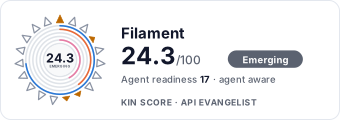 It updates itself when the score changes. Paste this where you link to your API docs:
<a href="https://apis.io/providers/filament/"><img src="https://apis.io/badge/filament/card.svg" alt="Filament on APIs.io — Kin Score by API Evangelist"></a>Other styles, a README pill and a shields.io endpoint are on the badge page.
APIs 1
Individual APIs this provider publishes, each with its own machine-readable definition.
Filament API
Signature-authenticated REST + WebSocket order-book API for the Filament perpetual DEX on Sei. Place limit/market orders, cancel orders, manage isolated collateral, set TP/SL, r...
Event Specifications 1
AsyncAPI definitions for this provider's event-driven and streaming APIs.
Filament Orderbook Streaming API
Real-time WebSocket streams for the Filament perpetual DEX on Sei: order-book state, live asset price feed, and per-account order updates.
ASYNCAPISecurity Posture 2
Authentication, domain security, vulnerability disclosure, and trust-center signals.
Resources
Get Started 3
Portal, sign-up, and the first successful call
Documentation 3
Reference material describing how the API behaves
Agent Surfaces 3
MCP servers, agent skills, and machine-readable catalogs
Design & Contract 3
Pagination, idempotency, versioning, errors, and events
Access & Security 3
Authentication, authorization, and security posture
Company 2
The organization behind the API
Other 2
Properties that don't map to a standard resource type
Source (apis.yml)
Work with this as data
Every provider here is available over the APIs.io API and to AI agents over MCP.