
Extropic
Extropic is a hardware company building thermodynamic (probabilistic) computing systems designed to run generative AI workloads at dramatically lower energy cost than GPUs. Its core hardware is the Thermodynamic Sampling Unit (TSU) — an inherently probabilistic chip whose physics natively performs the sampling that probabilistic AI algorithms depend on — together with the XTR-0 prototype platform for low-latency communication between Extropic chips and traditional processors. Extropic also develops THRML, an open-source JAX library for building and sampling probabilistic graphical models (block Gibbs sampling and energy-based models), which serves as a simulator and prototyping surface for the block-sampling programs that will one day run on TSU hardware. Extropic is not an API provider: it ships no REST/GraphQL API, developer portal, or hosted service — its public developer surface is the THRML Python library, its documentation, and an agent skill. Backed by Kindred Ventures; surfaced to the API Evangelist network as an AI-hardware portfolio company.
Extropic is profiled on the APIs.io network. Tagged areas include Company, Artificial Intelligence, Hardware, Semiconductors, and Thermodynamic Computing.
Extropic’s developer surface includes documentation, API reference, getting-started guide, engineering blog, and 14 more developer resources.
Kin Score
 Kin Score
How this is scored →
scored 2026-11-06 · rubric v0.27.0
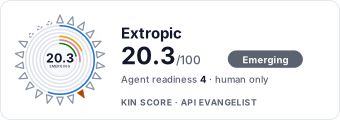 It updates itself when the score changes. Paste this where you link to your API docs:
<a href="https://apis.io/providers/extropic/"><img src="https://apis.io/badge/extropic/card.svg" alt="Extropic on APIs.io — Kin Score by API Evangelist"></a>Other styles, a README pill and a shields.io endpoint are on the badge page.
- Machine-Readable Contract +18 pts — api_specs includes an OpenAPI document
- MCP Server +12 pts — deployment.mode + probe verdict on the mcp/ manifest, not the pointer; an unprobed slug falls back to authorship
- Agentic Access Contract +10 pts — agentic_access artifact present (x-agentic-access), graded by author
- Machine-Readable Auth +10 pts — a served openid-configuration/oauth-authorization-server carrying `issuer` (served), else the securitySchemes class in the provider OpenAPIs — bound (mutualTLS, DPoP, Signature) > negotiable (oauth2 authorizationCode/clientCredentials, openIdConnect) > bearer (http bearer, apiKey)
- Idempotency +9 pts — OpenAPI mutating operations declare an idempotency key — a header, a request-body property, or a named de-duplication token whose own description says so (verified); else common[].type matches /idempoten/i (documented)
- Stable Error Semantics +8 pts — OpenAPI $refs a shared error schema across 4xx/5xx responses (verified), else common[].type includes ErrorCatalog / ErrorCodes / DeclineCodes
- Contract Quality scores 0.0 — up to +25.0 composite points
- Access Clarity scores 21.1 — up to +15.8 composite points
- Developer Ergonomics scores 26.2 — up to +14.8 composite points
Markets this provider is in provisional
The Kin Score Market layer reads a provider inside its market: its position, and how deep its integrations go. Depth is only comparable within a position. Provisional and unweighted: not part of the Kin Score or agent readiness.
| Market | Position | Depth | Registered MCP server | Declares compatibility |
|---|---|---|---|---|
| Agent Skills (SKILL.md packages) | undeclared | - | - | 1 |
Registered MCP server and declares compatibility are report only — not weighted. Undeclared means we found nothing we can read, so there is no number: we never infer integrations.
Standards implemented 1
Standards this provider implements or carries. De facto ones are profiled and measured by the API Commons; formal ones come from the standards directory and are linked by the provider's own tags. The evidence column says how each claim was established — not that it was made.
Agent Skills 1
Packaged agent skills for driving this provider's APIs from an AI assistant.
thrml
AGENT SKILLSecurity Posture 1
Authentication, domain security, vulnerability disclosure, and trust-center signals.
Resources
Get Started 1
Portal, sign-up, and the first successful call
Documentation 3
Reference material describing how the API behaves
Agent Surfaces 2
MCP servers, agent skills, and machine-readable catalogs
Build 4
SDKs, sample code, and the tooling you integrate with
Access & Security 1
Authentication, authorization, and security posture
Operate 2
Status, limits, changes, and where to get help
Commercial 3
Pricing, plans, and the legal terms of use
Company 2
The organization behind the API
Source (apis.yml)
Work with this as data
Every provider here is available over the APIs.io API and to AI agents over MCP.