EnerVenue
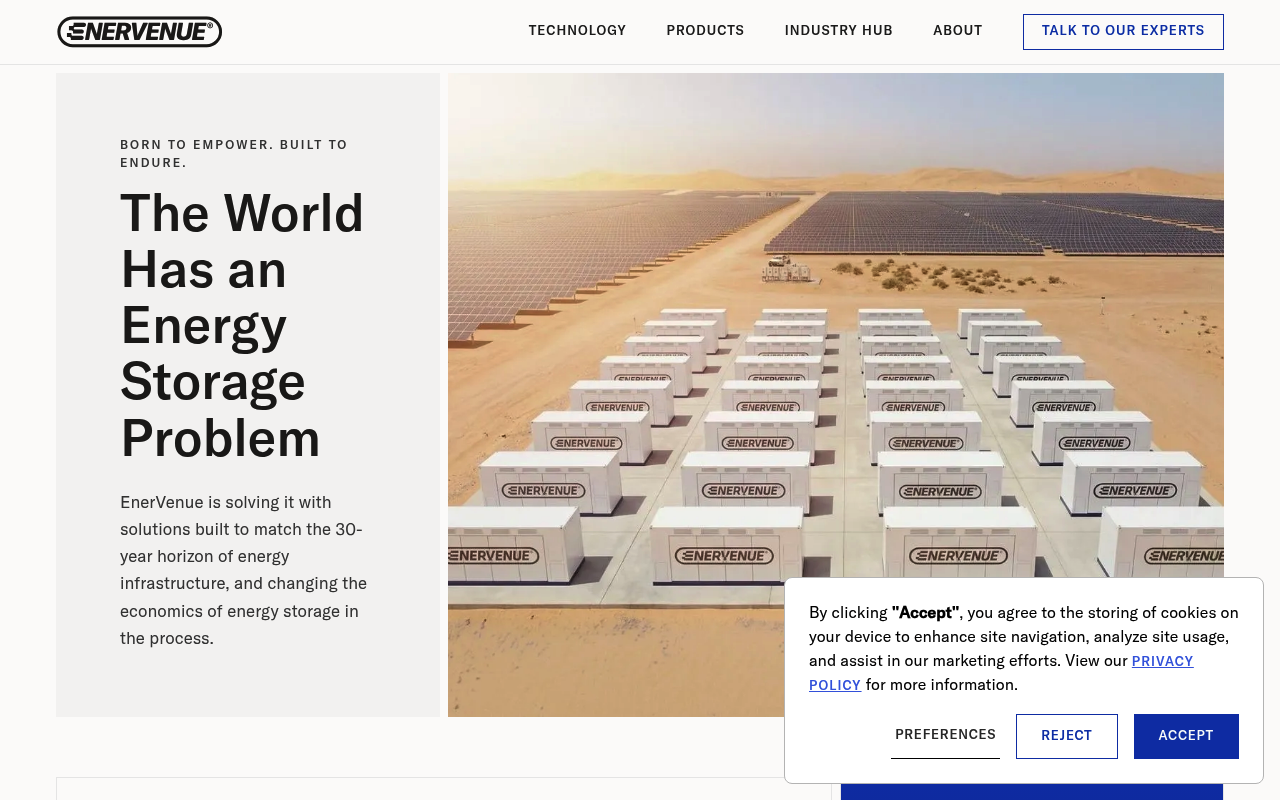
EnerVenue is a Fremont, California-based energy infrastructure company building long-duration stationary energy storage using a metal-hydrogen (nickel-hydrogen) battery chemistry derived from NASA-heritage technology that has powered the Hubble Space Telescope and the International Space Station since the 1980s. Co-founded by Stanford materials scientist Professor Yi Cui, EnerVenue refined the orbital nickel-hydrogen cell into a grid-scale "Energy Storage Vessel" (ESV) targeting a 30-year, 30,000+ cycle service life with 100% usable depth of discharge, ~90% round-trip efficiency, an operating range of -20 C to +60 C, no thermal runaway risk, and no active thermal management. The ESV's aqueous metal cell (AMC) uses a nickel hydroxide cathode, a nickel-alloy anode, an alkaline electrolyte, and hermetically sealed hydrogen gas storage built from steel, nickel, fiberglass, resin, and water — no lithium, cobalt, or rare earths. EnerVenue is scaling manufacturing through a one-million- square-foot gigafactory in Shelby County, Kentucky (1 GWh phase one, scaling toward 20 GWh per year with ~$1B of follow-on investment) plus a high-volume line in Changzhou, China (250 MWh by Q3 2026, 1 GWh in 2027). Customer commitments exceed 7 GWh and include Pine Gate Renewables (2.4 GWh, multi-year), Green Energy Renewable Solutions (Nicon Industries), Sonnell Power Solutions, and VedantaESS. The company closed a $300M Series B in 2026 to fund the gigafactory build-out. EnerVenue sells hardware, EPC-integrated storage systems, and long-duration service warranties — it does not publish a developer API, SDK, public OpenAPI specification, or open-source repository.
EnerVenue is profiled on the APIs.io network. Tagged areas include Energy Storage, Long Duration Energy Storage, Metal Hydrogen Battery, Nickel Hydrogen Battery, and Battery Energy Storage System.
EnerVenue’s developer surface includes support, documentation, YouTube channel, and 12 more developer resources.
Kin Score
 Kin Score
How this is scored →
Kin Score
How this is scored →scored 2026-10-17 · rubric v0.24.0
Security Posture 1
Authentication, domain security, vulnerability disclosure, and trust-center signals.
Resources
Get Started 1
Portal, sign-up, and the first successful call
Documentation 1
Reference material describing how the API behaves
Access & Security 1
Authentication, authorization, and security posture
Learn 2
Tutorials, courses, talks, and written guidance
Operate 2
Status, limits, changes, and where to get help
Company 5
The organization behind the API
Other 3
Properties that don't map to a standard resource type
Source (apis.yml)
Work with this as data
Every provider here is available over the APIs.io API and to AI agents over MCP.