EnergyHub is a Brooklyn, New York distributed energy resource management system (DERMS) vendor and an independent subsidiary of Alarm.com (Nasdaq ALRM), operating in its home market of the United States. Its Edge DERMS platform (formerly marketed as Mercury DERMS) lets electric utilities enroll, forecast, dispatch, and measure customer-owned distributed energy resources - smart thermostats, batteries, electric vehicles and EV chargers, solar inverters, and commercial and industrial loads - as virtual power plants, and the company says it has been running load control programs since 2009. EnergyHub sits squarely in the private middle layer of the energy value chain. It is not a utility, not a retailer, and not a market operator, so no consumer energy data mandate applies to it: there is no Green Button obligation, no Consumer Data Right designation, and no Ontario regulation in play. Its API posture is honestly partner-only and entirely undocumented in public. Two APIs are publicly announced by the company - the Mercury Edge Connect API, which EnergyHub states is "based on the Open ADR standard", and a Marketplace API for demand-response pre-enrollment at the device point of sale - but neither has public reference documentation, a published base URI, a schema, or a self-serve signup. The knowledge base at help.energyhub.com serves a public landing page while every technical guide and device-partner integration article behind it is gated by an Okta SSO login. A live host at mec.energyhub.com answers TLS with a valid DigiCert certificate and rejects every anonymous request with "400 No required SSL certificate was sent", which is mutual-TLS client-certificate enforcement rather than a public API. No consumer usage or billing data API exists for third parties, and no open grid or market data is published, so EnergyHub is closed on both the consumer-data and the market-data axis, and a developer gets in only by signing a commercial or DER partner agreement.
EnergyHub is listed with 2 APIs on the APIs.io network. Tagged areas include Energy, United States, Utilities, Electricity, and Grid.
EnergyHub’s developer surface includes authentication, documentation, signup flow, engineering blog, support, and 17 more developer resources.
Regulatory Posture applies to this provider. Its tags matched the
Energy & Utilities regime, so
Regulatory Posture carries 15 points of the composite.
If this regime is wrong for your business, say so on your
provider repo — the
applicability map is public and we will correct it.
Create-or-Update Ergonomics could not be measured. We hold no machine-readable contract for
this provider to read, so there is nothing to measure a write surface against. Excluded rather than scored zero:
never-measured and measured-empty are different facts. Publishing an OpenAPI is what makes this facet — and
several others — scorable at all.
The six quality facets above are damped to 85 points between them,
because the conditional facet above carries the other
15. That is why each facet's contribution is shown against a damped
maximum: raising a quality facet moves the composite by 85% of its nominal
weight, not 100%. The full arithmetic is at apis.io/rating/.
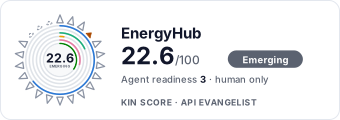
Show this score on your site.
It updates itself when the score changes. Paste this where you link to your API docs:
<a href="https://apis.io/providers/energyhub/"><img src="https://apis.io/badge/energyhub/card.svg" alt="EnergyHub on APIs.io — Kin Score by API Evangelist"></a>
Other styles, a README pill and a shields.io endpoint are on the badge page.
Raise your score.
Agent readiness — checks not met, largest first (exact, from this profile):
Idempotency+9 pts — OpenAPI mutating operations declare an idempotency key — a header, a request-body property, or a named de-duplication token whose own description says so (verified); else common[].type matches /idempoten/i (documented)
Stable Error Semantics+8 pts — OpenAPI $refs a shared error schema across 4xx/5xx responses (verified), else common[].type includes ErrorCatalog / ErrorCodes / DeclineCodes
A2A Agent Card+8 pts — a2a/-a2a.yml manifest, graded on conformance.grade against A2A 1.0.0
12 more unmet checks in the Agent Readiness table above.
Kin Score — facets with the most composite points still available (weight × headroom):
The Kin Score Market layer reads a provider inside its market:
its position, and how deep its integrations go. Depth is only comparable within a position. Provisional and unweighted:
not part of the Kin Score or agent readiness.
Registered MCP server and declares compatibility are report only — not weighted.
Undeclared means we found nothing we can read, so there is no number: we never infer integrations.
Standards this provider implements or carries. De facto ones are profiled and measured by the API Commons; formal ones come from the standards directory and are linked by the provider's own tags. The evidence column says how each claim was established — not that it was made.
Mercury Edge Connect is EnergyHub's standardized integration framework for connecting DER providers (thermostat, battery, EV, EV charger, and solar inverter manufacturers) to th...
The Marketplace API integrates the Mercury/Edge DERMS platform with utility marketplace providers and online retailers so that a consumer buying a DER device can be pre-enrolled...
aid: energyhub
url: https://raw.githubusercontent.com/api-evangelist/energyhub/refs/heads/main/apis.yml
name: EnergyHub
kind: company
description: 'EnergyHub is a Brooklyn, New York distributed energy resource management system (DERMS) vendor and an independent
  subsidiary of Alarm.com (Nasdaq ALRM), operating in its home market of the United States. Its Edge DERMS platform (formerly
  marketed as Mercury DERMS) lets electric utilities enroll, forecast, dispatch, and measure customer-owned distributed energy
  resources - smart thermostats, batteries, electric vehicles and EV chargers, solar inverters, and commercial and industrial
  loads - as virtual power plants, and the company says it has been running load control programs since 2009. EnergyHub sits
  squarely in the private middle layer of the energy value chain. It is not a utility, not a retailer, and not a market operator,
  so no consumer energy data mandate applies to it: there is no Green Button obligation, no Consumer Data Right designation,
  and no Ontario regulation in play. Its API posture is honestly partner-only and entirely undocumented in public. Two APIs
  are publicly announced by the company - the Mercury Edge Connect API, which EnergyHub states is "based on the Open ADR standard",
  and a Marketplace API for demand-response pre-enrollment at the device point of sale - but neither has public reference
  documentation, a published base URI, a schema, or a self-serve signup. The knowledge base at help.energyhub.com serves a
  public landing page while every technical guide and device-partner integration article behind it is gated by an Okta SSO
  login. A live host at mec.energyhub.com answers TLS with a valid DigiCert certificate and rejects every anonymous request
  with "400 No required SSL certificate was sent", which is mutual-TLS client-certificate enforcement rather than a public
  API. No consumer usage or billing data API exists for third parties, and no open grid or market data is published, so EnergyHub
  is closed on both the consumer-data and the market-data axis, and a developer gets in only by signing a commercial or DER
  partner agreement.'
deliveryModel:
  model: saas
  open_source: false
  commercial: true
  callable_host: false
  label: Hosted service · you call their endpoint
  confidence: medium
  source:
  - pricing
  generated: '2026-08-28'
  method: derived
accessModel:
  pricing: unknown
  onboarding: unknown
  trial: false
  try_now: false
  public: false
  label: Unknown
  confidence: low
  source:
  - authentication
  - security
  generated: '2026-11-06'
  method: derived
image: https://ez7jkrb8oox.exactdn.com/app/uploads/2024/10/favicon.png
tags:
- Energy
- United States
- Utilities
- Electricity
- Grid
- DERMS
- Distributed Energy Resources
- Demand Response
- Virtual Power Plant
- OpenADR
- EV Charging
- Solar
- Energy Storage
- Smart Thermostats
created: '2026-07-27'
modified: '2026-07-27'
specificationVersion: '0.23'
apis:
- aid: energyhub:mercury-edge-connect-api
  name: EnergyHub Mercury Edge Connect API
  description: Mercury Edge Connect is EnergyHub's standardized integration framework for connecting DER providers (thermostat,
    battery, EV, EV charger, and solar inverter manufacturers) to the Mercury/Edge DERMS platform. EnergyHub states in its
    2021-02-18 announcement that "At the heart of Mercury Edge Connect is a new API designed specifically to meet the requirements
    of managing behind-the-meter DERs at scale. The API is based on the Open ADR standard, with enhanced functionality around
    automated enrollment, monitoring, and other functionality required for managing enterprise-wide portfolios of grid-edge
    and customer-owned DERs." No public reference documentation, schema, or operation list is published. The host mec.energyhub.com
    (the name matches Mercury Edge Connect; that mapping is inferred, not stated by EnergyHub) was probed on 2026-07-27 and
    is live behind a valid DigiCert RapidSSL certificate for CN=mec.energyhub.com, returning HTTP 400 "No required SSL certificate
    was sent" to every anonymous request on /, /openapi.json, /swagger.json, /docs, /api-docs, /.well-known/openid-configuration,
    /health, /v1, /api, and /oadr, which is mutual TLS client-certificate authentication consistent with the OpenADR 2.0b
    VEN/VTN security model. Access requires a DER partner agreement.
  humanURL: https://www.energyhub.com/news/mercury-edge-connect-announcement
  baseURL: https://mec.energyhub.com
  tags:
  - DERMS
  - OpenADR
  - Demand Response
  - Distributed Energy Resources
  - Partners
  tags_raw:
  - DERMS
  - OpenADR
  - Demand Response
  - Distributed Energy Resources
  - Partner
  properties:
  - type: Announcement
    url: https://www.energyhub.com/news/mercury-edge-connect-announcement
  - type: Documentation
    url: https://help.energyhub.com/articles/mec/mec-overview
  - type: PartnerProgram
    url: https://www.energyhub.com/der-partner-ecosystem/become-a-partner
- aid: energyhub:marketplace-api
  name: EnergyHub Marketplace API
  description: The Marketplace API integrates the Mercury/Edge DERMS platform with utility marketplace providers and online
    retailers so that a consumer buying a DER device can be pre-enrolled in a utility demand-response program at the point
    of sale. EnergyHub's 2021-05-13 announcement says the API "automates the verification of DER program eligibility, incentive
    processing, and enrollment for a seamless workflow from the point of sale to program enrollment" and that "The open Marketplace
    API can connect with any retail transaction, online and brick-and-mortar." Named launch integrators are EFI, Enervee,
    and Uplight. Despite the word "open" in the announcement, no public documentation, base URI, schema, authentication scheme,
    or signup was found on any EnergyHub property probed on 2026-07-27; access is via a commercial marketplace partnership.
  humanURL: https://www.energyhub.com/news/marketplace-api-announcement
  tags:
  - Demand Response
  - Enrollment
  - Marketplace
  - Incentives
  - Partners
  tags_raw:
  - Demand Response
  - Enrollment
  - Marketplace
  - Incentives
  - Partner
  properties:
  - type: Announcement
    url: https://www.energyhub.com/news/marketplace-api-announcement
  - type: PartnerProgram
    url: https://www.energyhub.com/der-partner-ecosystem/become-a-partner
common:
- type: DomainSecurity
  url: security/energyhub-domain-security.yml
- type: Authentication
  name: EnergyHub authentication profile (mutual TLS, probed)
  url: authentication/energyhub-authentication.yml
- type: Conformance
  name: EnergyHub standards conformance
  url: conformance/energyhub-conformance.yml
- type: Lifecycle
  name: EnergyHub API lifecycle posture
  url: lifecycle/energyhub-lifecycle.yml
- type: Packages
  name: EnergyHub package registry sweep
  url: packages/energyhub-packages.yml
- type: LLMsTxt
  url: llms/energyhub-llms.txt
- type: Integrations
  name: EnergyHub DER partner integrations catalog
  url: integrations/_index.yml
- type: Website
  url: https://www.energyhub.com/
- type: Documentation
  url: https://help.energyhub.com/home/en-us/
- type: Platform
  url: https://www.energyhub.com/edge-derms-platform/platform-overview
- type: Integrations
  url: https://www.energyhub.com/edge-derms-platform/utility-integrations
- type: Partners
  url: https://www.energyhub.com/der-partner-ecosystem
- type: Signup
  url: https://www.energyhub.com/der-partner-ecosystem/become-a-partner
- type: Blog
  url: https://www.energyhub.com/news-announcements
- type: About
  url: https://www.energyhub.com/company
- type: Careers
  url: https://www.energyhub.com/careers
- type: Support
  url: https://www.energyhub.com/contact
- type: TermsOfService
  url: https://www.energyhub.com/terms
- type: PrivacyPolicy
  url: https://www.energyhub.com/privacy-policy
- type: UserGuide
  name: ChargingRewards app user guide (the only public documentation section)
  url: https://help.energyhub.com/articles/chargingrewards/overview
- type: Patents
  url: https://www.energyhub.com/patents
- type: Resources
  url: https://www.energyhub.com/resources
- type: GitHubOrganization
  url: https://github.com/energyhub
- type: LinkedIn
  url: https://www.linkedin.com/company/energyhub/
maintainers:
- FN: Kin Lane
  email: kin@apievangelist.com
EnergyHub API — frequently asked questions
Does EnergyHub have an API?
Yes. APIs.io lists 2 APIs from EnergyHub, including EnergyHub Mercury Edge Connect API and EnergyHub Marketplace API.
How do I authenticate with the EnergyHub API?
EnergyHub uses bearer-token authentication (mutualTLS · 2 schemes). The details are profiled on APIs.io as Energyhub Authentication.
Is the EnergyHub API ready for AI agents?
EnergyHub has a Kin Score of 22.6 out of 100 (emerging) and an Agent Readiness score of 2.5 (human-only), scored by API Evangelist on 2026-11-06.
Calls without X-API-Key need no key. Calls with it need a paid plan — get a key.
Get an API key
Free tier, no form to fill in. Signing in shares your email address with us — we
store it to create your key and to recognise you if you sign in with another
provider. See our Privacy Policy and
Terms.
 Kin Score
How this is scored →
 It updates itself when the score changes. Paste this where you link to your API docs: