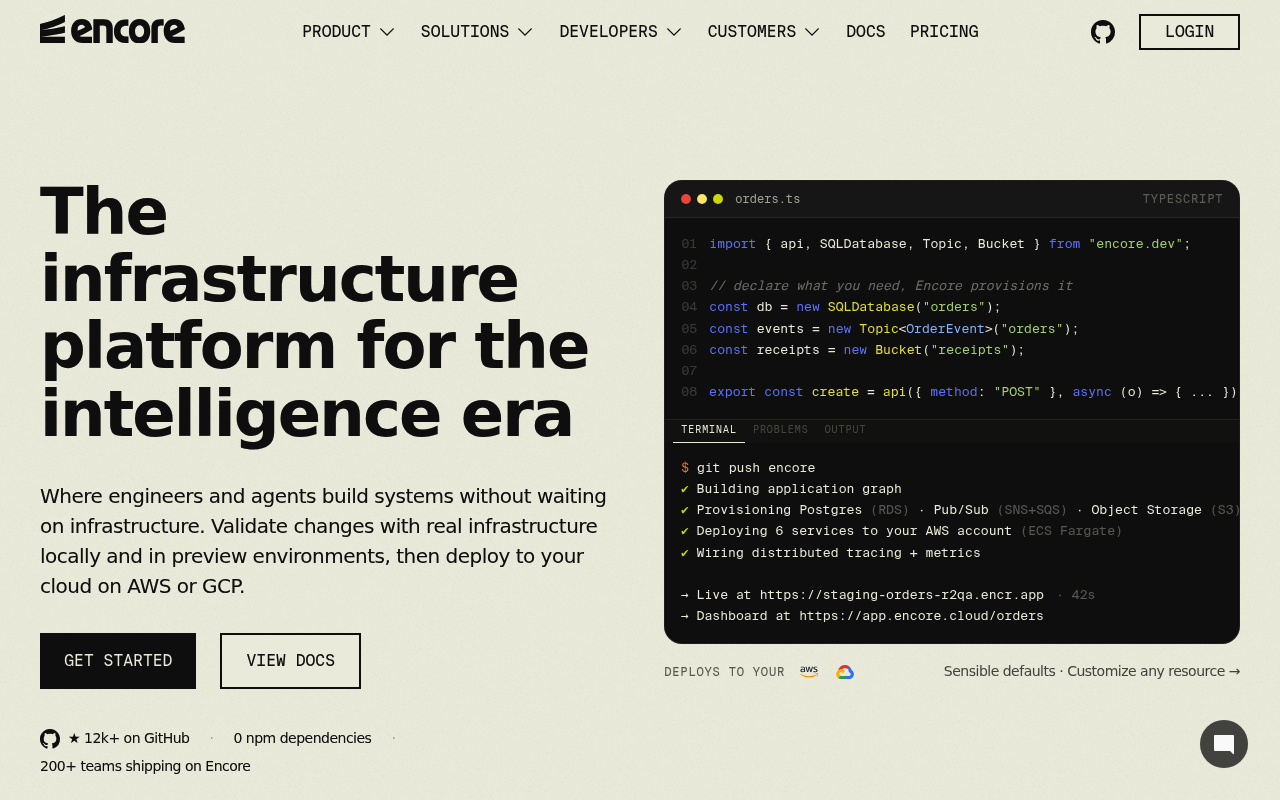
Encore is a backend application framework and developer cloud that lets engineering teams build type-safe distributed systems in TypeScript (Encore.ts) and Go (Encore.go) using declarative Infrastructure from Code. Developers describe APIs, databases, Pub/Sub, object storage, caches, cron jobs, and secrets as typed code primitives; the framework provisions matching infrastructure locally with no Docker Compose, and Encore Cloud provisions equivalent managed resources in the customer's own AWS or GCP account. The platform ships built-in distributed tracing, a local development dashboard, auto-generated API docs and client SDKs, a Model Context Protocol server for AI agents, preview environments per pull request, and CI/CD — positioning Encore as an opinionated alternative to PaaS and a productivity layer on top of hyperscaler infrastructure.
Encore publishes 6 API contracts indexed on the APIs.io network, including Apps API, Framework API, and 4 more. Tagged areas include Backend, Framework, Cloud, TypeScript, and Go.
The Encore catalog on APIs.io includes 1 JSON-LD context and 2 Spectral governance rulesets.
Encore’s developer surface includes documentation, getting-started guide, developer portal, pricing, engineering blog, changelog, and 37 more developer resources.
51.9/100developing▬ flatAgent48/100agent readyFront door AI3/6
light
Heartbeat98/100
alive
open core · MPL-2.0
Full breakdown ↓
scored 2026-11-06 · rubric v0.27.0 · Show this score on your site →
Regulatory Posture applies to this provider. Its tags matched the
Horizontal (data, software, accessibility, platform) regime, so
Regulatory Posture carries 15 points of the composite.
If this regime is wrong for your business, say so on your
provider repo — the
applicability map is public and we will correct it.
Create-or-Update Ergonomics applies to this provider. This API accepts writes, so it
carries 10 points of the composite. It is scored from the published contracts
themselves: whether a caller can create-or-update in one call, whether the write accepts a key the caller already
holds, and whether the response says which branch ran. Without that, every write needs a search-and-branch in
front of it, and the first time that check is skipped a duplicate record is created.
Scored against the observed mean rather than raw — a provider at the catalog average is unchanged by this facet,
not penalised by it.
The six quality facets above are damped to 75 points between them,
because the conditional facet above carries the other
25. That is why each facet's contribution is shown against a damped
maximum: raising a quality facet moves the composite by 75% of its nominal
weight, not 100%. The full arithmetic is at apis.io/rating/.
Show this score on your site.
It updates itself when the score changes. Paste this where you link to your API docs:
<a href="https://apis.io/providers/encore-dev/"><img src="https://apis.io/badge/encore-dev/card.svg" alt="Encore on APIs.io — Kin Score by API Evangelist"></a>
Other styles, a README pill and a shields.io endpoint are on the badge page.
Raise your score.
Agent readiness — checks not met, largest first (exact, from this profile):
Idempotency+9 pts — OpenAPI mutating operations declare an idempotency key — a header, a request-body property, or a named de-duplication token whose own description says so (verified); else common[].type matches /idempoten/i (documented)
A2A Agent Card+8 pts — a2a/-a2a.yml manifest, graded on conformance.grade against A2A 1.0.0
Request/Response Examples+7 pts — share of operations carrying request/response examples; else an Examples / Code Samples link
Typed Event Surface+6 pts — AsyncAPI document, OR webhooks/callbacks objects in the as-published OpenAPI, OR common[].type includes Webhooks
Documented Reversibility+6 pts — a reversal operation in the contract, graded up when a window is documented too
Pagination+5 pts — share of collection GETs (an array, or one wrapped in data/items/results ...) that declare a page/limit/offset/cursor parameter, a Link header or a next/cursor field; na with no collection GETs
5 more unmet checks in the Agent Readiness table above.
Kin Score — facets with the most composite points still available (weight × headroom):
The Kin Score Market layer reads a provider inside its market:
its position, and how deep its integrations go. Depth is only comparable within a position. Provisional and unweighted:
not part of the Kin Score or agent readiness.
Registered MCP server and declares compatibility are report only — not weighted.
Undeclared means we found nothing we can read, so there is no number: we never infer integrations.
Standards this provider implements or carries. De facto ones are profiled and measured by the API Commons; formal ones come from the standards directory and are linked by the provider's own tags. The evidence column says how each claim was established — not that it was made.
Encore captures distributed traces, structured logs, and runtime metrics automatically from every api(), database query, Pub/Sub publish, cron tick, and outbound HTTP call. The ...
Encore ships a built-in Model Context Protocol server (`encore mcp start` for SSE, `encore mcp run` for stdio) that exposes the live Encore application — services, middleware, a...
Encore.ts — TypeScript backend framework with zero npm dependencies, claimed 9x faster than Express.js and 3x faster than ElysiaJS and Hono via a Rust runtime
Encore.go — Go backend framework with type-safe APIs declared via //encore:api annotations
Infrastructure from Code (IfC) — declare PostgreSQL, Pub/Sub, object storage, caches, cron jobs, and secrets as typed code primitives
Automatic local development environment with Docker-free database, Pub/Sub, and bucket provisioning
Local Development Dashboard with distributed tracing, API explorer, service catalog, database explorer, and architecture flow diagrams
Type-safe service-to-service calls with automatic service discovery and network plumbing
Auto-generated client SDKs in TypeScript, Go, and JavaScript from the backend source
Auto-generated API documentation and service catalog kept in sync with source
Raw endpoints (api.raw) for webhooks and low-level HTTP, plus streaming endpoints for WebSockets
aid: encore-dev
url: https://raw.githubusercontent.com/api-evangelist/encore-dev/refs/heads/main/apis.yml
apis:
- aid: encore-dev:encore-infrastructure-api
  name: Encore Infrastructure API
  tags:
  - Backend
  - Infrastructure
  - Database
  - Pub/Sub
  - Caching
  - Object Storage
  - Cron
  - Secrets
  tags_raw:
  - Backend
  - Infrastructure
  - Databases
  - PubSub
  - Caching
  - ObjectStorage
  - Cron
  - Secrets
  humanURL: https://encore.dev/docs/ts/primitives
  properties:
  - url: https://encore.dev/docs/ts/primitives
    type: Documentation
  - url: https://encore.dev/docs/ts/primitives/databases
    type: Documentation
  - url: https://encore.dev/docs/ts/primitives/pubsub
    type: Documentation
  - url: https://encore.dev/docs/ts/primitives/cron-jobs
    type: Documentation
  - url: https://encore.dev/docs/ts/primitives/object-storage
    type: Documentation
  - url: https://encore.dev/docs/ts/primitives/secrets
    type: Documentation
  - url: json-schema/encore-infrastructure-resource-schema.json
    type: JSONSchema
  description: Encore's Infrastructure from Code API lets developers declare cloud infrastructure resources — PostgreSQL databases,
    Pub/Sub topics and subscriptions, object storage buckets, cron jobs, caches, and secrets — as typed code primitives inside
    their backend. Encore parses these declarations to provision matching infrastructure locally (Docker-free) for development
    and on AWS or GCP in production via Encore Cloud, without Terraform, YAML, or manual wiring.
- aid: encore-dev:encore-observability-api
  name: Encore Observability API
  tags:
  - Observability
  - Tracing
  - Metrics
  - Logs
  - DevDashboard
  humanURL: https://encore.dev/docs/ts/observability/tracing
  properties:
  - url: https://encore.dev/docs/ts/observability/tracing
    type: Documentation
  - url: https://encore.dev/docs/ts/observability/dev-dash
    type: Documentation
  - url: https://encore.dev/docs/ts/observability/flow
    type: Documentation
  - url: https://encore.dev/docs/ts/observability/service-catalog
    type: Documentation
  - url: json-schema/encore-trace-event-schema.json
    type: JSONSchema
  description: Encore captures distributed traces, structured logs, and runtime metrics automatically from every api(), database
    query, Pub/Sub publish, cron tick, and outbound HTTP call. The local Development Dashboard surfaces traces, the service
    catalog, an auto-generated architecture flow diagram, the database explorer, and the API explorer. In production, traces
    and metrics ship to Encore Cloud (20M events/month included on Pro) or forward to Datadog, Grafana, Sentry, and other
    third-party backends.
- aid: encore-dev:encore-mcp-server
  name: Encore MCP Server
  tags:
  - Artificial Intelligence
  - MCP
  - AI Agents
  - Developer Tools
  tags_raw:
  - AI
  - MCP
  - ModelContextProtocol
  - AgenticAI
  - DeveloperTools
  - Agentic AI
  humanURL: https://encore.dev/docs/ts/cli/mcp
  properties:
  - url: https://encore.dev/docs/ts/cli/mcp
    type: Documentation
  - url: https://modelcontextprotocol.io
    type: Documentation
  description: Encore ships a built-in Model Context Protocol server (`encore mcp start` for SSE, `encore mcp run` for stdio)
    that exposes the live Encore application — services, middleware, auth handlers, databases, Pub/Sub topics, cron jobs,
    buckets, traces, metrics, source files, and documentation — to AI agents like Cursor and Claude Code. This lets agents
    reason about and modify a running backend with full context, including verifying that a newly added publish call shows
    up in traces.
- aid: encore-dev:encore-dev-apps-api
  name: Encore Apps API
  description: The Apps API from Encore — 5 operation(s) for apps.
  humanURL: https://encore.dev/docs/ts/primitives/defining-apis
  tags:
  - Application
  tags_raw:
  - Apps
  properties:
  - type: OpenAPI
    url: openapi/encore-dev-apps-api-openapi.yml
  - type: Documentation
    url: https://encore.dev/docs/ts/primitives/defining-apis
  - type: Documentation
    url: https://encore.dev/docs/go/primitives/defining-apis
  - type: JSONSchema
    url: json-schema/encore-api-endpoint-schema.json
  - type: JSONSchema
    url: json-schema/encore-service-schema.json
  - type: JSONLD
    url: json-ld/encore-dev-context.jsonld
  - type: Documentation
    url: https://encore.dev/docs/platform
  - type: Portal
    url: https://encore.cloud
- aid: encore-dev:encore-dev-encore-api
  name: Encore API
  description: The Encore API from Encore — 2 operation(s) for encore.
  humanURL: https://encore.dev/docs/ts/primitives/defining-apis
  tags:
  - Encore
  properties:
  - type: OpenAPI
    url: openapi/encore-dev-encore-api-openapi.yml
  - type: Documentation
    url: https://encore.dev/docs/ts/primitives/defining-apis
  - type: Documentation
    url: https://encore.dev/docs/go/primitives/defining-apis
  - type: JSONSchema
    url: json-schema/encore-api-endpoint-schema.json
  - type: JSONSchema
    url: json-schema/encore-service-schema.json
  - type: JSONLD
    url: json-ld/encore-dev-context.jsonld
  - type: Documentation
    url: https://encore.dev/docs/platform
  - type: Portal
    url: https://encore.cloud
- aid: encore-dev:encore-dev-encore-framework-api-api
  name: Encore Framework API
  description: The Encore Framework API API from Encore — 1 operation(s) for encore framework api.
  humanURL: https://encore.dev/docs/ts/primitives/defining-apis
  tags:
  - Encore Framework API
  properties:
  - type: OpenAPI
    url: openapi/encore-dev-encore-framework-api-api-openapi.yml
  - type: Documentation
    url: https://encore.dev/docs/ts/primitives/defining-apis
  - type: Documentation
    url: https://encore.dev/docs/go/primitives/defining-apis
  - type: JSONSchema
    url: json-schema/encore-api-endpoint-schema.json
  - type: JSONSchema
    url: json-schema/encore-service-schema.json
  - type: JSONLD
    url: json-ld/encore-dev-context.jsonld
  - type: Documentation
    url: https://encore.dev/docs/platform
  - type: Portal
    url: https://encore.cloud
common:
- type: CapabilityMap
  url: capabilities/encore-dev-capability-edges.yml
  name: Encore Business Capability Map
- type: Website
  url: https://www.encore.dev/
- type: PostmanWorkspace
  url: https://www.postman.com/kinlaneapi/encore/overview
- type: AgenticAccess
  url: agentic-access/encore-dev-agentic-access.yml
- type: VulnerabilityDisclosure
  url: security/encore-dev-vulnerability-disclosure.yml
- type: DomainSecurity
  url: security/encore-dev-domain-security.yml
- url: https://github.com/encoredev
  name: GitHub Organization
  type: GitHubOrganization
- url: https://github.com/encoredev/encore
  name: Encore Framework Repository
  type: SourceCode
- url: https://github.com/encoredev/examples
  name: Encore Examples Repository
  type: SourceCode
- url: https://github.com/encoredev/encore.dev
  name: Encore Runtime API Contract
  type: SourceCode
- url: https://encore.dev/docs
  type: Documentation
- url: https://encore.dev/docs/ts
  name: Encore.ts Documentation
  type: Documentation
- url: https://encore.dev/docs/go
  name: Encore.go Documentation
  type: Documentation
- url: https://encore.dev/docs/ts/quick-start
  name: TypeScript Quick Start
  type: GettingStarted
- url: https://encore.dev/docs/go/quick-start
  name: Go Quick Start
  type: GettingStarted
- url: https://encore.cloud
  name: Encore Cloud Portal
  type: Portal
- url: https://encore.cloud/pricing
  name: Encore Cloud Pricing
  type: Pricing
- url: https://encore.dev/blog
  name: Encore Engineering Blog
  type: Blog
- url: https://encore.dev/changelog
  name: Changelog
  type: ChangeLog
- url: https://status.encore.cloud
  name: Encore Cloud Status
  type: StatusPage
- url: https://encore.dev/discord
  name: Encore Discord Community
  type: Community
- url: https://encore.dev/docs/ts/cli/mcp
  name: MCP Server
  type: Documentation
- url: https://encore.dev/docs/ts/ai-integration
  name: AI Integration Guide
  type: Documentation
- url: https://encore.dev/docs/ts/observability/tracing
  name: Distributed Tracing
  type: Documentation
- url: https://encore.dev/docs/ts/observability/dev-dash
  name: Local Development Dashboard
  type: Documentation
- url: https://encore.dev/docs/ts/primitives/databases
  name: Databases (PostgreSQL)
  type: Documentation
- url: https://encore.dev/docs/ts/primitives/pubsub
  name: Pub/Sub
  type: Documentation
- url: https://encore.dev/docs/ts/primitives/cron-jobs
  name: Cron Jobs
  type: Documentation
- url: https://encore.dev/docs/ts/primitives/object-storage
  name: Object Storage
  type: Documentation
- url: https://encore.dev/docs/ts/primitives/secrets
  name: Secrets
  type: Documentation
- url: https://encore.dev/docs/ts/develop/auth
  name: Authentication
  type: Documentation
- url: https://encore.dev/docs/ts/develop/middleware
  name: Middleware
  type: Documentation
- url: https://encore.dev/docs/ts/develop/streaming-apis
  name: Streaming APIs (WebSockets)
  type: Documentation
- url: https://encore.dev/docs/ts/cli/cli-reference
  name: Encore CLI Reference
  type: SDKs
- url: https://encore.dev/docs/ts/develop/client-generation
  name: Generated Client SDKs (TypeScript, Go, JavaScript)
  type: SDKs
- url: https://encore.dev/docs/ts/develop/api-docs
  name: Auto-Generated API Documentation
  type: Documentation
- url: https://github.com/encoredev/homebrew-tap
  name: Homebrew Tap
  type: SDKs
- url: https://encore.dev/use-cases
  name: Use Cases
  type: Documentation
- url: plans/encore-dev-plans-pricing.yml
  type: Plans
- url: rate-limits/encore-dev-rate-limits.yml
  type: RateLimits
- url: finops/encore-dev-finops.yml
  type: FinOps
- url: vocabulary/encore-dev-vocabulary.yml
  type: Vocabulary
- url: rules/encore-dev-rules.yml
  type: SpectralRules
- type: Features
  data:
  - Encore.ts — TypeScript backend framework with zero npm dependencies, claimed 9x faster than Express.js and 3x faster than
    ElysiaJS and Hono via a Rust runtime
  - Encore.go — Go backend framework with type-safe APIs declared via //encore:api annotations
  - Infrastructure from Code (IfC) — declare PostgreSQL, Pub/Sub, object storage, caches, cron jobs, and secrets as typed
    code primitives
  - Automatic local development environment with Docker-free database, Pub/Sub, and bucket provisioning
  - Local Development Dashboard with distributed tracing, API explorer, service catalog, database explorer, and architecture
    flow diagrams
  - Type-safe service-to-service calls with automatic service discovery and network plumbing
  - Auto-generated client SDKs in TypeScript, Go, and JavaScript from the backend source
  - Auto-generated API documentation and service catalog kept in sync with source
  - Raw endpoints (api.raw) for webhooks and low-level HTTP, plus streaming endpoints for WebSockets
  - Built-in authentication primitives and pluggable auth handlers (Clerk, Auth0, Firebase, Ory)
  - Built-in middleware, request validation, and response shaping derived from TypeScript interfaces / Go structs
  - Encore MCP Server exposing services, traces, metrics, source, and docs to AI agents
  - '`encore run`, `encore build docker`, and `git push encore` for local, container, and managed deployments'
  - Write-once / deploy-anywhere — same code runs locally, on AWS, on GCP, or self-hosted via Docker export
  - Encore Cloud preview environments per pull request, automatic infra provisioning, and CI/CD
  - Multi-cloud production deployments on AWS (RDS, SQS, SNS, S3) and GCP (Cloud SQL, Pub/Sub, GCS)
  - Distributed tracing with 1M events/month free, 20M/month on Pro, forwarding to Datadog, Grafana, and Sentry
  - SOC 2 compliance assistance and custom RBAC on Enterprise
  - Open-source MPL-2.0 framework with ~12,000 GitHub stars and active v1.57.x release cadence
  - Python support on the roadmap
  sources:
  - https://encore.dev
  - https://encore.dev/docs/ts
  - https://encore.dev/docs/go
  - https://encore.cloud/pricing
  - https://github.com/encoredev/encore
  - https://encore.dev/blog
  updated: '2026-05-24'
deliveryModel:
  model: open-core
  license: MPL-2.0
  license_evidence:
    repo: encoredev/encore
    spdx: MPL-2.0
    stars: 12388
  open_source: true
  commercial: true
  callable_host: true
  label: Open core · an OSS project plus a commercial hosted product
  confidence: medium
  source:
  - openapi
  - pricing
  - repository-license
  generated: '2026-09-25'
  method: derived
accessModel:
  pricing: freemium
  onboarding: unknown
  trial: false
  try_now: false
  public: false
  label: Freemium
  confidence: low
  source:
  - plans
  - security
  generated: '2026-11-06'
  method: derived
created: '2026-05-24T00:00:00.000Z'
modified: '2026-09-16'
name: Encore
position: Producing
description: Encore is a backend application framework and developer cloud that lets engineering teams build type-safe distributed
  systems in TypeScript (Encore.ts) and Go (Encore.go) using declarative Infrastructure from Code. Developers describe APIs,
  databases, Pub/Sub, object storage, caches, cron jobs, and secrets as typed code primitives; the framework provisions matching
  infrastructure locally with no Docker Compose, and Encore Cloud provisions equivalent managed resources in the customer's
  own AWS or GCP account. The platform ships built-in distributed tracing, a local development dashboard, auto-generated API
  docs and client SDKs, a Model Context Protocol server for AI agents, preview environments per pull request, and CI/CD —
  positioning Encore as an opinionated alternative to PaaS and a productivity layer on top of hyperscaler infrastructure.
image: https://encore.dev/assets/branding/icon.svg
humanURL: https://encore.dev
baseURL: https://encore.dev
tags:
- Backend
- Framework
- Cloud
- TypeScript
- Go
- Developer Tools
- Infrastructure from Code
- Microservices
- Observability
- Multi-Cloud
tags_raw:
- Backend
- Framework
- Cloud
- TypeScript
- Go
- DeveloperTools
- InfrastructureFromCode
- Microservices
- Observability
- Multicloud
maintainers:
- FN: Kin Lane
  email: info@apievangelist.com
  X: apievangelist
  url: https://apievangelist.com
specificationVersion: '0.23'
Encore API — frequently asked questions
Does Encore have an API?
Yes. APIs.io lists 6 APIs from Encore, including Encore Infrastructure API, Encore Observability API and Encore MCP Server, and 3 more.
Is there an OpenAPI specification for the Encore API?
Yes. APIs.io indexes 3 OpenAPI specifications for Encore, each linked for download from this page.
How much does the Encore API cost?
Encore publishes its prices; its Pro plan is $49 per member/ month as of 2026-10-28. APIs.io lists 3 pricing plans for Encore, with each plan's price, limits and inclusions under Pricing on this page.
Does Encore have an MCP server?
Yes. APIs.io lists 1 MCP server for Encore: Remote MCP server at api.encore.dev over HTTP.
Is the Encore API ready for AI agents?
Encore has a Kin Score of 51.9 out of 100 (developing) and an Agent Readiness score of 47.9 (agent-ready), scored by API Evangelist on 2026-11-06.
Calls without X-API-Key need no key. Calls with it need a paid plan — get a key.
Get an API key
Free tier, no form to fill in. Signing in shares your email address with us — we
store it to create your key and to recognise you if you sign in with another
provider. See our Privacy Policy and
Terms.
 Kin Score
How this is scored →
 It updates itself when the score changes. Paste this where you link to your API docs: