Open, tool-agnostic API collections (OpenAPI-derived and Bruno).
Overlays applied on top of this provider's contracts. Each card says who wrote it: a document the provider publishes, or one API Evangelist derived or generated.
Authentication, domain security, vulnerability disclosure, and trust-center signals.
Recommended x-agentic-access execution contracts for AI agents.
aid: embat
name: Embat
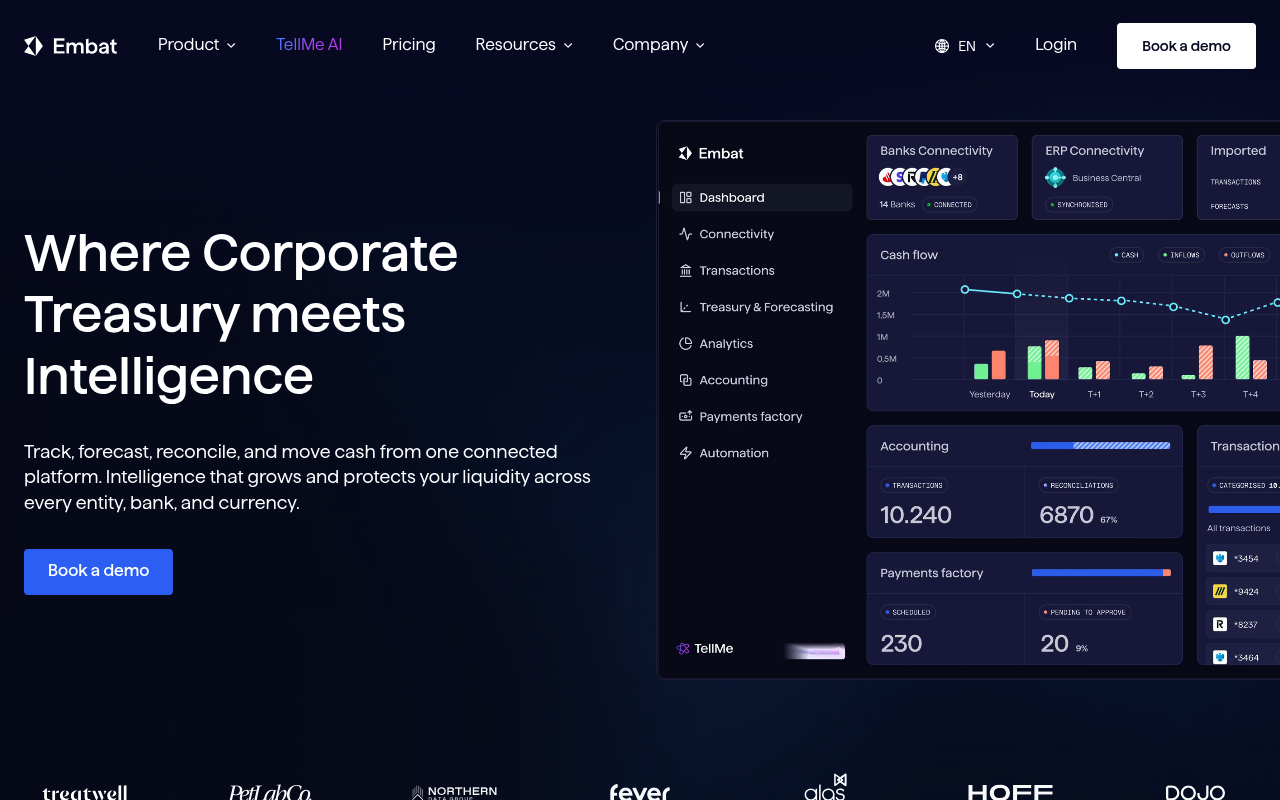
description: Embat is a real-time treasury management platform for finance teams, founded in Madrid and backed by Creandum.
  Its REST/JSON API (OpenAPI 3.1, 103 operations across 21 resource areas) connects third-party applications and ERPs to Embat
  to manage bank connections, balances, transactions, payments and payment orders, cash-flow forecasting, scenarios, accounting
  entries and accounts, contacts, and bank reconciliation across multiple companies. Authentication is HTTP Bearer using a
  JWT idToken obtained from an email/password token endpoint (60-minute expiry, no refresh); every resource is scoped by a
  companyId path parameter and list endpoints paginate with limit + nextPageToken.
url: https://raw.githubusercontent.com/api-evangelist/embat/refs/heads/main/apis.yml
x-type: company
x-source: vc-portfolio
x-backed-by:
- creandum
x-tier: stub
x-tier-reason: portfolio-lead
deliveryModel:
  model: saas
  open_source: false
  commercial: true
  callable_host: true
  label: Hosted service · you call their endpoint
  confidence: high
  source:
  - openapi
  - pricing
  generated: '2026-08-28'
  method: derived
accessModel:
  pricing: unknown
  onboarding: unknown
  trial: false
  try_now: false
  public: false
  label: Unknown
  confidence: low
  source:
  - authentication
  - security
  - sandbox
  generated: '2026-09-03'
  method: derived
specificationVersion: '0.23'
created: '2026-07-17'
modified: '2026-07-19'
image: https://storage.googleapis.com/embat-production.appspot.com/assets/favicon.ico
x-docs-platform: redocly
x-docs-platform-confidence: medium
x-docs-platform-checked: 2026-10-03
tags:
- Company
- Fintech
- Treasury Management
- Payments
- Cash Flow
- Banking
- Reconciliation
- Forecasting
apis:
- aid: embat:embat-accountingaccounts-api
  name: Embat AccountingAccounts API
  description: '`AccountingAccount` represents an account in the company''s chart of accounts. `accountingCode` is the unique
    identifier of an account and is used as its ID; it also determines the account''s default classification (`type`) when
    none is sent.


    Accounting accounts are the backbone Embat uses to classify money movements: `Payments` and accounting entries reference
    an account by `accountingCode` to record where a transaction is posted, and `Transactions` are reconciled against the
    account''s `balance`.


    **Typical flow:** notify Embat of the accounts that exist in your ERP so that payments and reconciliations can reference
    them.


    1. **Create or update accounts.** Send each account from your chart of accounts with `POST /accountingaccounts/{companyId}`
    (or the bulk variant `POST /accountingaccounts/{companyId}/bulk`). Sending an `accountingCode` that already exists updates
    that account instead of creating a duplicate.

    2. **Keep accounts in sync.** As accounts change in your ERP (renamed, deactivated, reclassified), reflect those changes
    with `PATCH /accountingaccounts/{companyId}/{accountingCode}` (or the bulk variant `PATCH /accountingaccounts/{companyId}`),
    or simply resend the account with `POST` — creation is an upsert, so an existing `accountingCode` is updated instead of
    duplicated. Note that `type` can only be changed via `PATCH`.

    3. **Read accounts.** Use `GET /accountingaccounts/{companyId}` to list all accounts, or `GET /accountingaccounts/{companyId}/{accountingCode}`
    to retrieve a single one, including its current `balance`.

    4. **Delete accounts.** `DELETE /accountingaccounts/{companyId}/{accountingCode}` (or the bulk variant) deactivates an
    account rather than permanently removing it; deactivated accounts still appear in list/retrieve responses with `active:
    false`.'
  humanURL: https://api.embat.io/docs
  baseURL: https://api.embat.io
  tags:
  - AccountingAccounts
  properties:
  - type: OpenAPI
    url: openapi/embat-accountingaccounts-api-openapi.yml
  - type: Documentation
    url: https://api.embat.io/docs
  - type: APIReference
    url: https://api.embat.io/docs
- aid: embat:embat-attributes-api
  name: Embat Attributes API
  description: "`Attribute` represents a custom field that you can define once and then use to tag records across Embat, such\
    \ as an ERP dimension, a cost center or any other analytic field you want available as a filter in tables, charts and\
    \ reports. `customId` is the unique identifier of an attribute: set your own value to use as your ERP dimension ID, or\
    \ let Embat auto-generate one.\n\nAn attribute has a `type` — `list` (a fixed set of `values` to choose from), `string`\
    \ or `number` (free-form value) — and can optionally be nested under a parent attribute via `parentCustomId` to model\
    \ hierarchies (e.g. a \"City\" attribute whose values are nested under a \"Country\" attribute's values).\n\nAttribute\
    \ values are attached to other entities — `Payments`, `Contacts`, `Operations`, `Transactions` and `AccountingEntries`\
    \ — by sending the attribute's `customId` together with the chosen `value`/`valueCustomId` in that entity's `attributes`\
    \ field.\n\n**Typical flow:**\n\n1. **Create the attribute** with `POST /attributes/{companyId}`, defining its `type`\
    \ and, for `list` attributes, its `values`:\n\n```json\nPOST /attributes/{companyId}\n{\n  \"customId\": \"cost-center\"\
    ,\n  \"source\": \"erp\",\n  \"name\": \"Cost Center\",\n  \"type\": \"list\",\n  \"values\": [\n    { \"customId\": \"\
    marketing\", \"name\": \"Marketing\" },\n    { \"customId\": \"sales\", \"name\": \"Sales\" }\n  ]\n}\n```\n\n2. **Tag\
    \ other entities with the attribute.** When creating or updating a payment, contact, operation, transaction or accounting\
    \ entry, reference the attribute in its `attributes` field:\n\n```json\n{\n  \"customId\": \"marketing\",\n  \"value\"\
    : \"Marketing\"\n}\n```\n\n3. **Maintain the value list** with `POST /attributes/{companyId}/{customId}/values/bulk` to\
    \ add values without touching the rest of the attribute, or update the attribute directly to replace its full value list."
  humanURL: https://api.embat.io/docs
  baseURL: https://api.embat.io
  tags:
  - Attributes
  properties:
  - type: OpenAPI
    url: openapi/embat-attributes-api-openapi.yml
  - type: Documentation
    url: https://api.embat.io/docs
  - type: APIReference
    url: https://api.embat.io/docs
- aid: embat:embat-authentication-api
  name: Embat Authentication API
  description: "`Authentication` provides the credentials Embat issues to access the rest of the public API. Every other endpoint\
    \ requires a JWT `idToken` in the `Authorization: Bearer <idToken>` header; requests with no token, or with an invalid\
    \ or expired one, are rejected with `401`.\n\nAn `email`/`password` pair identifies a service user with access to a group\
    \ of companies in Embat. Keep these credentials secret: never commit them to a repository, embed them in client-side code,\
    \ or expose them in publicly accessible logs.\n\n**Typical flow:**\n\n1. Exchange your `email`/`password` for a bearer\
    \ token:\n\n```json\nPOST /authentication/token\n{\n  \"email\": \"erp-integration@acme-corp.com\",\n  \"password\": \"\
    your-service-password\"\n}\n```\n\nwhich returns:\n\n```json\n{ \"idToken\": \"eyJhbGciOiJSUzI1NiIsImtpZCI6IjE5YzY4In0...\"\
    \ }\n```\n\n2. Send that token as `Authorization: Bearer <idToken>` on every subsequent request.\n3. The token expires\
    \ **60 minutes** after issuance. Call `/authentication/token` again with the same credentials to get a new one; there\
    \ is no separate refresh endpoint.\n4. Accounts with multi-factor authentication enabled cannot authenticate through this\
    \ endpoint.\n5. If `email` or `password` is missing or malformed, the validation error response never echoes back the\
    \ submitted values, so credentials are never reflected in error output.\n\nAll requests must be made over **HTTPS**."
  humanURL: https://api.embat.io/docs
  baseURL: https://api.embat.io
  tags:
  - Authentication
  properties:
  - type: OpenAPI
    url: openapi/embat-authentication-api-openapi.yml
  - type: Documentation
    url: https://api.embat.io/docs
  - type: APIReference
    url: https://api.embat.io/docs
- aid: embat:embat-balances-api
  name: Embat Balances API
  description: '`Balance` represents the end-of-day balance of a bank product (account) for a given calendar day. Embat records
    one balance per product per day, expressed both in the product''s own currency (`balance`) and, when available, in the
    company accounting currency (`accountingBalance`, converted using the exchange rate as of that day).


    Each balance is linked to a `Product` (a bank account, credit line, card...) held at one of the company''s connected `Banks`.
    Balances whose linked product no longer exists in Embat are not returned.


    **Typical flow:** use `GET /balances/{companyId}` to read the daily balance history of a company''s bank products, filtering
    by `productId` and by date range, or `GET /balances/{companyId}/{id}` to retrieve a single balance you already know the
    `id` of — for example after obtaining it from a previous list call.'
  humanURL: https://api.embat.io/docs
  baseURL: https://api.embat.io
  tags:
  - Balances
  properties:
  - type: OpenAPI
    url: openapi/embat-balances-api-openapi.yml
  - type: Documentation
    url: https://api.embat.io/docs
  - type: APIReference
    url: https://api.embat.io/docs
- aid: embat:embat-banks-api
  name: Embat Banks API
  description: '`Bank` represents a banking relationship connected to your company in Embat — for example, an aggregated connection
    to a specific banking entity. Each bank relationship groups the `bankProducts` (checking accounts, credit lines, cards...)
    held at that entity, together with the oldest successful aggregation timestamp among them.


    `GET /banks/{companyId}` only returns relationships that have at least one product, and each relationship''s `bankProducts`
    only lists its currently active products. Use `GET /banks/{companyId}/{id}` to retrieve a single relationship by its Embat
    `id` regardless of whether it currently has active products.


    To read balances and transactions for a specific account, use the `id` of an entry in `bankProducts` with the `Products`
    and `Transactions` endpoints.'
  humanURL: https://api.embat.io/docs
  baseURL: https://api.embat.io
  tags:
  - Banks
  properties:
  - type: OpenAPI
    url: openapi/embat-banks-api-openapi.yml
  - type: Documentation
    url: https://api.embat.io/docs
  - type: APIReference
    url: https://api.embat.io/docs
- aid: embat:embat-categories-api
  name: Embat Categories API
  description: "`Category` represents a treasury or cashflow classification in Embat, used to group transactions, forecasts\
    \ and operations for reporting (e.g. \"Providers\", \"Payroll\", \"Subscriptions\"). Categories are created and managed\
    \ in the Embat application; this API only lists and retrieves them. `parentId` is the Embat ID of the parent category,\
    \ letting you build a category tree such as:\n\n- Payments\n    - Providers\n        - Europe\n        - Latam\n    -\
    \ Payroll\n\n- Collections\n    - Subscriptions\n\nA category has no `parentId` when it is a top-level category.\n\nCategories\
    \ are referenced by `categoryId` on `Transactions`, `Forecasts` and `Operations` to classify each movement. In the Embat\
    \ application you can also map an ERP ledger account to a category, so operations posted against that account are categorized\
    \ automatically.\n\n**Typical flow:** look up the categories configured for a company with `GET /categories/{companyId}`\
    \ (or a single one with `GET /categories/{companyId}/{id}`) and use their `id` as the `categoryId` when creating or reading\
    \ transactions, forecasts or operations through the corresponding endpoints."
  humanURL: https://api.embat.io/docs
  baseURL: https://api.embat.io
  tags:
  - Categories
  properties:
  - type: OpenAPI
    url: openapi/embat-categories-api-openapi.yml
  - type: Documentation
    url: https://api.embat.io/docs
  - type: APIReference
    url: https://api.embat.io/docs
- aid: embat:embat-companies-api
  name: Embat Companies API
  description: 'A `Company` represents a legal entity configured in your Embat workspace. Its `id` is the `companyId` used
    throughout this API: almost every other endpoint is scoped by `companyId` and requires it as a path parameter.


    `Company` is the parent entity of the API: it has no dependency on any other entity, while every other entity (Payments,
    Operations, Transactions, Contacts, Accounting Accounts, etc.) belongs to one. A company also has `Users` with access
    to it, retrievable with `GET /companies/{companyId}/users`.


    **Typical flow:**


    1. **Resolve the `companyId`.** Call `GET /companies` to list the companies your credentials have access to and pick the
    `id` of the one you want to work with.

    2. **Use it everywhere.** Pass that `id` as `companyId` in the path of any other endpoint in this API.

    3. **Optionally inspect the company.** `GET /companies/{companyId}` returns its legal name, administrative contact, tags
    and configuration (e.g. accounting currency).'
  humanURL: https://api.embat.io/docs
  baseURL: https://api.embat.io
  tags:
  - Companies
  properties:
  - type: OpenAPI
    url: openapi/embat-companies-api-openapi.yml
  - type: Documentation
    url: https://api.embat.io/docs
  - type: APIReference
    url: https://api.embat.io/docs
- aid: embat:embat-contacts-api
  name: Embat Contacts API
  description: "`Contact` represents a client or supplier your company transacts with. `customId` is the unique identifier\
    \ of a contact: set your own value to use as your ERP contact ID, or let Embat auto-generate one.\n\nA contact is referenced\
    \ from other entities to identify who is involved in a transaction: `Operations` (invoices/bills) are billed to or from\
    \ a contact, `Payments` can record a collection or payment made to a contact, and `AccountingEntries` can be linked to\
    \ a contact for reconciliation. A contact also carries the bank account details (`accounts`, `paymentsAccounts`) Embat\
    \ uses to execute payments to it.\n\n**Typical flow:** contacts are usually kept in sync from your ERP, since they are\
    \ the master data referenced when creating operations and payments.\n\n1. **Create or update a contact from your ERP.**\
    \ Whenever a client or supplier is created or edited in your ERP, upsert it in Embat with its identification and, if relevant,\
    \ bank account details:\n\n```json\nPOST /contacts/{companyId}\n{\n  \"customId\": \"erp-contact-001\",\n  \"legalName\"\
    : \"Acme Supplies S.L.\",\n  \"taxId\": \"B12345678\",\n  \"type\": \"supplier\",\n  \"paymentsAccounts\": [\n    { \"\
    currency\": \"EUR\", \"default\": true, \"details\": { \"iban\": \"ES9121000418450200051332\" } }\n  ]\n}\n```\n\n2. **Reference\
    \ the contact by `customId`.** Use the same `customId` in `Operations` and `Payments` to link them to this contact.\n\
    3. **Keep it up to date.** Sending `POST /contacts/{companyId}` again with the same `customId` updates the existing contact\
    \ instead of creating a duplicate; use `PATCH /contacts/{companyId}/{customId}` (or the bulk variant) to update specific\
    \ fields only."
  humanURL: https://api.embat.io/docs
  baseURL: https://api.embat.io
  tags:
  - Contacts
  properties:
  - type: OpenAPI
    url: openapi/embat-contacts-api-openapi.yml
  - type: Documentation
    url: https://api.embat.io/docs
  - type: APIReference
    url: https://api.embat.io/docs
- aid: embat:embat-debtscheduleconfigs-api
  name: Embat DebtScheduleConfigs API
  description: '<div style="background-color:#fff3cd; color:#856404; padding: 10px; border-left: 6px solid #ffeeba;">

    <strong>⚠️ Warning:</strong> This API section is in BETA. It might undergo significant changes and may not be stable.

    </div>


    <code>Debt Schedule Config</code> represents the amortization schedule configured for a debt product: payment frequency,
    interest rate, outstanding and granted balances, and the full calendar of scheduled payments broken down into principal,
    interest and tax components.


    A debt schedule config is linked to the `Bank` relationship the debt is held with (`bankId`) and to two `Products`: the
    `debtProductId` being amortized and the product used to pay each installment (`settlementAccountId`, returned as `settlementProductId`).


    **Typical flow:** debt schedule configurations are read-only from this API — they are set up in Embat and exposed here
    for consumption.


    1. **List configurations** with `GET /debtscheduleconfigs/{companyId}`, optionally filtering by `startUpdatedAt`/`endUpdatedAt`
    to read only what changed since your last poll.

    2. **Retrieve a single configuration** with `GET /debtscheduleconfigs/{companyId}/{id}` to get its full payment calendar
    (`debtSchedulePaymentsCalendar`).'
  humanURL: https://api.embat.io/docs
  baseURL: https://api.embat.io
  tags:
  - DebtScheduleConfigs
  properties:
  - type: OpenAPI
    url: openapi/embat-debtscheduleconfigs-api-openapi.yml
  - type: Documentation
    url: https://api.embat.io/docs
  - type: APIReference
    url: https://api.embat.io/docs
- aid: embat:embat-files-api
  name: Embat Files API
  description: '`File` represents a banking file exchanged between Embat and a bank: either a file **received** from a bank
    (a reception, e.g. an account statement or a confirmation file) or a file **submitted** to a bank (an emission, e.g. a
    payment order file). Files are identified by an Embat-generated `id` and, when the bank could be identified, carry the
    related `Bank`.


    Files list endpoints are not scoped by `companyId`: they return the files across every company accessible to the authenticated
    user. `companyId` is only used when creating a file emission.


    **Typical flow:**


    1. **Discover new receptions.** Poll `GET /files/receptions` periodically; each entry reports whether it has already been
    `downloaded`. Use `nextPageToken` to page through results.

    2. **Download a reception''s content.** Once you have identified a file of interest, fetch its raw content with `GET /files/receptions/{fileId}`.

    3. **Submit a file to a bank.** To send a file to a bank on behalf of a company (e.g. a payment order), call `POST /files/{companyId}/{bankId}`
    with the file content and its format.

    4. **Track emissions.** List the files you have submitted, and any submitted on your behalf, with `GET /files/emissions`.'
  humanURL: https://api.embat.io/docs
  baseURL: https://api.embat.io
  tags:
  - File
  tags_raw:
  - Files
  properties:
  - type: OpenAPI
    url: openapi/embat-files-api-openapi.yml
  - type: Documentation
    url: https://api.embat.io/docs
  - type: APIReference
    url: https://api.embat.io/docs
- aid: embat:embat-forecasts-api
  name: Embat Forecasts API
  description: "`Forecast` represents a treasury cash flow projection generated by Embat for a given date, classified under\
    \ a `Category` and grouped into a `Scenario` (e.g. a base case or a stress scenario). Each scenario has its own currency\
    \ and periodicity — `daily`, `weekly`, `monthly` or `yearly` — that determines how forecasted periods are spaced.\n\n\
    Forecasts are generated in Embat; this API does not support creating or deleting them. Use it to read forecasted cash\
    \ flows and, optionally, to mark them as synchronized with your own systems.\n\n**Typical flow:**\n\n1. **Read forecasts.**\
    \ Pull the forecasted amounts for a company with `GET /forecasts/{companyId}`, optionally filtered by `scenarioId`, a\
    \ date range, or synchronization status (`sync`).\n2. **Confirm them as synchronized.** Once you have processed a forecast\
    \ on your side, mark it as synchronized with `PATCH /forecasts/{companyId}/{id}` (or the bulk variant `PATCH /forecasts/{companyId}`):\n\
    \n```json\nPATCH /forecasts/{companyId}/{id}\n{\n  \"sync\": true\n}\n```"
  humanURL: https://api.embat.io/docs
  baseURL: https://api.embat.io
  tags:
  - Forecast
  tags_raw:
  - Forecasts
  properties:
  - type: OpenAPI
    url: openapi/embat-forecasts-api-openapi.yml
  - type: Documentation
    url: https://api.embat.io/docs
  - type: APIReference
    url: https://api.embat.io/docs
- aid: embat:embat-foreignexchangerates-api
  name: Embat ForeignExchangeRates API
  description: '`ForeignExchangeRate` records the daily exchange rates Embat uses to convert amounts between currencies for
    accounting purposes. Each record captures the rates observed on a given `date` for a set of currencies against a `baseCurrency`
    (EUR as stored).


    These are the same rates Embat applies internally when it computes exchange rates and accounting amounts on entities such
    as `Payment`, `Balance` and `Transaction`. Foreign exchange rates are read-only reference data: this API does not support
    creating, updating or deleting them.


    **Typical flow:** look up the rate for a given day to reproduce or audit a currency conversion made elsewhere in Embat.


    1. List the rates for a date range, optionally expressed against a currency other than EUR:


    ```

    GET /foreignexchangerates?baseCurrency=USD&startDate=2024-01-01&endDate=2024-01-31

    ```


    2. Or retrieve a single record you already know the `id` of, always expressed against EUR:


    ```

    GET /foreignexchangerates/{id}

    ```'
  humanURL: https://api.embat.io/docs
  baseURL: https://api.embat.io
  tags:
  - ForeignExchangeRates
  properties:
  - type: OpenAPI
    url: openapi/embat-foreignexchangerates-api-openapi.yml
  - type: Documentation
    url: https://api.embat.io/docs
  - type: APIReference
    url: https://api.embat.io/docs
- aid: embat:embat-logs-api
  name: Embat Logs API
  description: "`Logs` let your integration report execution events, warnings or errors observed while interacting with the\
    \ Embat API, so Embat's support team can diagnose integration issues.\n\nLogs are write-only: there is no endpoint to\
    \ list or retrieve the logs you send. Use `code` to classify the event by severity and, where available, by the entity\
    \ it relates to (for example `PAYMENTS_ERROR` for an issue involving `Payments`, or `AUTHORIZATION_WARNING` for an authentication\
    \ issue). Use the generic `INFO`, `WARNING` or `ERROR` codes for events not tied to one of those entities.\n\n**Typical\
    \ flow:** report a log whenever your integration completes, skips or fails a step of its synchronization with Embat, for\
    \ example after `POST /payments/{companyId}` returns an error:\n\n```json\nPOST /logs/{companyId}\n{\n  \"erp\": \"netsuite\"\
    ,\n  \"erpVersion\": \"2024.1\",\n  \"connectorVersion\": \"1.4.2\",\n  \"level\": \"ERROR\",\n  \"code\": \"PAYMENTS_ERROR\"\
    ,\n  \"message\": \"Failed to post payment: missing accounting account\"\n}\n```\n\nLog delivery is best-effort: both\
    \ endpoints return `204` as soon as the request is accepted, and any failure while recording a log afterwards is not reported\
    \ back to the caller. To send several logs at once, use `POST /logs/{companyId}/bulk`."
  humanURL: https://api.embat.io/docs
  baseURL: https://api.embat.io
  tags:
  - Logs
  properties:
  - type: OpenAPI
    url: openapi/embat-logs-api-openapi.yml
  - type: Documentation
    url: https://api.embat.io/docs
  - type: APIReference
    url: https://api.embat.io/docs
- aid: embat:embat-operations-api
  name: Embat Operations API
  description: "`Operation` represents an accounting operation with a pending amount to settle — typically an invoice or bill\
    \ due from or to a `Contact` (client or supplier). An invoice with several due dates is modeled as several operations,\
    \ one per due date. `customId` is the unique identifier of an operation: set your own value to use as your ERP operation\
    \ ID, or let Embat auto-generate one.\n\nOperations are the counterpart of `Payment`s: each payment created against an\
    \ operation reduces its `pendingAmount`, and once the full amount is settled the operation's `status` automatically becomes\
    \ `paid`. Operations can also be grouped into an invoice group or remittance (see `operationsCustomIds`), reference a\
    \ `Contact`, be classified with a `Category`, and carry custom `attributes`.\n\n**Typical flow:**\n\n1. **Notify Embat\
    \ of invoices/bills issued in your ERP.** Create the operation with its due date and amount:\n\n```json\nPOST /operations/{companyId}\n\
    {\n  \"customId\": \"invoice-2024-001\",\n  \"issuanceDate\": \"2024-01-01T00:00:00Z\",\n  \"dueDate\": \"2024-01-31T00:00:00Z\"\
    ,\n  \"currency\": \"EUR\",\n  \"concept\": \"Consulting services January\",\n  \"amount\": 1250.50\n}\n```\n\n2. **Track\
    \ settlement.** As payments are recorded against the operation (see `Payments`), its `pendingAmount` decreases and `status`\
    \ moves from `pending`/`overdue` to `paid`. Once an operation already has a payment recorded against it in Embat, most\
    \ of its fields can no longer be updated — see the create/update endpoint descriptions for the exact rules.\n3. **Keep\
    \ dates and status in sync.** Use `PATCH /operations/{companyId}/{customId}` (or the bulk variant) to correct `dueDate`/`paymentDate`,\
    \ update `status`, or attach `attributes` — or resend the full operation with `POST`, since sending a `customId` that\
    \ already exists updates the operation instead of duplicating it.\n4. **Group operations into a remittance (invoice group).**\
    \ Create the individual operations as usual. When your ERP later groups and pays them together, send one more operation\
    \ representing the remittance — `documentType: invoiceGroup`, the grouped total as `amount`, and the grouped operations'\
    \ IDs in `operationsCustomIds`:\n\n```json\nPOST /operations/{companyId}\n{\n  \"customId\": \"remittance-2024-07\",\n\
    \  \"documentType\": \"invoiceGroup\",\n  \"amount\": 3750.0,\n  \"issuanceDate\": \"2024-07-01T00:00:00Z\",\n  \"dueDate\"\
    : \"2024-07-31T00:00:00Z\",\n  \"paymentDate\": \"2024-07-31T00:00:00Z\",\n  \"operationsCustomIds\": [\"invoice-2024-001\"\
    , \"invoice-2024-002\", \"invoice-2024-003\"]\n}\n```\n\nEmbat marks every grouped operation as `paid` with `pendingAmount:\
    \ 0` and links it to the remittance. From then on, the grouped operations' lifecycle is managed through the remittance:\
    \ updating them directly has no effect, and resending the remittance without some of them releases those operations back\
    \ to `pending` with their full pending amount. Use `DELETE /operations/{companyId}/{customId}` to cancel an operation\
    \ that no longer applies."
  humanURL: https://api.embat.io/docs
  baseURL: https://api.embat.io
  tags: []
  tags_raw:
  - Operations
  properties:
  - type: OpenAPI
    url: openapi/embat-operations-api-openapi.yml
  - type: Documentation
    url: https://api.embat.io/docs
  - type: APIReference
    url: https://api.embat.io/docs
- aid: embat:embat-payments-api
  name: Embat Payments API
  description: "`Payment` represents money moving between a bank transaction and the operations (invoices, bills) or accounting\
    \ entries it settles. `customId` is the unique identifier of a payment: set your own value to use as your ERP payment\
    \ ID, or let Embat auto-generate one.\n\nA payment links the bank world and the accounting world in Embat: it can represent\
    \ the relationship between a `Transaction` (the bank movement) and one or more `Operations` (the invoices/bills being\
    \ paid), a cash movement posted directly to an accounting account, or a movement involving a `Contact` (client or supplier).\
    \ Payments can also reference a `Product` to resolve the accounting code used for classification, and a `Category` for\
    \ reporting.\n\n**Typical flow:** payments synchronize accounting in both directions between your ERP and Embat.\n\n1.\
    \ **Notify Embat of payments posted in your ERP.** When a payment is recorded in your ERP, create it in Embat with the\
    \ operations it settles — each settled amount reduces the pending amount of the corresponding operation (invoice/bill)\
    \ in Embat:\n\n```json\nPOST /payments/{companyId}\n{\n  \"customId\": \"erp-payment-001\",\n  \"date\": \"2024-01-15T00:00:00Z\"\
    ,\n  \"amount\": 1250.50,\n  \"currency\": \"EUR\",\n  \"operations\": [\n    { \"customId\": \"invoice-2024-001\", \"\
    amount\": 1250.50 }\n  ]\n}\n```\n\n2. **Read payments created from Embat.** Periodically pull the payments generated\
    \ in Embat that are pending on your side, using `GET /payments/{companyId}` with the `sync` filter (payments not yet synchronized)\
    \ and `startUpdatedAt`/`endUpdatedAt` for incremental reads since your last poll. This endpoint never returns payments\
    \ you created through `POST /payments/{companyId}` — retrieve those by `customId` with `GET /payments/{companyId}/{customId}`.\n\
    3. **Confirm them back.** Once those payments are posted in your ERP, mark them as synchronized and registered (or record\
    \ an `error`) with `PATCH /payments/{companyId}/{customId}` (or the bulk variant `PATCH /payments/{companyId}`)."
  humanURL: https://api.embat.io/docs
  baseURL: https://api.embat.io
  tags:
  - Payments
  properties:
  - type: OpenAPI
    url: openapi/embat-payments-api-openapi.yml
  - type: Documentation
    url: https://api.embat.io/docs
  - type: APIReference
    url: https://api.embat.io/docs
- aid: embat:embat-products-api
  name: Embat Products API
  description: '`Product` represents a bank account, credit line, card or wallet held by the company — either aggregated automatically
    from a bank connection, or added manually in Embat. A product can optionally be linked to an accounting account via `accountingCode`,
    used to reconcile its balance against Embat''s chart of accounts.


    Products are grouped under a `Bank` relationship (`bankId`), hold the end-of-day snapshots reported by `Balances` and
    the movements reported by `Transactions`, and are referenced by `Payments` (`productId`) to resolve the accounting code
    used for classification.


    **Typical flow:** retrieve the products of a company with `GET /products/{companyId}` (or a single one with `GET /products/{companyId}/{id}`)
    to obtain the `id` values used across other endpoints — for example to filter `Transactions` or `Balances`, or to set
    `productId` on a `Payment`. Once a product''s accounting account is known, set it with `PATCH /products/{companyId}/{id}`
    (or the bulk variant `PATCH /products/{companyId}`).'
  humanURL: https://api.embat.io/docs
  baseURL: https://api.embat.io
  tags:
  - Product
  tags_raw:
  - Products
  properties:
  - type: OpenAPI
    url: openapi/embat-products-api-openapi.yml
  - type: Documentation
    url: https://api.embat.io/docs
  - type: APIReference
    url: https://api.embat.io/docs


# --- truncated at 32 KB (41 KB total) ---
# Full source: https://raw.githubusercontent.com/api-evangelist/embat/refs/heads/main/apis.yml
Every provider here is available over the APIs.io API and to AI agents over MCP.
 Kin Score
How this is scored →
Kin Score
How this is scored →