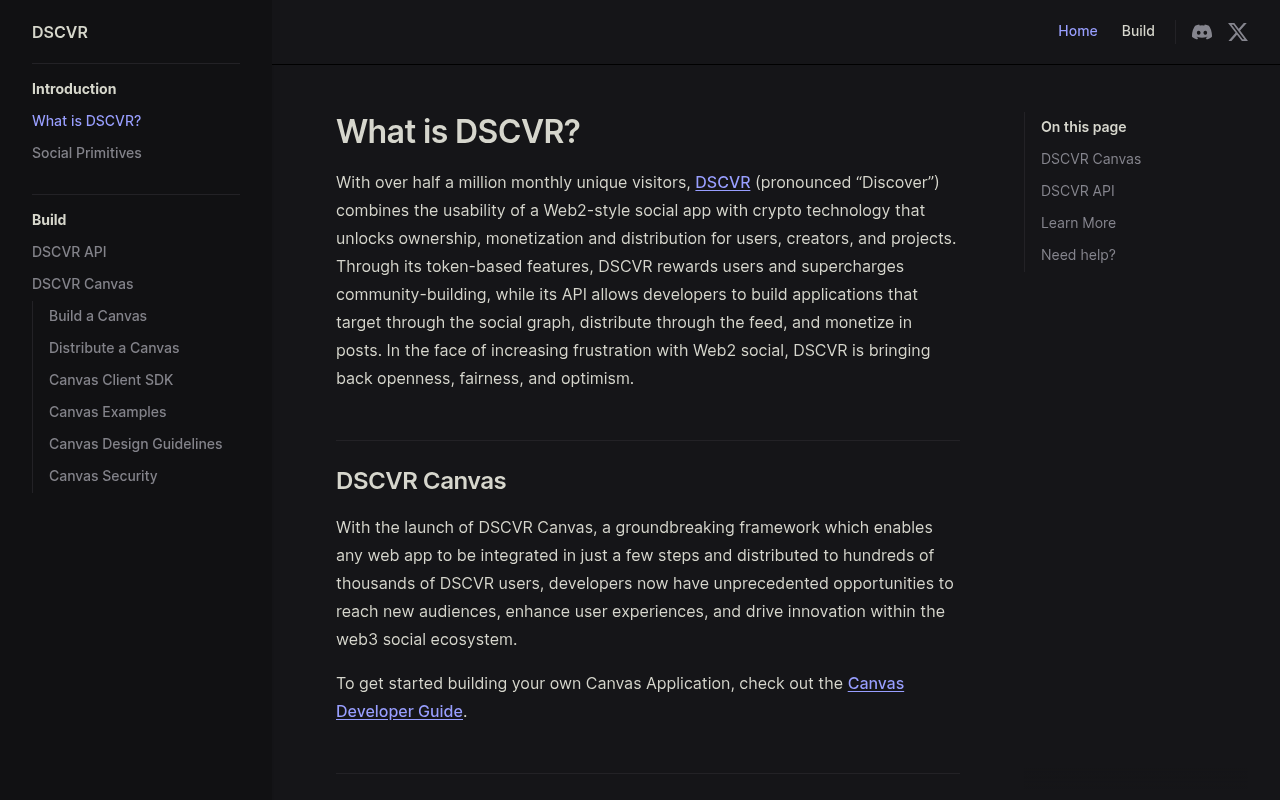
DSCVR website screenshot

DSCVR

DSCVR (pronounced "discover") is a Web3 social platform that blends a Web2-style social experience with crypto-native ownership, monetization, and distribution. Users post and interact inside token-gated communities called Portals, earn DSCVR Points and daily streaks, and connect on-chain wallets across Solana and the Internet Computer. For developers, DSCVR exposes a public GraphQL API over its SocialFi graph — users, portals, content, wallets, reactions, and frame messages — alongside the DSCVR Canvas / Frames framework for embedding interactive mini-apps directly into the social feed, all backed by first-party TypeScript SDKs.

DSCVR is listed with 1 API on the APIs.io network. Tagged areas include Company, Social, Web3, GraphQL, and Blockchain.

DSCVR’s developer surface includes documentation, API reference, getting-started guide, engineering blog, support, signup flow, CLI, and 18 more developer resources.

31.9/100 thin ▬ flat Agent 16/100 agent aware saas Full breakdown ↓
scored 2026-10-09 · rubric v0.23.0
1 API
CompanySocialWeb3GraphQLBlockchainSolanaInternet ComputerSocialFiSocial GraphDeveloper Platform

Kin Score

Kin Score Kin Score How this is scored →
scored 2026-10-09 · rubric v0.23.0
Regulatory Posture applies to this provider. Its tags matched the Horizontal (data, software, accessibility, platform) regime, so Regulatory Posture carries 15 points of the composite. If this regime is wrong for your business, say so on your provider repo — the applicability map is public and we will correct it.
Create-or-Update Ergonomics could not be measured. We hold no machine-readable contract for this provider to read, so there is nothing to measure a write surface against. Excluded rather than scored zero: never-measured and measured-empty are different facts. Publishing an OpenAPI is what makes this facet — and several others — scorable at all.
The six quality facets above are damped to 85 points between them, because the conditional facet above carries the other 15. That is why each facet's contribution is shown against a damped maximum: raising a quality facet moves the composite by 85% of its nominal weight, not 100%. The full arithmetic is at apis.io/rating/.
Improve this rating by publishing the missing artifacts — every area above can be raised, and the full rubric is at apis.io/rating/. Every facet and dimension name above is a link: it opens that measurement's own page — what it means, the exact checks that feed it, how the whole catalog distributes on it, and the providers at the top of it. This rating is computed from github.com/api-evangelist/dscvr: open an issue to ask a question, or submit a pull request to add artifacts. Submit an artifact on GitHub — free → Manage your own listing — the Influence plan, $499/mo →

Standards implemented 1

Standards this provider implements or carries. De facto ones are profiled and measured by the API Commons; formal ones come from the standards directory and are linked by the provider's own tags. The evidence column says how each claim was established — not that it was made.

tagged — the provider's own APIs.json carries the standard as a tag; implementation not verified

APIs 1

Individual APIs this provider publishes, each with its own machine-readable definition.

DSCVR API

Public GraphQL API over DSCVR's SocialFi graph. Query users (by id or username), portals (by id or slug), content (posts and comments), on-chain wallets, reactions, and unpack F...

Security Posture 2

Authentication, domain security, vulnerability disclosure, and trust-center signals.

Dscvr Authentication

none · 1 scheme

SECURITY

Dscvr Domain Security

TLSv1.3 · DMARC

SECURITY

Resources

Get Started 4

Portal, sign-up, and the first successful call

Documentation 3

Reference material describing how the API behaves

Agent Surfaces 4

MCP servers, agent skills, and machine-readable catalogs

Design & Contract 5

Pagination, idempotency, versioning, errors, and events

Build 4

SDKs, sample code, and the tooling you integrate with

Access & Security 2

Authentication, authorization, and security posture

Operate 1

Status, limits, changes, and where to get help

Company 2

The organization behind the API

Source (apis.yml)

apis.yml Raw ↑
aid: dscvr
name: DSCVR
description: DSCVR (pronounced "discover") is a Web3 social platform that blends a Web2-style social experience with crypto-native
  ownership, monetization, and distribution. Users post and interact inside token-gated communities called Portals, earn DSCVR
  Points and daily streaks, and connect on-chain wallets across Solana and the Internet Computer. For developers, DSCVR exposes
  a public GraphQL API over its SocialFi graph — users, portals, content, wallets, reactions, and frame messages — alongside
  the DSCVR Canvas / Frames framework for embedding interactive mini-apps directly into the social feed, all backed by first-party
  TypeScript SDKs.
url: https://raw.githubusercontent.com/api-evangelist/dscvr/refs/heads/main/apis.yml
x-type: company
x-source: vc-portfolio
x-backed-by:
- polychain
x-tier: stub
x-tier-reason: portfolio-lead
deliveryModel:
  model: saas
  open_source: false
  commercial: true
  callable_host: false
  label: Hosted service · you call their endpoint
  confidence: medium
  source:
  - pricing
  generated: '2026-08-28'
  method: derived
accessModel:
  pricing: unknown
  onboarding: unknown
  trial: false
  try_now: false
  public: false
  label: Unknown
  confidence: low
  source:
  - authentication
  generated: '2026-07-22'
  method: derived
specificationVersion: '0.23'
created: '2026-07-17'
modified: '2026-07-18'
x-docs-platform: vitepress
x-docs-platform-confidence: medium
x-docs-platform-checked: 2026-09-25
tags:
- Company
- Social
- Web3
- GraphQL
- Blockchain
- Solana
- Internet Computer
- SocialFi
- Social Graph
- Developer Platform
image: https://dscvr.one/favicon.ico
apis:
- name: DSCVR API
  description: Public GraphQL API over DSCVR's SocialFi graph. Query users (by id or username), portals (by id or slug), content
    (posts and comments), on-chain wallets, reactions, and unpack Frame messages. Currently unauthenticated — queries run
    with logged-out-user permissions.
  humanURL: https://docs.dscvr.one/build/dscvr-api/
  baseURL: https://api.dscvr.one/graphql
  properties:
  - type: GraphQL
    url: graphql/dscvr-graphql.graphql
  - type: Documentation
    url: https://docs.dscvr.one/build/dscvr-api/
maintainers:
- FN: Kin Lane
  email: kin@apievangelist.com
- FN: APIs.json
  email: info@apis.io
common:
- type: DomainSecurity
  url: security/dscvr-domain-security.yml
- type: Website
  url: https://dscvr.one
- type: DeveloperPortal
  url: https://docs.dscvr.one/
- type: Documentation
  url: https://docs.dscvr.one/
- type: APIReference
  url: https://docs.dscvr.one/build/dscvr-api/
- type: GettingStarted
  url: https://docs.dscvr.one/build/dscvr-canvas/build-a-canvas
- type: Blog
  url: https://blog.dscvr.one/
- type: GitHubOrganization
  url: https://github.com/dscvr-one
- type: Support
  url: https://discord.gg/DX4CaFph3s
- type: SignUp
  url: https://dscvr.one/
- type: GraphQL
  url: graphql/dscvr-graphql.graphql
- type: Packages
  url: packages/dscvr-packages.yml
- type: SDKs
  url: packages/dscvr-packages.yml
- type: CLI
  url: cli/dscvr-cli.yml
- type: Components
  url: components/dscvr-components.yml
- type: Sandbox
  url: sandbox/dscvr-sandbox.yml
- type: X-MCPServerCandidate
  url: mcp/dscvr-mcp.yml
  note: 'Renamed from MCPServer 2026-09-03 (roadmap#247): the manifest self-describes as status: candidate — a tool list derived
    from the published API contracts, not an existing server. The scorer already read the manifest and reported mcp_server
    correctly; the MCPServer type was crediting the artifact-type surfaces with a server that does not exist.'
- type: AgentSkill
  url: skills/_index.yml
- type: LLMsTxt
  url: llms/dscvr-llms.txt
- type: Authentication
  url: authentication/dscvr-authentication.yml
- type: Conventions
  url: conventions/dscvr-conventions.yml
- type: DataModel
  url: data-model/dscvr-data-model.yml
- type: Conformance
  url: conformance/dscvr-conformance.yml
- type: Lifecycle
  url: lifecycle/dscvr-lifecycle.yml
- type: WellKnown
  url: well-known/dscvr-well-known.yml
x-enrichment:
  date: '2026-07-19'
  status: backfilled
  pass: local-v1
  note: backfilled from .gitignore signal + verified work evidence

Work with this as data

Every provider here is available over the APIs.io API and to AI agents over MCP.

MCP server

One button, every client — Claude, Cursor, VS Code and the rest.

https://apis.io/mcp

Tools for providers

9 MCP tools reach this
  • find_providersBrowse and filter every provider in the catalog.
  • get_provider_artifactsEvery artifact this provider publishes, grouped by type.
  • get_provider_operationsEvery operation across all of their OpenAPIs — one call instead of parsing every spec.
  • get_provider_toolsEvery MCP tool they ship, with the operation each wraps.
  • get_provider_evidenceHow each part of their score was established. Free — the basis for a claim should not sit behind it.
  • get_provider_ratingPRO — composite, band, trend and facet scores.
  • apis_io_searchSTART HERE — APIs, providers and tags for one query, each with its total.
  • resolveTurn a domain, URL or GitHub org into the provider it belongs to.
  • find_cohortsEvery scored population of providers in the catalog.
All 92 tools →

Call it yourself

curl for this page
This provider
curl "https://apis.io/api/v1/providers/dscvr"
All providers
curl "https://apis.io/api/v1/providers?limit=25"
Every operation they expose
curl "https://apis.io/api/v1/providers/dscvr/operations?limit=25"
How their score was established
curl "https://apis.io/api/v1/providers/dscvr/evidence"

Discovery needs no key. Ratings and market analysis are Pro.

Get an API key

Free tier, no form to fill in. Signing in shares your email address with us — we store it to create your key and to recognise you if you sign in with another provider. See our Privacy Policy and Terms.

A second provider on the same verified email joins the account you already have.