Curity website screenshot

Curity

Curity is a Stockholm-based identity company whose Curity Identity Server is a self-hosted OAuth 2.0 and OpenID Connect server. Its interfaces are the standard OAuth/OIDC endpoints, a RESTCONF administration API, GraphQL user and client management APIs, and SCIM 2.0 user provisioning, all served by each customer deployment rather than a Curity-hosted base URL.

Curity is listed with 4 APIs on the APIs.io network. Tagged areas include Company, Identity, OAuth, OpenID Connect, and Authorization.

Curity’s developer surface includes documentation, engineering blog, changelog, getting-started guide, pricing, and 14 more developer resources.

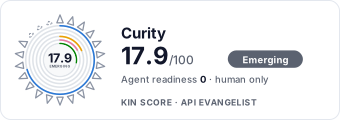
17.9/100 emerging ▼ -10.7 Agent 0/100 human only Heartbeat 100/100 alive Full breakdown ↓
scored 2026-11-06 · rubric v0.27.0 · Show this score on your site →
4 APIs
CompanyIdentityOAuthOpenID ConnectAuthorizationAPI SecurityAuthentication

Kin Score

Kin Score Kin Score How this is scored →
scored 2026-11-06 · rubric v0.27.0
Regulatory Posture applies to this provider. Its tags matched the Horizontal (data, software, accessibility, platform) regime, so Regulatory Posture carries 15 points of the composite. If this regime is wrong for your business, say so on your provider repo — the applicability map is public and we will correct it.
Create-or-Update Ergonomics could not be measured. We hold no machine-readable contract for this provider to read, so there is nothing to measure a write surface against. Excluded rather than scored zero: never-measured and measured-empty are different facts. Publishing an OpenAPI is what makes this facet — and several others — scorable at all.
The six quality facets above are damped to 85 points between them, because the conditional facet above carries the other 15. That is why each facet's contribution is shown against a damped maximum: raising a quality facet moves the composite by 85% of its nominal weight, not 100%. The full arithmetic is at apis.io/rating/.
Show this score on your site. Kin Score badge preview for Curity It updates itself when the score changes. Paste this where you link to your API docs:
<a href="https://apis.io/providers/curity/"><img src="https://apis.io/badge/curity/card.svg" alt="Curity on APIs.io — Kin Score by API Evangelist"></a>
Other styles, a README pill and a shields.io endpoint are on the badge page.
Raise your score.
Agent readiness — checks not met, largest first (exact, from this profile):
  • Machine-Readable Contract +18 pts — api_specs includes an OpenAPI document
  • MCP Server +12 pts — deployment.mode + probe verdict on the mcp/ manifest, not the pointer; an unprobed slug falls back to authorship
  • Agentic Access Contract +10 pts — agentic_access artifact present (x-agentic-access), graded by author
  • Machine-Readable Auth +10 pts — a served openid-configuration/oauth-authorization-server carrying `issuer` (served), else the securitySchemes class in the provider OpenAPIs — bound (mutualTLS, DPoP, Signature) > negotiable (oauth2 authorizationCode/clientCredentials, openIdConnect) > bearer (http bearer, apiKey)
  • Idempotency +9 pts — OpenAPI mutating operations declare an idempotency key — a header, a request-body property, or a named de-duplication token whose own description says so (verified); else common[].type matches /idempoten/i (documented)
  • Stable Error Semantics +8 pts — OpenAPI $refs a shared error schema across 4xx/5xx responses (verified), else common[].type includes ErrorCatalog / ErrorCodes / DeclineCodes
13 more unmet checks in the Agent Readiness table above.
Kin Score — facets with the most composite points still available (weight × headroom):
Each check links to what satisfies it. Publish the artifact, or tell us where it already lives, and the score moves on the next scoring run.
Improve this rating by publishing the missing artifacts — every area above can be raised, and the full rubric is at apis.io/rating/. Every facet and dimension name above is a link: it opens that measurement's own page — what it means, the exact checks that feed it, how the whole catalog distributes on it, and the providers at the top of it. This rating is computed from the provider profile at artifacts.apis.io/curity/apis.yml: open an issue on github.com/api-evangelist/curity to ask a question or point us at an artifact you publish. Submit an artifact on GitHub — free → Manage your own listing — the Influence plan, $499/mo →

Markets this provider is in provisional

The Kin Score Market layer reads a provider inside its market: its position, and how deep its integrations go. Depth is only comparable within a position. Provisional and unweighted: not part of the Kin Score or agent readiness.

MarketPositionDepthRegistered MCP serverDeclares compatibility
OpenID Certified Implementations (OIDC, FAPI, OpenID4VC) standard 50.5 - -

Registered MCP server and declares compatibility are report only — not weighted. Undeclared means we found nothing we can read, so there is no number: we never infer integrations.

Standards implemented 2

Standards this provider implements or carries. De facto ones are profiled and measured by the API Commons; formal ones come from the standards directory and are linked by the provider's own tags. The evidence column says how each claim was established — not that it was made.

tagged — the provider's own APIs.json carries the standard as a tag; implementation not verified

APIs 4

Individual APIs this provider publishes, each with its own machine-readable definition.

Curity RESTCONF Admin API

RESTCONF (RFC 8040) API on the Curity Identity Server admin service for reading and changing the full server configuration; served by each self-hosted deployment.

Curity GraphQL APIs

GraphQL APIs exposed by the Curity Identity Server for user management and dynamic client (DCR) management, protected by OAuth access tokens.

Curity SCIM 2.0 API

SCIM 2.0 user provisioning endpoints served by the Curity Identity Server user management service.

Curity OAuth and OpenID Connect

Standard OAuth 2.0 and OpenID Connect endpoints (authorize, token, introspection, userinfo, revocation, dynamic registration, discovery) served by the Curity Identity Server tok...

Security Posture 2

Authentication, domain security, vulnerability disclosure, and trust-center signals.

Curity Domain Security

TLSv1.3 · DMARC

SECURITY

Curity Trust Center

SOC 2, ISO 27001

SECURITY

Resources

Get Started 2

Portal, sign-up, and the first successful call

Documentation 1

Reference material describing how the API behaves

Agent Surfaces 2

MCP servers, agent skills, and machine-readable catalogs

Build 2

SDKs, sample code, and the tooling you integrate with

Access & Security 3

Authentication, authorization, and security posture

Operate 2

Status, limits, changes, and where to get help

Commercial 3

Pricing, plans, and the legal terms of use

Company 3

The organization behind the API

Other 1

Properties that don't map to a standard resource type

Source (apis.yml)

apis.yml Raw ↑
aid: curity
name: Curity
accessModel:
  pricing: unknown
  onboarding: unknown
  trial: false
  try_now: false
  public: false
  label: Unknown
  confidence: low
  probe_state: none
  source:
  - security
  generated: '2026-11-06'
  method: derived
image: https://curity.io/images/open-graph/homepage-sharing-image.jpg?v=20260618
description: Curity is a Stockholm-based identity company whose Curity Identity Server is a self-hosted OAuth 2.0 and OpenID
  Connect server. Its interfaces are the standard OAuth/OIDC endpoints, a RESTCONF administration API, GraphQL user and client
  management APIs, and SCIM 2.0 user provisioning, all served by each customer deployment rather than a Curity-hosted base
  URL.
url: https://raw.githubusercontent.com/api-evangelist/curity/refs/heads/main/apis.yml
x-type: company
x-source: harvest:market-layer-gap
x-tier: profiled
x-tier-reason: harvest
specificationVersion: '0.20'
created: '2026-10-13'
modified: '2026-10-13'
tags:
- Company
- Identity
- OAuth
- OpenID Connect
- Authorization
- API Security
- Authentication
tags_raw:
- Company
- Identity
- OAuth
- OpenID Connect
- Authorization
- API Security
- Authentication
maintainers:
- FN: Kin Lane
  email: kin@apievangelist.com
- FN: APIs.json
  email: info@apis.io
common:
- type: IntegrationEdges
  url: integrations/curity-integration-edges.yml
- type: Compliance
  url: https://trust.curity.io/
- type: LLMsTxt
  url: llms/curity-llms.txt
- type: Hosts
  url: hosts/curity-hosts.yml
- type: TrustCenter
  url: security/curity-trust-center.yml
- type: DomainSecurity
  url: security/curity-domain-security.yml
- type: Website
  url: https://curity.io
- type: Documentation
  url: https://docs.curity.io/
- type: DeveloperPortal
  url: https://developer.curity.io/
- type: Blog
  url: https://curity.io/blog/
- type: ChangeLog
  url: https://curity.io/resources/whats-new/
- type: GettingStarted
  url: https://curity.io/resources/getting-started/
- type: GitHubOrganization
  url: https://github.com/curityio
- type: Newsroom
  url: https://curity.io/news/
- type: Pricing
  url: https://curity.io/pricing/
- type: PrivacyPolicy
  url: https://curity.io/resources/learn/privacy-and-gdpr/
- type: StatusPage
  url: https://status.curity.io/
- type: TermsOfService
  url: https://curity.io/terms-of-service/
- type: LLMsTxt
  url: https://curity.io/llms.txt
apis:
- aid: curity:restconf-admin-api
  name: Curity RESTCONF Admin API
  description: RESTCONF (RFC 8040) API on the Curity Identity Server admin service for reading and changing the full server
    configuration; served by each self-hosted deployment.
  humanURL: https://curity.io/docs/identity-server/administration/restconf
  tags:
  - Administration
  - RESTCONF
  - Configuration
  properties:
  - type: Documentation
    url: https://curity.io/docs/identity-server/administration/restconf
  - type: Video
    url: https://curity.io/resources/videos/introduction-to-RESTCONF-admin.api/
  - type: Tutorial
    url: https://curity.io/resources/learn/access-rules-in-restconf/
- aid: curity:graphql-apis
  name: Curity GraphQL APIs
  description: GraphQL APIs exposed by the Curity Identity Server for user management and dynamic client (DCR) management,
    protected by OAuth access tokens.
  humanURL: https://curity.io/docs/identity-server/developer-guide/graphql
  tags:
  - GraphQL
  - User Management
  - Client Management
  properties:
  - type: Documentation
    url: https://curity.io/docs/identity-server/developer-guide/graphql
  - type: Documentation
    url: https://curity.io/docs/identity-server/administration/graphql
  - type: Tutorial
    url: https://curity.io/resources/learn/graphql-user-management/
  - type: Tutorial
    url: https://curity.io/resources/learn/graphql-client-management/
- aid: curity:scim-2.0-api
  name: Curity SCIM 2.0 API
  description: SCIM 2.0 user provisioning endpoints served by the Curity Identity Server user management service.
  humanURL: https://curity.io/resources/learn/managing-users-with-scim/
  tags:
  - SCIM
  - Provisioning
  - User Management
  properties:
  - type: Tutorial
    url: https://curity.io/resources/learn/managing-users-with-scim/
  - type: Tutorial
    url: https://curity.io/resources/learn/user-provisioning-with-scim/
- aid: curity:oauth-and-openid-connect
  name: Curity OAuth and OpenID Connect
  description: Standard OAuth 2.0 and OpenID Connect endpoints (authorize, token, introspection, userinfo, revocation, dynamic
    registration, discovery) served by the Curity Identity Server token service.
  humanURL: https://curity.io/docs/identity-server/developer-guide/
  tags:
  - OAuth
  - OpenID Connect
  - Tokens
  - Authentication
  tags_raw:
  - OAuth
  - OpenID Connect
  - Tokens
  - Authentication
  properties:
  - type: Documentation
    url: https://curity.io/docs/identity-server/developer-guide/
x-coverage:
  state: none
  reason: no-developer-program
  method: derived
  generated: '2026-10-13'
  generator: derive-coverage.py (pre-flight evidence)
  detail: the company publishes no developer documentation host and no machine-readable contract on its own domain
  evidence:
  - url: https://curity.io
    status: 200
x-enrichment:
  status: enriched
  pass: local-v5
  date: '2026-10-13'

Curity API — frequently asked questions

Does Curity have an API?

Yes. APIs.io lists 4 APIs from Curity, including Curity RESTCONF Admin API, Curity GraphQL APIs and Curity SCIM 2.0 API, and 1 more.

Is the Curity API ready for AI agents?

Curity has a Kin Score of 17.9 out of 100 (emerging) and an Agent Readiness score of 0.0 (human-only), scored by API Evangelist on 2026-11-06.

Work with this as data

Every provider here is available over the APIs.io API and to AI agents over MCP.

MCP server

One button, every client — Claude, Cursor, VS Code and the rest.

https://apis.io/mcp

Tools for providers

9 MCP tools reach this
  • find_providersBrowse and filter every provider in the catalog.
  • get_provider_artifactsEvery artifact this provider publishes, grouped by type.
  • get_provider_operationsEvery operation across all of their OpenAPIs — one call instead of parsing every spec.
  • get_provider_toolsEvery MCP tool they ship, with the operation each wraps.
  • get_provider_evidenceHow each part of their score was established. Free — the basis for a claim should not sit behind it.
  • get_provider_ratingPRO — composite, band, trend and facet scores.
  • apis_io_searchSTART HERE — APIs, providers and tags for one query, each with its total.
  • resolveTurn a domain, URL or GitHub org into the provider it belongs to.
  • find_cohortsEvery scored population of providers in the catalog.
All 92 tools →

Call it yourself

curl for this page
This provider
curl "https://apis.io/api/v1/providers/curity"
All providers
curl "https://apis.io/api/v1/providers?limit=25"
Every operation they expose
curl "https://apis.io/api/v1/providers/curity/operations?limit=25"
How their score was established
curl "https://apis.io/api/v1/providers/curity/evidence"

Calls without X-API-Key need no key. Calls with it need a paid plan — get a key.

Get an API key

Free tier, no form to fill in. Signing in shares your email address with us — we store it to create your key and to recognise you if you sign in with another provider. See our Privacy Policy and Terms.

A second provider on the same verified email joins the account you already have.