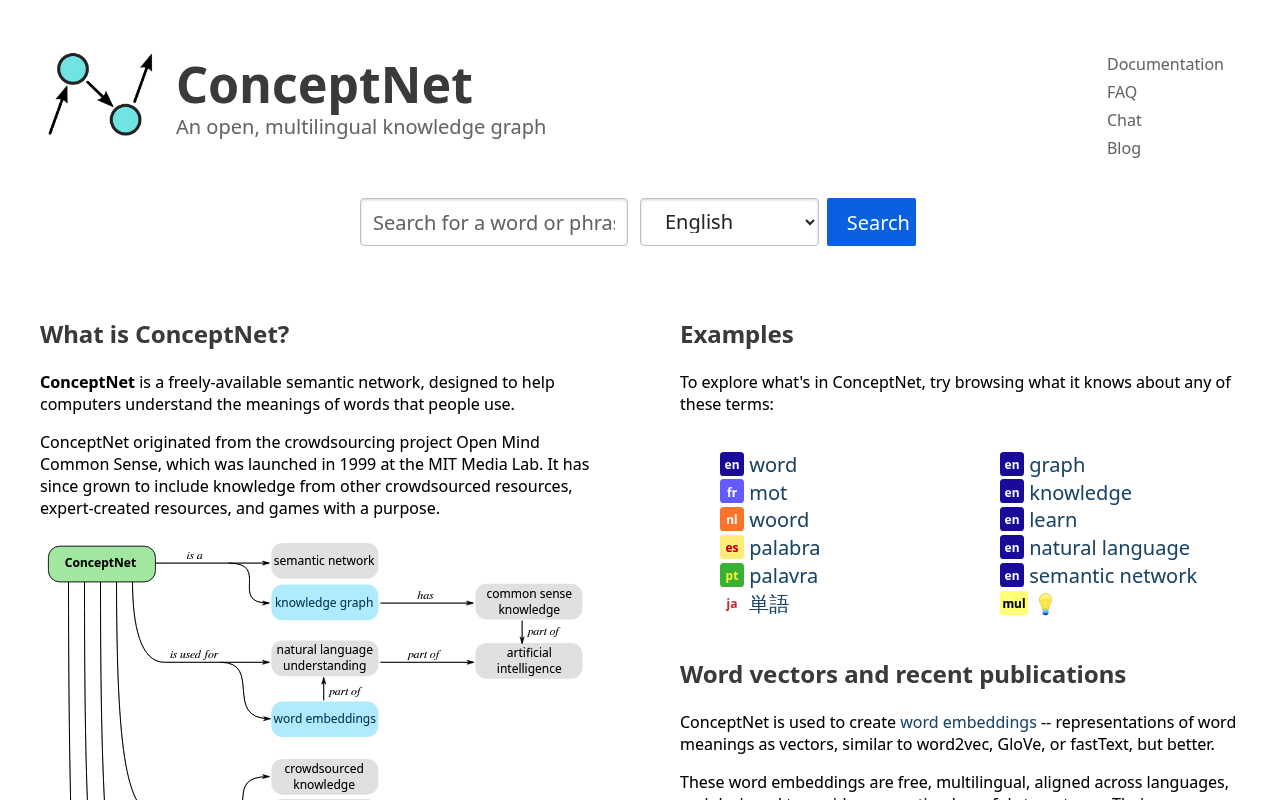
ConceptNet is a freely available multilingual knowledge graph that gives computers access to common-sense knowledge. It represents over 13 million links between concepts across 100+ languages, drawing from crowd-sourced resources (Open Mind Common Sense, Wiktionary), expert-created resources (WordNet, JMDict), and games with a purpose (Verbosity, nadya.jp). The public REST API provides JSON-LD responses and receives over 50,000 daily hits. ConceptNet also powers Numberbatch, a set of multilingual word embeddings aligned across languages that outperform word2vec, GloVe, and fastText on standard benchmarks.
ConceptNet publishes 8 API contracts indexed on the APIs.io network, including Concepts API, Edges API, Query API, and 5 more. Tagged areas include Knowledge Graph, Natural Language Processing, Semantic Web, Common Sense, and Multilingual.
The ConceptNet catalog on APIs.io includes 1 Spectral governance ruleset.
ConceptNet’s developer surface includes documentation, getting-started guide, FAQ, support, and 11 more developer resources.
Regulatory Posture applies to this provider. Its tags matched the
Government & Public Sector regime, so
Regulatory Posture carries 15 points of the composite.
If this regime is wrong for your business, say so on your
provider repo — the
applicability map is public and we will correct it.
Create-or-Update Ergonomics does not apply to this provider. The published contracts declare
no write operations, and a read-only API cannot create-or-update. The facet is excluded from this provider's
denominator entirely — not scored zero. A reference or data API is not deficient for being unable to
upsert.
The six quality facets above are damped to 85 points between them,
because the conditional facet above carries the other
15. That is why each facet's contribution is shown against a damped
maximum: raising a quality facet moves the composite by 85% of its nominal
weight, not 100%. The full arithmetic is at apis.io/rating/.
Improve this rating by publishing the missing artifacts — every area above can be raised, and the full rubric is at apis.io/rating/. Every facet and dimension name above is a link: it opens that measurement's own page — what it means, the exact checks that feed it, how the whole catalog distributes on it, and the providers at the top of it. This rating is computed from github.com/api-evangelist/conceptnet: open an issue to ask a question, or submit a pull request to add artifacts.
Submit an artifact on GitHub — free →Manage your own listing — the Influence plan, $499/mo →
The ConceptNet REST API exposes the full ConceptNet 5 knowledge graph via JSON-LD endpoints. Consumers can look up concept nodes by language and term, query edges by relation ty...
aid: conceptnet
name: ConceptNet
description: ConceptNet is a freely available multilingual knowledge graph that gives computers access to common-sense knowledge.
  It represents over 13 million links between concepts across 100+ languages, drawing from crowd-sourced resources (Open Mind
  Common Sense, Wiktionary), expert-created resources (WordNet, JMDict), and games with a purpose (Verbosity, nadya.jp). The
  public REST API provides JSON-LD responses and receives over 50,000 daily hits. ConceptNet also powers Numberbatch, a set
  of multilingual word embeddings aligned across languages that outperform word2vec, GloVe, and fastText on standard benchmarks.
url: https://conceptnet.io
deliveryModel:
  model: saas
  license_evidence:
    not_product:
    - commonsense/conceptnet5
  open_source: unknown
  commercial: true
  callable_host: true
  label: Hosted service · you call their endpoint
  confidence: low
  source:
  - openapi
  - pricing
  - repository-not-product
  generated: '2026-09-25'
  method: derived
accessModel:
  pricing: free
  onboarding: unknown
  trial: false
  try_now: false
  public: false
  label: Free
  confidence: medium
  source:
  - plans
  generated: '2026-07-22'
  method: derived
image: https://conceptnet.io/img/conceptnet-logo.png
specificationVersion: '0.23'
created: '2026-06-13'
modified: '2026-06-13'
x-source: manual
x-category: Knowledge Graphs
tags:
- Knowledge Graph
- Natural Language Processing
- Semantic Web
- Common Sense
- Multilingual
- Word Embeddings
- Linked Data
- Open Data
tags_raw:
- Knowledge Graph
- NLP
- Semantic Web
- Common Sense
- Multilingual
- Word Embeddings
- Linked Data
- Open Data
apis:
- name: ConceptNet REST API
  description: The ConceptNet REST API exposes the full ConceptNet 5 knowledge graph via JSON-LD endpoints. Consumers can
    look up concept nodes by language and term, query edges by relation type, retrieve semantically related terms ranked by
    Numberbatch embedding similarity, compute pairwise relatedness scores between concepts, and normalize natural-language
    text into canonical ConceptNet URIs. No authentication or API key is required. Rate limits of 3,600 requests/hour and
    120 requests/minute apply. The /related and /relatedness endpoints each count as 2 requests against the quota.
  humanURL: https://github.com/commonsense/conceptnet5/wiki/API
  baseURL: https://api.conceptnet.io
  tags:
  - Knowledge Graph
  - Natural Language Processing
  - Semantic Relations
  - Multilingual
  - Common Sense
  tags_raw:
  - Knowledge Graph
  - NLP
  - Semantic Relations
  - Multilingual
  - Common Sense
  properties:
  - type: Documentation
    url: https://github.com/commonsense/conceptnet5/wiki/API
  - type: GettingStarted
    url: https://github.com/commonsense/conceptnet5/wiki
  - type: Downloads
    url: https://github.com/commonsense/conceptnet5/wiki/Downloads
- aid: conceptnet:conceptnet-concepts-api
  name: ConceptNet Concepts API
  description: Look up concept nodes in the knowledge graph
  humanURL: https://github.com/commonsense/conceptnet5/wiki/API
  baseURL: https://api.conceptnet.io
  tags:
  - Concepts
  properties:
  - type: OpenAPI
    url: openapi/conceptnet-concepts-api-openapi.yml
- aid: conceptnet:conceptnet-edges-api
  name: ConceptNet Edges API
  description: Access individual edge (assertion) records
  humanURL: https://github.com/commonsense/conceptnet5/wiki/API
  baseURL: https://api.conceptnet.io
  tags:
  - Edges
  properties:
  - type: OpenAPI
    url: openapi/conceptnet-edges-api-openapi.yml
- aid: conceptnet:conceptnet-query-api
  name: ConceptNet Query API
  description: Complex multi-parameter edge queries
  humanURL: https://github.com/commonsense/conceptnet5/wiki/API
  baseURL: https://api.conceptnet.io
  tags:
  - Query
  properties:
  - type: OpenAPI
    url: openapi/conceptnet-query-api-openapi.yml
- aid: conceptnet:conceptnet-relations-api
  name: ConceptNet Relations API
  description: Browse edges grouped by relation type
  humanURL: https://github.com/commonsense/conceptnet5/wiki/API
  baseURL: https://api.conceptnet.io
  tags:
  - Relations
  properties:
  - type: OpenAPI
    url: openapi/conceptnet-relations-api-openapi.yml
- aid: conceptnet:conceptnet-similarity-api
  name: ConceptNet Similarity API
  description: Semantic similarity and relatedness using Numberbatch embeddings
  humanURL: https://github.com/commonsense/conceptnet5/wiki/API
  baseURL: https://api.conceptnet.io
  tags:
  - Similarity
  properties:
  - type: OpenAPI
    url: openapi/conceptnet-similarity-api-openapi.yml
- aid: conceptnet:conceptnet-sources-api
  name: ConceptNet Sources API
  description: Access provenance and source information
  humanURL: https://github.com/commonsense/conceptnet5/wiki/API
  baseURL: https://api.conceptnet.io
  tags:
  - Sources
  properties:
  - type: OpenAPI
    url: openapi/conceptnet-sources-api-openapi.yml
- aid: conceptnet:conceptnet-utilities-api
  name: ConceptNet Utilities API
  description: URI normalization and text standardization
  humanURL: https://github.com/commonsense/conceptnet5/wiki/API
  baseURL: https://api.conceptnet.io
  tags:
  - Utilities
  properties:
  - type: OpenAPI
    url: openapi/conceptnet-utilities-api-openapi.yml
common:
- type: IssueTracker
  url: https://github.com/commonsense/conceptnet5/issues
- type: AgenticAccess
  url: agentic-access/conceptnet-agentic-access.yml
- type: DomainSecurity
  url: security/conceptnet-domain-security.yml
- type: Website
  url: https://conceptnet.io
- type: Documentation
  url: https://github.com/commonsense/conceptnet5/wiki/API
- type: GettingStarted
  url: https://github.com/commonsense/conceptnet5/wiki
- type: GitHubOrganization
  url: https://github.com/commonsense
- type: GitHubRepository
  url: https://github.com/commonsense/conceptnet5
- type: License
  url: https://creativecommons.org/licenses/by-sa/4.0/
- type: Downloads
  url: https://github.com/commonsense/conceptnet5/wiki/Downloads
- type: FAQ
  url: https://github.com/commonsense/conceptnet5/wiki/FAQ
- type: Support
  url: https://groups.google.com/g/conceptnet-users
- type: Plans
  url: plans/conceptnet-plans-pricing.yml
- type: RateLimits
  url: rate-limits/conceptnet-rate-limits.yml
- type: FinOps
  url: finops/conceptnet-finops.yml
features:
- name: Multilingual Knowledge Graph
  description: Covers concepts in 100+ languages with cross-language semantic links. Each concept node is identified by a
    URI such as /c/en/dog or /c/fr/chien, enabling cross-lingual knowledge transfer and multilingual NLP pipelines.
- name: Semantic Relations
  description: Edges encode typed relations including IsA, UsedFor, CapableOf, AtLocation, Causes, HasProperty, PartOf, SimilarTo,
    Antonym, RelatedTo, and many more. Each edge carries a weight representing confidence from the source data.
- name: JSON-LD Linked Data API
  description: All API responses use the JSON-LD format with @context, @id, and @type annotations, enabling seamless integration
    with RDF toolchains and semantic web applications.
- name: Related Terms (Numberbatch Embeddings)
  description: The /related endpoint returns ranked semantically related concepts using ConceptNet Numberbatch word vectors
    — cross-lingual embeddings designed to avoid harmful stereotypes and outperform word2vec, GloVe, and fastText on analogy
    and similarity benchmarks.
- name: Pairwise Relatedness Score
  description: The /relatedness endpoint returns a similarity score between 0 and 1 for any two concept URIs, enabling quick
    semantic similarity checks without building a local embedding model.
- name: Complex Edge Queries
  description: The /query endpoint accepts combinations of start, end, rel, node, other, and sources parameters to slice the
    knowledge graph by subject, object, relation type, or data source simultaneously.
- name: URI Normalization
  description: The /uri endpoint converts raw natural-language text in any supported language into a canonical ConceptNet
    URI, handling tokenization, lowercasing, and language-specific normalization automatically.
- name: No Authentication Required
  description: The public API requires no registration, API key, or OAuth token. Any HTTP client can query api.conceptnet.io
    directly.
useCases:
- name: Semantic Similarity in NLP Pipelines
  description: Use /relatedness or /related to score or rank term similarity in question answering, text classification, and
    entity disambiguation tasks without training a custom embedding model.
- name: Knowledge-Graph-Augmented AI
  description: Enrich LLM prompts or retrieval pipelines with structured commonsense facts by querying /c/{language}/{term}
    for edges describing causes, properties, and typical locations of a concept.
- name: Cross-Language Information Retrieval
  description: Leverage ConceptNet's multilingual graph to expand a query in one language to synonymous concepts in another,
    supporting multilingual search and cross-lingual document clustering.
- name: Educational Vocabulary Tools
  description: Build vocabulary-learning apps that surface semantic neighbors, antonyms, and example sentences for any word
    in dozens of languages using the IsA, SimilarTo, and Antonym relation edges.
- name: Commonsense Reasoning Datasets
  description: Use ConceptNet as a gold-standard knowledge source for generating or evaluating commonsense reasoning benchmarks
    and training data for language models.
- name: Chatbot Knowledge Enrichment
  description: Query ConceptNet for UsedFor, CapableOf, and AtLocation edges to give chatbots and virtual assistants grounded
    commonsense knowledge about everyday objects and actions.
integrations:
- name: Python (conceptnet5)
  description: The open-source Python codebase includes a local AssertionFinder API for querying a self-hosted ConceptNet
    database without HTTP overhead.
  url: https://github.com/commonsense/conceptnet5
- name: ConceptNet Numberbatch
  description: Pre-trained multilingual word embedding vectors (h5 and text formats) that can be loaded directly into NumPy,
    PyTorch, or TensorFlow for offline semantic similarity computation.
  url: https://github.com/commonsense/conceptnet-numberbatch
- name: Linked Data / RDF
  description: JSON-LD responses integrate directly with JSON-LD processors, RDF triple stores (Apache Jena, Virtuoso), and
    SPARQL query engines.
solutions:
- name: Zero-Cost Semantic Enrichment
  description: Query /related for any concept in an NLP pipeline at zero cost and without authentication, adding knowledge-graph
    context to otherwise purely statistical models.
- name: Self-Hosted High-Volume Deployment
  description: For applications exceeding 3,600 requests/hour, download the full ConceptNet data dump and run a local PostgreSQL-backed
    instance using the open-source codebase, eliminating rate limits entirely.
maintainers:
- FN: Kin Lane
  email: kin@apievangelist.com
Discovery needs no key. Ratings and market analysis are Pro.
Get an API key
Free tier, no form to fill in. Signing in shares your email address with us — we
store it to create your key and to recognise you if you sign in with another
provider. See our Privacy Policy and
Terms.
 Kin Score
How this is scored →
Kin Score
How this is scored →