
Cirkul
Cirkul, Inc. is a Tampa, Florida direct-to-consumer beverage company founded in 2016 by Garrett Waggoner and Andy Gay. Cirkul sells a reusable bottle system paired with patented flavor cartridges — called Sips — that sit in the bottle lid behind a dial, letting a drinker adjust flavor intensity without pre-mixing. The cartridge lines include LifeSip, FitSip and GoSip, covering more than 100 zero-sugar, zero-calorie flavors spanning fruit blends, iced teas, iced coffees and caffeinated and electrolyte formulations. Cirkul does not publish a general-purpose developer API or an OpenAPI definition; its machine-readable surface is an agent-commerce one, served from its own drinkcirkul.com Shopify storefront: an anonymous Model Context Protocol server at /api/mcp, a Universal Commerce Protocol (UCP) merchant profile at /.well-known/ucp, a UCP shopping MCP endpoint at /api/ucp/mcp, published agent instructions at /agents.md and /llms.txt, and OAuth 2.0 / OpenID Connect discovery for the Shopify Customer Account API.
Cirkul is listed with 1 API on the APIs.io network. Tagged areas include Company, Beverages, Consumer Packaged Goods, Direct to Consumer, and E-Commerce.
Cirkul’s developer surface includes documentation, getting-started guide, support, engineering blog, pricing, signup flow, authentication, and 21 more developer resources.
Kin Score
 Kin Score
How this is scored →
Kin Score
How this is scored →scored 2026-10-23 · rubric v0.25.0
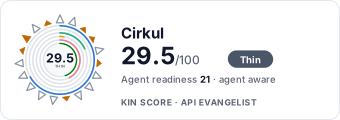 It updates itself when the score changes. Paste this where you link to your API docs:
<a href="https://apis.io/providers/cirkul/"><img src="https://apis.io/badge/cirkul/card.svg" alt="Cirkul on APIs.io — Kin Score by API Evangelist"></a>Other styles, a README pill and a shields.io endpoint are on the badge page.
Markets this provider is in provisional
The Kin Score Market layer reads a provider inside its market: its position, and how deep its integrations go. Depth is only comparable within a position. Provisional and unweighted: not part of the Kin Score or agent readiness.
| Market | Position | Depth | Registered MCP server | Declares compatibility |
|---|---|---|---|---|
| Food Safety (GFSI-recognised certification) | undeclared | - | - | - |
Registered MCP server and declares compatibility are report only — not weighted. Undeclared means we found nothing we can read, so there is no number: we never infer integrations.
APIs 1
Individual APIs this provider publishes, each with its own machine-readable definition.
Cirkul Storefront Agent API
The agent-facing commerce surface Cirkul serves from its own drinkcirkul.com host. It comprises an anonymous Model Context Protocol (MCP) server at /api/mcp exposing five tools ...
MCP Servers 1
Model Context Protocol servers that expose these APIs to AI agents.
Security Posture 2
Authentication, domain security, vulnerability disclosure, and trust-center signals.
Scopes 1
OAuth scopes governing access to this provider's APIs.
Resources
Get Started 2
Portal, sign-up, and the first successful call
Documentation 1
Reference material describing how the API behaves
Agent Surfaces 4
MCP servers, agent skills, and machine-readable catalogs
Design & Contract 4
Pagination, idempotency, versioning, errors, and events
Build 2
SDKs, sample code, and the tooling you integrate with
Access & Security 3
Authentication, authorization, and security posture
Operate 2
Status, limits, changes, and where to get help
Commercial 3
Pricing, plans, and the legal terms of use
Company 4
The organization behind the API
Other 3
Properties that don't map to a standard resource type
Source (apis.yml)
Work with this as data
Every provider here is available over the APIs.io API and to AI agents over MCP.