
Bungalow
Bungalow is a US residential rental platform for single-family homes, operating both a co-living ("Coliving Home") product where individual rooms in a house are leased to separately screened housemates and a whole-home ("Group Home") product leased to a single group. Founded in 2017 by Andrew Collins and Justin McCarty and headquartered in Miami, FL, the company pairs a renter-facing marketplace and mobile app with a homeowner property-management portal and an SFR investment service ("Radar Powered by Bungalow") covering sourcing, underwriting, renovation and management. Bungalow publishes a small, anonymous, read-mostly public REST API — the Bungalow API at fieldstone.bungalow.com — so that third-party listing sites, rental search portals and partner platforms can syndicate its markets and property listings, retrieve showing availability, book a showing, and submit an application source. Authenticated Hotpads and Facebook Catalog XML feeds are offered to approved integration partners as a richer alternative, and partners are asked to post lead-capture webhooks back to Bungalow. Active in roughly 23 markets across the United States.
Bungalow publishes 4 API contracts indexed on the APIs.io network, including Applications API, Listings API, Markets API, and 1 more. Tagged areas include Company, Real Estate, Residential Real Estate, Rental Listings, and Property Management.
The Bungalow catalog on APIs.io includes 1 event-driven AsyncAPI specification.
Bungalow’s developer surface includes documentation, API reference, getting-started guide, support, engineering blog, signup flow, authentication, and 23 more developer resources.
What this lets a business do 1
Business capabilities this provider's published APIs can perform, derived from its own contracts. Browse all capabilities →
Kin Score
 Kin Score
How this is scored →
Kin Score
How this is scored →scored 2026-10-23 · rubric v0.25.0
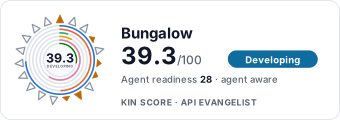 It updates itself when the score changes. Paste this where you link to your API docs:
<a href="https://apis.io/providers/bungalow/"><img src="https://apis.io/badge/bungalow/card.svg" alt="Bungalow on APIs.io — Kin Score by API Evangelist"></a>Other styles, a README pill and a shields.io endpoint are on the badge page.
APIs 4
Individual APIs this provider publishes, each with its own machine-readable definition.
Bungalow Applications API
The Applications API from Bungalow — 1 operation(s) for applications.
Bungalow Listings API
Listings endpoints allow you to get all listings in a market or a singular property. Rooms within properties can become marketable before the room is vacant, generally if there ...
Bungalow Markets API
A market is a generalized geographical area that often represents a city (e.g. Seattle, Boston), but can also represent a broader metropolitan area (e.g. Bay Area).
Bungalow Showings API
These two endpoints will give you everything you need to get booking availability, as well as create a showing at a given property.
Event Specifications 1
AsyncAPI definitions for this provider's event-driven and streaming APIs.
Bungalow Webhooks
ASYNCAPIOpenAPI Overlays 1
Overlays applied on top of this provider's contracts. Each card says who wrote it: a document the provider publishes, or one API Evangelist derived or generated.
Security Posture 2
Authentication, domain security, vulnerability disclosure, and trust-center signals.
Resources
Get Started 4
Portal, sign-up, and the first successful call
Documentation 3
Reference material describing how the API behaves
Agent Surfaces 3
MCP servers, agent skills, and machine-readable catalogs
Design & Contract 6
Pagination, idempotency, versioning, errors, and events
Build 1
SDKs, sample code, and the tooling you integrate with
Access & Security 2
Authentication, authorization, and security posture
Operate 2
Status, limits, changes, and where to get help
Commercial 2
Pricing, plans, and the legal terms of use
Company 5
The organization behind the API
Other 2
Properties that don't map to a standard resource type
Source (apis.yml)
Work with this as data
Every provider here is available over the APIs.io API and to AI agents over MCP.