
Atmosic
Atmosic Technologies is a fabless semiconductor company headquartered in San Jose, California that designs ultra-low-power wireless system-on-chips for the Internet of Things, with the stated goal of radically reducing — and in some deployments eliminating — device dependence on batteries. Its ATM2, ATM3, ATM33/e and ATM34/e families combine Bluetooth LE (plus 802.15.4 for Thread, Matter and Zigbee on the ATM34/e) radios with an Arm Cortex-M33F application processor, Arm TrustZone, cryptographic accelerators, and patented energy-harvesting and controlled wake-up receiver technology. Design wins include Samsung's SmartTag2 and Google Android TV remote controls. Atmosic ships an EMBEDDED developer surface rather than a public web API: the open-source OpenAir SDK built on the Zephyr RTOS and distributed from the Atmosic GitHub organization as a west manifest, a published AT command set for host control of BLE peripheral, central and GATT roles, an atm_isp protobuf schema describing the in-system-programming archive format, desktop programming and RF utilities, DevTools mobile apps, evaluation kits, and an NDA-gated customer portal for the commercial SDK and datasheets.
Atmosic is profiled on the APIs.io network. Tagged areas include Company, Semiconductors, Bluetooth Low Energy, Wireless, and Energy Harvesting.
Atmosic’s developer surface includes CLI, changelog, documentation, getting-started guide, API reference, support, engineering blog, and 17 more developer resources.
Kin Score
 Kin Score
How this is scored →
Kin Score
How this is scored →scored 2026-10-23 · rubric v0.25.0
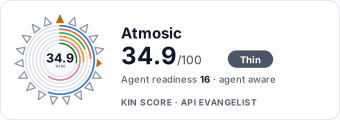 It updates itself when the score changes. Paste this where you link to your API docs:
<a href="https://apis.io/providers/atmosic/"><img src="https://apis.io/badge/atmosic/card.svg" alt="Atmosic on APIs.io — Kin Score by API Evangelist"></a>Other styles, a README pill and a shields.io endpoint are on the badge page.
Markets this provider is in provisional
The Kin Score Market layer reads a provider inside its market: its position, and how deep its integrations go. Depth is only comparable within a position. Provisional and unweighted: not part of the Kin Score or agent readiness.
| Market | Position | Depth | Registered MCP server | Declares compatibility |
|---|---|---|---|---|
| Semiconductor Consortia (RISC-V, OCP hardware, CHIPS awards) | undeclared | - | - | - |
Registered MCP server and declares compatibility are report only — not weighted. Undeclared means we found nothing we can read, so there is no number: we never infer integrations.
Security Posture 1
Authentication, domain security, vulnerability disclosure, and trust-center signals.
Resources
Get Started 3
Portal, sign-up, and the first successful call
Documentation 2
Reference material describing how the API behaves
Agent Surfaces 1
MCP servers, agent skills, and machine-readable catalogs
Design & Contract 4
Pagination, idempotency, versioning, errors, and events
Build 5
SDKs, sample code, and the tooling you integrate with
Access & Security 1
Authentication, authorization, and security posture
Operate 3
Status, limits, changes, and where to get help
Commercial 2
Pricing, plans, and the legal terms of use
Company 2
The organization behind the API
Other 1
Properties that don't map to a standard resource type
Source (apis.yml)
Work with this as data
Every provider here is available over the APIs.io API and to AI agents over MCP.