
Anomalo
Anomalo is an AI-powered data quality and data observability platform that automatically detects, alerts on, triages and helps resolve data issues before they reach analytics, reporting or AI models. It connects directly to cloud data warehouses and lakehouses — Snowflake, Databricks, BigQuery, Redshift, Amazon S3 and others — profiles the tables it monitors, and applies unsupervised machine learning to surface anomalies without requiring engineers to hand-author rules or maintain thresholds, alongside declaratively configured validation checks. The platform covers structured, semi-structured and unstructured data, performs root-cause analysis on failed checks, tracks table lineage, and routes alerts to Slack, Microsoft Teams, Jira, ServiceNow, PagerDuty and email. Anomalo exposes a REST Public API (`/api/public/v1/`) for warehouse connection, table configuration, check authoring and execution, check-run results, labels, lineage edges, users, API keys and access-group administration, plus a first-party Python client and CLI, an Apache Airflow provider, and an official MCP server shipped as a Google Gemini CLI extension. Anomalo is deployed per-tenant, with API documentation gated to customers; the company holds SOC 2 Type 2 and ISO 27001 attestations.
Anomalo is listed with 19 APIs on the APIs.io network, including Access Groups API, API Keys API, Check Runs API, and 16 more. Tagged areas include Data Quality, Data Observability, Data Monitoring, Anomaly Detection, and Data Governance.
Anomalo’s developer surface includes documentation, support, engineering blog, signup flow, CLI, authentication, changelog, and 23 more developer resources.
Kin Score
 Kin Score
How this is scored →
Kin Score
How this is scored →scored 2026-10-23 · rubric v0.25.0
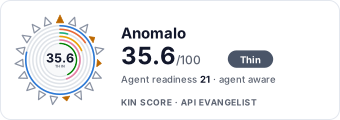 It updates itself when the score changes. Paste this where you link to your API docs:
<a href="https://apis.io/providers/anomalo/"><img src="https://apis.io/badge/anomalo/card.svg" alt="Anomalo on APIs.io — Kin Score by API Evangelist"></a>Other styles, a README pill and a shields.io endpoint are on the badge page.
APIs 19
Individual APIs this provider publishes, each with its own machine-readable definition.
Anomalo MCP Server
Official Anomalo MCP (Model Context Protocol) server, published by Anomalo as a Google Gemini CLI extension under the Apache-2.0 license. Runs locally over stdio against a custo...
Anomalo Access Groups API
The Access Groups API from Anomalo — 10 operation(s) for access groups.
Anomalo API Keys API
The API Keys API from Anomalo — 2 operation(s) for api keys.
Anomalo Check Runs API
The Check Runs API from Anomalo — 2 operation(s) for check runs.
Anomalo Checks API
The Checks API from Anomalo — 9 operation(s) for checks.
Anomalo Document Collections API
Sets of unstructured documents Anomalo monitors and analyzes.
Anomalo Documents API
Individual documents within a collection, and the issues found in them.
Anomalo Exports API
The Exports API from Anomalo — 1 operation(s) for exports.
Anomalo Issues API
Data quality issues detected across an organization's unstructured content.
Anomalo Labels API
The Labels API from Anomalo — 5 operation(s) for labels.
Anomalo Lineage API
The Lineage API from Anomalo — 3 operation(s) for lineage.
Anomalo Notification Channels API
The Notification Channels API from Anomalo — 3 operation(s) for notification channels.
Anomalo Organizations API
The Organizations API from Anomalo — 3 operation(s) for organizations.
Anomalo Sensitive Columns API
The Sensitive Columns API from Anomalo — 2 operation(s) for sensitive columns.
Anomalo System API
The System API from Anomalo — 1 operation(s) for system.
Anomalo Tables API
The Tables API from Anomalo — 10 operation(s) for tables.
Anomalo Tasks API
The Tasks API from Anomalo — 1 operation(s) for tasks.
Anomalo Users API
The Users API from Anomalo — 6 operation(s) for users.
Anomalo Warehouses API
The Warehouses API from Anomalo — 5 operation(s) for warehouses.
Scroll for all 19
Open Collections 2
Open, tool-agnostic API collections (OpenAPI-derived and Bruno).
Anomalo Public API
OPEN COLLECTIONAnomalo Unstructured Data API
OPEN COLLECTIONMCP Servers 1
Model Context Protocol servers that expose these APIs to AI agents.
OpenAPI Overlays 1
Overlays applied on top of this provider's contracts. Each card says who wrote it: a document the provider publishes, or one API Evangelist derived or generated.
Anomalo Public Api Overlay
DERIVEDSecurity Posture 2
Authentication, domain security, vulnerability disclosure, and trust-center signals.
Scopes 1
OAuth scopes governing access to this provider's APIs.
Resources
Get Started 2
Portal, sign-up, and the first successful call
Documentation 1
Reference material describing how the API behaves
Agent Surfaces 4
MCP servers, agent skills, and machine-readable catalogs
Design & Contract 5
Pagination, idempotency, versioning, errors, and events
Build 4
SDKs, sample code, and the tooling you integrate with
Access & Security 4
Authentication, authorization, and security posture
Operate 3
Status, limits, changes, and where to get help
Commercial 2
Pricing, plans, and the legal terms of use
Company 4
The organization behind the API
Other 1
Properties that don't map to a standard resource type
Source (apis.yml)
Work with this as data
Every provider here is available over the APIs.io API and to AI agents over MCP.