Algorand
Algorand is a pure proof-of-stake blockchain platform designed for speed, security, and decentralization. It exposes REST APIs through two core daemons — Algod (the Algorand protocol daemon) for real-time node interaction including submitting transactions, querying account balances, retrieving blocks, and managing smart contracts; and the Indexer daemon for deep historical querying of accounts, assets, applications, transactions, and blocks from a PostgreSQL-backed store. A third daemon, KMD (Key Management Daemon), handles local key storage and signing. Public archival endpoints are freely available via third-party providers such as Nodely/AlgoNode, and the developer toolchain is anchored by AlgoKit with SDKs for Python, JavaScript, Go, and Java.
Algorand publishes 15 API contracts indexed on the APIs.io network, including Common API, Key API, Lookup API, and 12 more. Tagged areas include Blockchain, Cryptocurrency, Proof of Stake, DeFi, and Smart Contracts.
The Algorand catalog on APIs.io includes 1 JSON-LD context and 1 Spectral governance ruleset.
Algorand’s developer surface includes authentication, developer portal, documentation, getting-started guide, CLI, engineering blog, support, and 17 more developer resources.
Kin Score
 Kin Score
How this is scored →
scored 2026-11-06 · rubric v0.27.0
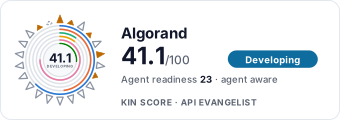 It updates itself when the score changes. Paste this where you link to your API docs:
<a href="https://apis.io/providers/algorand/"><img src="https://apis.io/badge/algorand/card.svg" alt="Algorand on APIs.io — Kin Score by API Evangelist"></a>Other styles, a README pill and a shields.io endpoint are on the badge page.
- MCP Server +12 pts — deployment.mode + probe verdict on the mcp/ manifest, not the pointer; an unprobed slug falls back to authorship
- Idempotency +9 pts — OpenAPI mutating operations declare an idempotency key — a header, a request-body property, or a named de-duplication token whose own description says so (verified); else common[].type matches /idempoten/i (documented)
- A2A Agent Card +8 pts — a2a/
-a2a.yml manifest, graded on conformance.grade against A2A 1.0.0 - Request/Response Examples +7 pts — share of operations carrying request/response examples; else an Examples / Code Samples link
- Registration Without a Human +6 pts — a `registration_endpoint` in the served RFC 8414 / OIDC discovery document
- Delegated User Identity +6 pts — a served discovery document listing authorization_code in grant_types_supported (served), else an oauth2 authorizationCode flow or openIdConnect declared in an OpenAPI (documented)
- Access Clarity scores 26.3 — up to +14.7 composite points
- Contract Quality scores 47.8 — up to +13.1 composite points
- Operational Transparency scores 10.5 — up to +11.6 composite points
Standards implemented 1
Standards this provider implements or carries. De facto ones are profiled and measured by the API Commons; formal ones come from the standards directory and are linked by the provider's own tags. The evidence column says how each claim was established — not that it was made.
APIs 15
Individual APIs this provider publishes, each with its own machine-readable definition.
Algorand KMD REST API
The Key Management Daemon (KMD) REST API provides local key storage and transaction signing for Algorand nodes. It exposes wallet management, key generation, and signing endpoin...
Algorand Common API
The common API from Algorand — 6 operation(s) for common.
Algorand Key API
The Key API from Algorand — 4 operation(s) for key.
Algorand Lookup API
The lookup API from Algorand — 14 operation(s) for lookup.
Algorand Master Key API
The Master Key API from Algorand — 1 operation(s) for master key.
Algorand Multisig API
The Multisig API from Algorand — 6 operation(s) for multisig.
Algorand Private API
The private API from Algorand — 7 operation(s) for private.
Algorand Program API
The Program API from Algorand — 1 operation(s) for program.
Algorand Public API
The public API from Algorand — 43 operation(s) for public.
Algorand Search API
The search API from Algorand — 6 operation(s) for search.
Algorand Swagger.json API
The Swagger.json API from Algorand — 1 operation(s) for swagger.json.
Algorand Transaction API
The Transaction API from Algorand — 1 operation(s) for transaction.
Algorand Versions API
The Versions API from Algorand — 1 operation(s) for versions.
Algorand Wallet API
The Wallet API from Algorand — 6 operation(s) for wallet.
Algorand Wallets API
The Wallets API from Algorand — 1 operation(s) for wallets.
Scroll for all 15
Postman Collections 18
Ready-to-run Postman collections for exercising this provider's APIs.
Algod REST API. common API
POSTMANScroll for all 18
Open Collections 18
Open, tool-agnostic API collections (OpenAPI-derived and Bruno).
Algod REST API. common API
OPEN COLLECTIONAlgod REST API. common data API
OPEN COLLECTIONAlgod REST API. common experimental API
OPEN COLLECTIONAlgod REST API. common Key API
OPEN COLLECTIONAlgod REST API. common lookup API
OPEN COLLECTIONAlgod REST API. common Master Key API
OPEN COLLECTIONAlgod REST API. common Multisig API
OPEN COLLECTIONAlgod REST API. common nonparticipating API
OPEN COLLECTIONAlgod REST API. common participating API
OPEN COLLECTIONAlgod REST API. common private API
OPEN COLLECTIONAlgod REST API. common Program API
OPEN COLLECTIONAlgod REST API. common public API
OPEN COLLECTIONAlgod REST API. common search API
OPEN COLLECTIONAlgod REST API. common Swagger.json API
OPEN COLLECTIONAlgod REST API. common Transaction API
OPEN COLLECTIONAlgod REST API. common Versions API
OPEN COLLECTIONAlgod REST API. common Wallet API
OPEN COLLECTIONAlgod REST API. common Wallets API
OPEN COLLECTIONScroll for all 18
GraphQL 1
GraphQL schemas published by this provider.
Algorand GraphQL Schema
This GraphQL schema provides a unified interface over the Algorand Algod and Indexer REST APIs. The Algorand blockchain exposes two core REST daemons: **Algod** for real-time no...
GRAPHQLAlgorand API pricing
Not yet checked against Algorand's own pricing page. Compiled by API Evangelist on 2026-06-13 from nodely.io/; confirm before you rely on a figure. A free plan or tier is listed.
| Plan | Price |
|---|---|
| Free (No Key Required) free | Free |
| Unlimited (Shared Infrastructure) subscription | $256.00 per monthly subscription / month |
| Business SLA subscription | $256.00 per annual subscription (billed monthly equivalent) / month |
| Enterprise (Dedicated / Analytics) enterprise | — |
Plan details, limits and sources →
Rate limits
- Free tier frontend requests per second: 60 requests per second
- Free tier monthly request quota: 6000000 requests per month
- Free tier monthly data transfer: 150 gb per month
Compiled by API Evangelist, not yet checked against Algorand's documentation. All 7 limits →
Billed by: month · FinOps profile →
Pricing Plans 1
Published pricing tiers and plan structures.
Algorand Plans
PLANSRate Limits 1
Documented rate limits and quota policies.
Algorand Rate Limits
RATE LIMITSService Levels 1
Uptime the provider promises or reports, as SLA4OAI. Read from its own pages; APIs.io runs no monitors.
Algorand
SLAFinOps 1
Cost, billing, and metering signals for API financial operations.
Algorand Finops
FINOPSFeatures 8
Notable capabilities this provider offers.
Real-Time Node Interaction
Algod API provides live access to node state, pending transactions, and block production
Historical Ledger Analytics
Indexer API enables deep search across all historical transactions, accounts, assets, and blocks
Transaction Submission
Submit signed raw transactions or transaction groups directly via the Algod API
Smart Contract Support
Query AVM application state, box storage, and logs; compile and simulate TEAL programs
Asset Management
Query Algorand Standard Assets (ASA) metadata, balances, and transaction history
State Proofs
Retrieve cryptographic state proofs for cross-chain verification and light-client support
Free Public Nodes
Nodely/AlgoNode provides free archival Algod and Indexer endpoints on mainnet and testnet
AlgoKit Toolchain
End-to-end developer toolkit with CLI, LocalNet sandbox, and utility SDKs
Scroll for all 8
Semantic Vocabularies 1
JSON-LD contexts and semantic vocabularies used across these APIs.
Algorand Context
JSON-LDSpectral Rules 1
Spectral governance rulesets for linting and validating these APIs.
Algorand — jsonschema rules
SPECTRALJSON Schema 3
Standalone JSON Schema definitions for this provider's data models.
Examples 2
Example request and response payloads for these APIs.
Algorand Algod Examples
EXAMPLEAlgorand Indexer Examples
EXAMPLESecurity Posture 2
Authentication, domain security, vulnerability disclosure, and trust-center signals.
Agentic Access 1
Recommended x-agentic-access execution contracts for AI agents.
Use Cases 7
What developers build with this provider.
DeFi Application Development
Query on-chain liquidity pools, AMMs, and ASA token balances in real time
NFT Marketplaces
Look up ASA metadata, ownership history, and transfer transactions for NFTs
Block Explorers
Retrieve and display blocks, transactions, and account state via Indexer search APIs
Wallet Integration
Fetch account balances, transaction history, and pending transactions for wallet UIs
Transaction Automation
Construct, sign, and broadcast payment, asset transfer, or application call transactions
Compliance and Auditing
Search historical transactions by address, round, or note field for audit trails
Smart Contract Deployment
Compile TEAL programs, simulate execution, and deploy AVM applications
Scroll for all 7
Integrations 5
Pre-built integrations with other platforms and tools.
AlgoKit
Official Algorand developer toolkit with CLI and SDK utilities for Python and TypeScript
Nodely
Free and commercial archival Algod and Indexer endpoints with global infrastructure
AlgoNode
Legacy free public API endpoints for Algorand mainnet and testnet
Pera Wallet
Reference wallet implementation using Algorand SDKs for transaction signing
Vestige
DeFi analytics platform querying Algorand pools and assets via Indexer
Resources
Get Started 2
Portal, sign-up, and the first successful call
Documentation 1
Reference material describing how the API behaves
Agent Surfaces 1
MCP servers, agent skills, and machine-readable catalogs
Build 8
SDKs, sample code, and the tooling you integrate with
Scroll for all 8
Access & Security 3
Authentication, authorization, and security posture
Operate 2
Status, limits, changes, and where to get help
Commercial 4
Pricing, plans, and the legal terms of use
Company 2
The organization behind the API
Other 1
Properties that don't map to a standard resource type
Source (apis.yml)
Algorand API — frequently asked questions
Does Algorand have an API?
Yes. APIs.io lists 15 APIs from Algorand, including Algorand KMD REST API, Algorand Common API and Algorand Key API, and 12 more.
Is there an OpenAPI specification for the Algorand API?
Yes. APIs.io indexes 14 OpenAPI specifications for Algorand, each linked for download from this page.
How do I authenticate with the Algorand API?
Algorand uses bearer-token authentication (apiKey · 2 schemes). The details are profiled on APIs.io as Algorand Authentication.
How much does the Algorand API cost?
APIs.io lists 4 pricing plans for Algorand, with each plan's price, limits and inclusions under Pricing on this page.
Is the Algorand API ready for AI agents?
Algorand has a Kin Score of 41.1 out of 100 (developing) and an Agent Readiness score of 23.4 (agent-aware), scored by API Evangelist on 2026-11-06.
Work with this as data
Every provider here is available over the APIs.io API and to AI agents over MCP.