aiCTX (now SynSense)
aiCTX AG — renamed SynSense AG in May 2020 — is a neuromorphic computing company founded in Zurich in 2017 out of the Institute of Neuroinformatics at the University of Zurich and ETH Zurich. It designs ultra-low-power mixed-signal neuromorphic processors and smart sensors for always-on, sub-milliwatt edge inference: the Speck and DYNAP-CNN event-driven vision SoCs, the Xylo family for audio and IMU signal processing, and the DVS, Rigi and AEVEON sensor series. Its developer surface is a stack of open-source Python libraries rather than a product web API — Samna (the device interface and runtime), Rockpool (spiking network training and deployment) and Sinabs (PyTorch spiking CNNs) — backed by a developer community, forum, and firmware and datasheet download hub at synsense.ai. The one HTTP API the company serves publicly is the anonymous, read-only WordPress REST content API behind that corporate site, which exposes its products, partners, offices, awards, open roles and news as machine-readable JSON.
aiCTX (now SynSense) publishes 1 API contract indexed on the APIs.io network. Tagged areas include Company, Neuromorphic Computing, Artificial Intelligence, Semiconductors, and Edge Computing.
aiCTX (now SynSense)’s developer surface includes documentation, API reference, getting-started guide, support, engineering blog, changelog, authentication, and 23 more developer resources.
Kin Score
 Kin Score
How this is scored →
Kin Score
How this is scored →scored 2026-10-23 · rubric v0.25.0
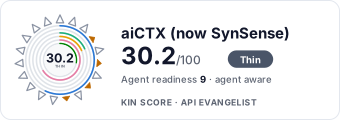 It updates itself when the score changes. Paste this where you link to your API docs:
<a href="https://apis.io/providers/aictx/"><img src="https://apis.io/badge/aictx/card.svg" alt="aiCTX (now SynSense) on APIs.io — Kin Score by API Evangelist"></a>Other styles, a README pill and a shields.io endpoint are on the badge page.
Markets this provider is in provisional
The Kin Score Market layer reads a provider inside its market: its position, and how deep its integrations go. Depth is only comparable within a position. Provisional and unweighted: not part of the Kin Score or agent readiness.
| Market | Position | Depth | Registered MCP server | Declares compatibility |
|---|---|---|---|---|
| Semiconductor Consortia (RISC-V, OCP hardware, CHIPS awards) | undeclared | - | - | - |
Registered MCP server and declares compatibility are report only — not weighted. Undeclared means we found nothing we can read, so there is no number: we never infer integrations.
APIs 1
Individual APIs this provider publishes, each with its own machine-readable definition.
aiCTX (now SynSense) Website (WordPress REST)
The public WordPress REST API (wp-json) of the aiCTX (now SynSense) website at www.synsense.ai: the route index of the site's content management system, catalogued as one site s...
Pricing Plans 1
Published pricing tiers and plan structures.
Aictx Plans Pricing
PLANSRate Limits 1
Documented rate limits and quota policies.
Aictx Rate Limits
RATE LIMITSOpenAPI Overlays 1
Overlays applied on top of this provider's contracts. Each card says who wrote it: a document the provider publishes, or one API Evangelist derived or generated.
Security Posture 2
Authentication, domain security, vulnerability disclosure, and trust-center signals.
Resources
Get Started 3
Portal, sign-up, and the first successful call
Documentation 2
Reference material describing how the API behaves
Agent Surfaces 4
MCP servers, agent skills, and machine-readable catalogs
Design & Contract 5
Pagination, idempotency, versioning, errors, and events
Build 3
SDKs, sample code, and the tooling you integrate with
Access & Security 2
Authentication, authorization, and security posture
Operate 4
Status, limits, changes, and where to get help
Commercial 3
Pricing, plans, and the legal terms of use
Company 3
The organization behind the API
Other 1
Properties that don't map to a standard resource type
Source (apis.yml)
Work with this as data
Every provider here is available over the APIs.io API and to AI agents over MCP.