
Abnormal AI
Abnormal AI (formerly Abnormal Security) is a San Francisco based cloud email and human-behavior security company whose behavioral AI platform protects Microsoft 365 and Google Workspace against phishing, business email compromise, vendor fraud, account takeover and misdirected email. The platform is API-first: it integrates with Microsoft and Google over their APIs rather than by rewriting MX records, and every capability in the Abnormal Portal — threats, cases, AI Security Mailbox, employee and vendor insights, audit logs, RBAC roles and users, security posture management and dashboard aggregations — is also reachable through the Abnormal Security Client API, a bearer-token REST API published as OpenAPI 3.0.3 on SwaggerHub with separate US and EU production hosts. Abnormal also streams the same event data to SIEM and SOAR platforms over near-real-time webhooks.
Abnormal AI publishes 17 API contracts indexed on the APIs.io network, including AI Security Mailbox (formerly known as Abuse Mailbox) API, Audit Logs API, Cases API, and 14 more. Tagged areas include Company, Security, Email Security, Cybersecurity, and Threat Intelligence.
The Abnormal AI catalog on APIs.io includes 1 event-driven AsyncAPI specification.
Abnormal AI’s developer surface includes documentation, API reference, getting-started guide, support, engineering blog, signup flow, authentication, and 29 more developer resources.
What this lets a business do 1
Business capabilities this provider's published APIs can perform, derived from its own contracts. Browse all capabilities →
Kin Score
 Kin Score
How this is scored →
Kin Score
How this is scored →scored 2026-10-23 · rubric v0.25.0
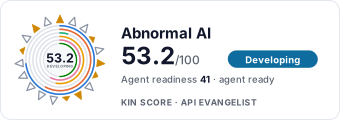 It updates itself when the score changes. Paste this where you link to your API docs:
<a href="https://apis.io/providers/abnormal/"><img src="https://apis.io/badge/abnormal/card.svg" alt="Abnormal AI on APIs.io — Kin Score by API Evangelist"></a>Other styles, a README pill and a shields.io endpoint are on the badge page.
Markets this provider is in provisional
The Kin Score Market layer reads a provider inside its market: its position, and how deep its integrations go. Depth is only comparable within a position. Provisional and unweighted: not part of the Kin Score or agent readiness.
| Market | Position | Depth | Registered MCP server | Declares compatibility |
|---|---|---|---|---|
| Cloud Security Attestation and Secure-by-Design | undeclared | - | - | - |
Registered MCP server and declares compatibility are report only — not weighted. Undeclared means we found nothing we can read, so there is no number: we never infer integrations.
APIs 17
Individual APIs this provider publishes, each with its own machine-readable definition.
Abnormal AI AI Security Mailbox (formerly known as Abuse Mailbox) API
API to manage AI Security Mailbox (formerly known as Abuse Mailbox)
Abnormal AI Audit Logs API
API to retrieve audit logs for Portal
Abnormal AI Cases API
APIs to manage Abnormal Cases
Abnormal AI Dashboard Aggregations API
APIs to manage Dashboard metrics
Abnormal AI Detection360 API
The Detection360 API from Abnormal AI — 1 operation(s) for detection360.
Abnormal AI Employee Insights API
API to manage employees
Abnormal AI Messages API
API to manage message details
Abnormal AI Resources API
The Resources API from Abnormal AI — 5 operation(s) for resources.
Abnormal AI Roles API
API to retrieve roles from RBAC system
Abnormal AI Search and Respond API
The Search and Respond API from Abnormal AI — 6 operation(s) for search and respond.
Abnormal AI Security Settings API
API to retrieve security settings including session timeout configuration
Abnormal AI SPM API
The SPM API from Abnormal AI — 6 operation(s) for spm.
Abnormal AI Threats API
APIs to manage threats notified in the Abnormal Threat Log
Abnormal AI Tokens API
API to manage SOAR API tokens
Abnormal AI URL Rewrite API
The URL Rewrite API from Abnormal AI — 1 operation(s) for url rewrite.
Abnormal AI Users API
API to retrieve users from RBAC system
Abnormal AI Vendors API
API to manage Vendorbase and threats from Vendors
Scroll for all 17
Open Collections 17
Open, tool-agnostic API collections (OpenAPI-derived and Bruno).
Abnormal Security Client Audit Logs API
OPEN COLLECTIONAbnormal Security Client Cases API
OPEN COLLECTIONAbnormal Security Client Dashboard Aggregations API
OPEN COLLECTIONAbnormal Security Client Detection360 API
OPEN COLLECTIONAbnormal Security Client Employee Insights API
OPEN COLLECTIONAbnormal Security Client Messages API
OPEN COLLECTIONAbnormal Security Client Resources API
OPEN COLLECTIONAbnormal Security Client Roles API
OPEN COLLECTIONAbnormal Security Client Search and Respond API
OPEN COLLECTIONAbnormal Security Client Security Settings API
OPEN COLLECTIONAbnormal Security Client SPM API
OPEN COLLECTIONAbnormal Security Client Threats API
OPEN COLLECTIONAbnormal Security Client Tokens API
OPEN COLLECTIONAbnormal Security Client URL Rewrite API
OPEN COLLECTIONAbnormal Security Client Users API
OPEN COLLECTIONAbnormal Security Client Vendors API
OPEN COLLECTIONScroll for all 17
Event Specifications 1
AsyncAPI definitions for this provider's event-driven and streaming APIs.
Abnormal Webhooks
ASYNCAPIOpenAPI Overlays 1
Overlays applied on top of this provider's contracts. Each card says who wrote it: a document the provider publishes, or one API Evangelist derived or generated.
Abnormal Client Api Overlay
DERIVEDSecurity Posture 4
Authentication, domain security, vulnerability disclosure, and trust-center signals.
Abnormal Trust Center
SOC 2, ISO/IEC 27001, ISO/IEC 27701, ISO/IEC 42001:2023, CSA STAR, FedRAMP Moderate, GovRAMP, TX-RAMP, CMMC, Cyber Essentials Plus, CJIS, ITAR, VPAT
SECURITYResources
Get Started 4
Portal, sign-up, and the first successful call
Documentation 2
Reference material describing how the API behaves
Agent Surfaces 4
MCP servers, agent skills, and machine-readable catalogs
Design & Contract 6
Pagination, idempotency, versioning, errors, and events
Build 2
SDKs, sample code, and the tooling you integrate with
Access & Security 6
Authentication, authorization, and security posture
Operate 4
Status, limits, changes, and where to get help
Commercial 2
Pricing, plans, and the legal terms of use
Company 2
The organization behind the API
Other 4
Properties that don't map to a standard resource type
Source (apis.yml)
Work with this as data
Every provider here is available over the APIs.io API and to AI agents over MCP.