Xanadu is a Canadian photonic quantum computing company building room-temperature, fault-tolerant, scalable quantum computers based on photonic continuous-variable (CV) and Gaussian boson sampling architectures. Xanadu maintains a large open-source software stack — most notably PennyLane (the cross-platform framework for quantum differentiable programming, quantum chemistry, and quantum machine learning), Catalyst (a JIT/MLIR compiler for hybrid quantum-classical programs), the PennyLane Lightning family of high-performance state-vector and tensor-network simulators, the PennyLane Plugin ecosystem (Qiskit/IBM, AWS Braket, Cirq, Rigetti, IonQ, AQT, Quantinuum, Qulacs, ProjectQ, and Xanadu's own Strawberry Fields), MrMustard, Jet, FlamingPy, The Walrus, Blackbird (the CV quantum assembly language), XIR, and the Xanadu Quantum Codebook. Xanadu hardware milestones include the X8 photonic chip, Borealis (quantum advantage demonstration on a 216-mode programmable Gaussian boson sampler), and Aurora (the first modular, networked photonic quantum computer combining server racks and kilometres of optical fibre). The Xanadu Cloud — the original photonic-hardware-as-a-service offering with REST/Python/CLI access to Borealis and X8 — has been retired (the `xanadu-cloud-client` and Strawberry Fields repos are archived), and Xanadu's developer-facing surface today centres on the PennyLane Python ecosystem and hardware execution via PennyLane plugins against partner cloud platforms.
Xanadu is listed with 14 APIs on the APIs.io network. Tagged areas include Quantum Computing, Photonic Quantum, Quantum Machine Learning, Quantum Chemistry, and Differentiable Programming.
Xanadu’s developer surface includes developer portal, documentation, getting-started guide, support, engineering blog, YouTube channel, release notes, and 28 more developer resources.
Regulatory Posture applies to this provider. Its tags matched the
Horizontal (data, software, accessibility, platform) regime, so
Regulatory Posture carries 15 points of the composite.
If this regime is wrong for your business, say so on your
provider repo — the
applicability map is public and we will correct it.
Open Source Surface applies to this provider. This product is open source and we
read its repository directly, so Open Source Surface carries
10 points of the composite. It is scored from what the repository actually
publishes — a security policy, a contribution guide, a release history, a code of conduct — read live from the
provider rather than inferred from our own catalog pointers.
This facet adds; nothing was taken away to make room for it. An open-source project is not excused from
the commercial facets, because exemption would strip it of the points it does earn.
If we have the wrong repository, or this product is not open source, say so on your
provider repo and we
will drop the facet rather than have you publish against it.
Create-or-Update Ergonomics could not be measured. We hold no machine-readable contract for
this provider to read, so there is nothing to measure a write surface against. Excluded rather than scored zero:
never-measured and measured-empty are different facts. Publishing an OpenAPI is what makes this facet — and
several others — scorable at all.
The six quality facets above are damped to 75 points between them,
because both conditional facets apply and carry
25 points together. That is why each facet's contribution is shown against a damped
maximum: raising a quality facet moves the composite by 75% of its nominal
weight, not 100%. The full arithmetic is at apis.io/rating/.
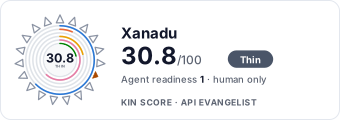
Show this score on your site.
It updates itself when the score changes. Paste this where you link to your API docs:
<a href="https://apis.io/providers/xanadu-ai/"><img src="https://apis.io/badge/xanadu-ai/card.svg" alt="Xanadu on APIs.io — Kin Score by API Evangelist"></a>
Other styles, a README pill and a shields.io endpoint are on the badge page.
Raise your score.
Agent readiness — checks not met, largest first (exact, from this profile):
Machine-Readable Auth+10 pts — a served openid-configuration/oauth-authorization-server carrying `issuer` (served), else the securitySchemes class in the provider OpenAPIs — bound (mutualTLS, DPoP, Signature) > negotiable (oauth2 authorizationCode/clientCredentials, openIdConnect) > bearer (http bearer, apiKey) Ask about this →
Idempotency+9 pts — OpenAPI mutating operations declare an idempotency key — a header, a request-body property, or a named de-duplication token whose own description says so (verified); else common[].type matches /idempoten/i (documented) Ask about this →
Stable Error Semantics+8 pts — OpenAPI $refs a shared error schema across 4xx/5xx responses (verified), else common[].type includes ErrorCatalog / ErrorCodes / DeclineCodes Ask about this →
12 more unmet checks in the Agent Readiness table above.
Kin Score — facets with the most composite points still available (weight × headroom):
Each check links to what satisfies it. Publish the artifact, or tell us where it already lives, and the score moves on the next scoring run.
Not sure how this applies to your stack? Ask about any one item. Kin Lane reads every question, looks at your profile and your situation, and replies with what a fix would take — scoped to that one area, priced up front, yours whether you ship it or not. Ask a question →
The Kin Score Market layer reads a provider inside its market:
its position, and how deep its integrations go. Depth is only comparable within a position. Provisional and unweighted:
not part of the Kin Score or agent readiness.
Registered MCP server and declares compatibility are report only — not weighted.
Undeclared means we found nothing we can read, so there is no number: we never infer integrations.
PennyLane is the flagship open-source Python framework for quantum differentiable programming — train and optimize variational quantum circuits with the same automatic different...
Catalyst is a JIT compiler for hybrid quantum programs written in PennyLane. The `@qjit` decorator compiles entire quantum-classical workflows — including conditionals, loops, a...
The Lightning plugin family — `lightning.qubit` (C++ CPU), `lightning.gpu` (cuQuantum), and `lightning.kokkos` (multi-architecture HPC) — provides Xanadu's fast state-vector and...
The PennyLane plugin layer exposes a uniform `qml.device` interface across third-party quantum SDKs and QPU clouds — IBM Qiskit / IBM Quantum, AWS Braket, Google Cirq, Rigetti F...
`qml.qchem` is PennyLane's quantum chemistry submodule for constructing molecular Hamiltonians, differentiable Hartree-Fock, VQE workflows, and resource estimation against fault...
MrMustard is a differentiable simulator that acts as a bridge between phase-space and Fock-space representations of bosonic / CV quantum systems. Built for design and optimizati...
The Walrus is a high-performance C++/Python library for computing hafnians, loop hafnians, Hermite polynomials, and Gaussian boson sampling probabilities — the numerical backbon...
Jet is a cross-platform C++ library for simulating quantum circuits via tensor-network contractions, with task-based parallelism for HPC-scale workloads.
FlamingPy is a Python library with multiple backends for efficient simulation of error correction in fault-tolerant photonic quantum architectures, including GKP-encoded qubit c...
Blackbird is Xanadu's quantum assembly language for continuous-variable photonic quantum computation. Programs target Strawberry Fields simulators and were historically deployed...
XIR is an intermediate representation language for quantum circuits, designed to ferry circuits between front-end frameworks (Strawberry Fields, PennyLane) and backend hardware/...
An interactive, free, browser-based quantum computing course built on PennyLane. Covers introductory quantum computing, single- and multi-qubit systems, quantum algorithms, and ...
Calls without X-API-Key need no key. Calls with it need a paid plan — get a key.
Get an API key
Free tier, no form to fill in. Signing in shares your email address with us — we
store it to create your key and to recognise you if you sign in with another
provider. See our Privacy Policy and
Terms.
 Kin Score
How this is scored →
 It updates itself when the score changes. Paste this where you link to your API docs: