Vector
Vector is an open source high-performance observability data pipeline from Datadog for collecting, transforming, and routing logs, metrics, and traces. Built in Rust for performance and reliability, Vector supports 50+ sources, 20+ transforms, and 80+ sinks. It provides a built-in API for health monitoring and component inspection, plus Vector Remap Language (VRL) for powerful data transformation.
Vector is listed with 3 APIs on the APIs.io network, including Health API, and 2 more. Tagged areas include Data Pipeline, Logs, Metrics, Observability, and Open Source.
The Vector catalog on APIs.io includes 1 JSON-LD context and 2 Spectral governance rulesets.
Vector’s developer surface includes documentation, release notes, engineering blog, Stack Overflow tag, and 15 more developer resources.
Kin Score
 Kin Score
How this is scored →
Kin Score
How this is scored →scored 2026-10-23 · rubric v0.25.0
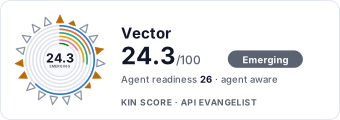 It updates itself when the score changes. Paste this where you link to your API docs:
<a href="https://apis.io/providers/vector/"><img src="https://apis.io/badge/vector/card.svg" alt="Vector on APIs.io — Kin Score by API Evangelist"></a>Other styles, a README pill and a shields.io endpoint are on the badge page.
Markets this provider is in provisional
The Kin Score Market layer reads a provider inside its market: its position, and how deep its integrations go. Depth is only comparable within a position. Provisional and unweighted: not part of the Kin Score or agent readiness.
| Market | Position | Depth | Registered MCP server | Declares compatibility |
|---|---|---|---|---|
| OpenSSF Best Practices Badge Holders | undeclared | - | - | - |
| Artifact Hub Cloud-Native Packages | undeclared | - | - | - |
Registered MCP server and declares compatibility are report only — not weighted. Undeclared means we found nothing we can read, so there is no number: we never infer integrations.
APIs 3
Individual APIs this provider publishes, each with its own machine-readable definition.
Vector Remap Language (VRL)
Vector Remap Language (VRL) is a purpose-built expression language for transforming observability data in Vector. Provides 100+ built-in functions for parsing, filtering, enrich...
Vector Helm Charts
Official Helm charts for deploying Vector on Kubernetes as a DaemonSet (agent mode) or Deployment (aggregator mode).
Vector Health API
Health check endpoints for load balancers and Kubernetes probes.
Open Collections 2
Open, tool-agnostic API collections (OpenAPI-derived and Bruno).
Vector Observability Health API
OPEN COLLECTIONVector Observability API
OPEN COLLECTIONPricing Plans 1
Published pricing tiers and plan structures.
Vector Plans Pricing
PLANSRate Limits 1
Documented rate limits and quota policies.
Vector Rate Limits
RATE LIMITSFinOps 1
Cost, billing, and metering signals for API financial operations.
Vector Finops
FINOPSFeatures 8
Notable capabilities this provider offers.
High-Performance Pipeline
Built in Rust with benchmarks showing 86+ MiB/s throughput for log pipeline workloads.
Unified Data Plane
Single binary handles logs, metrics, and traces from collection through routing.
50+ Sources
Native integrations for files, Kafka, Kubernetes, AWS S3/CloudWatch, Splunk, and more.
80+ Sinks
Route data to Elasticsearch, Datadog, S3, BigQuery, Splunk, Loki, and many more destinations.
Vector Remap Language (VRL)
Purpose-built expression language with 100+ functions for transforming observability data.
Observability API
Built-in HTTP/gRPC API for health checks and component inspection (must be explicitly enabled).
Kubernetes Native
Deploy as DaemonSet (agent) or Deployment (aggregator) with official Helm charts.
Agent and Aggregator Modes
Run as a lightweight agent on each node or as a centralized aggregator for fan-in routing.
Scroll for all 8
Semantic Vocabularies 1
JSON-LD contexts and semantic vocabularies used across these APIs.
Spectral Rules 2
Spectral governance rulesets for linting and validating these APIs.
Vector — jsonschema rules
SPECTRALVector API Rules
SPECTRALJSON Schema 1
Standalone JSON Schema definitions for this provider's data models.
HealthResponse
JSON SCHEMAJSON Structure 1
JSON Structure definitions describing this provider's data shapes.
Vector Observability Api Health Response Structure
JSON STRUCTUREExamples 1
Example request and response payloads for these APIs.
Security Posture 1
Authentication, domain security, vulnerability disclosure, and trust-center signals.
Agentic Access 1
Recommended x-agentic-access execution contracts for AI agents.
Use Cases 7
What developers build with this provider.
Log Pipeline Unification
Replace multiple log shippers with a single Vector pipeline for all log collection and routing.
Observability Cost Reduction
Filter, sample, and transform data before sending to expensive SaaS observability platforms.
Vendor Switching
Route observability data to multiple backends simultaneously to facilitate migration.
Kubernetes Log Collection
Deploy Vector as a DaemonSet to collect container logs from all Kubernetes nodes.
Log Enrichment
Parse, enrich, and normalize log events using VRL before routing to downstream systems.
Metrics Collection
Collect host and service metrics using Vector's built-in sources and forward to Prometheus or DataDog.
Splunk Cost Reduction
Use Vector to filter and route Splunk data to reduce indexing volume and licensing costs.
Scroll for all 7
Integrations 8
Pre-built integrations with other platforms and tools.
Datadog
Native Datadog logs and metrics sink; Vector was created and is maintained by Datadog.
Elasticsearch
Elasticsearch sink for forwarding logs and metrics to Elasticsearch clusters.
Splunk HEC
Splunk HTTP Event Collector sink for sending data to Splunk Enterprise and Cloud.
Kafka
Kafka source and sink for consuming and producing observability data streams.
AWS S3
S3 sink for archiving logs and metrics to Amazon S3 for long-term storage.
Grafana Loki
Loki sink for forwarding logs to Grafana's log aggregation system.
Prometheus
Prometheus remote write sink and scrape source for metrics pipelines.
Kubernetes
Kubernetes source for collecting container logs, pod metadata, and events.
Scroll for all 8
Resources
Documentation 2
Reference material describing how the API behaves
Agent Surfaces 1
MCP servers, agent skills, and machine-readable catalogs
Design & Contract 2
Pagination, idempotency, versioning, errors, and events
Build 3
SDKs, sample code, and the tooling you integrate with
Access & Security 1
Authentication, authorization, and security posture
Operate 5
Status, limits, changes, and where to get help
Commercial 3
Pricing, plans, and the legal terms of use
Company 2
The organization behind the API
Source (apis.yml)
Work with this as data
Every provider here is available over the APIs.io API and to AI agents over MCP.