United States Postal Service
The United States Postal Service (USPS) provides a modern REST API platform at developers.usps.com that gives ecommerce websites, shipping software, and logistics systems access to postal data and services. APIs cover address validation, package tracking, domestic and international shipping labels, pricing, carrier pickup scheduling, location finding, and Informed Delivery campaign management. The legacy Web Tools platform was retired January 25, 2026, with all functionality migrated to the new OAuth 2.0-secured API platform.
United States Postal Service publishes 12 API contracts indexed on the APIs.io network, including Addresses API, Carrier Pickup API, Domestic Prices API, and 9 more. Tagged areas include Government, Postal Service, Shipping, Logistics, and Address Validation.
The United States Postal Service catalog on APIs.io includes 4 JSON-LD contexts and 2 Spectral governance rulesets.
United States Postal Service’s developer surface includes authentication, developer portal, getting-started guide, documentation, FAQ, support, engineering blog, and 12 more developer resources.
Kin Score
 Kin Score
How this is scored →
Kin Score
How this is scored →scored 2026-10-23 · rubric v0.25.0
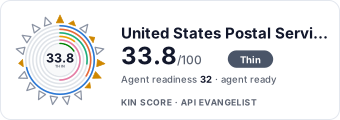 It updates itself when the score changes. Paste this where you link to your API docs:
<a href="https://apis.io/providers/usps/"><img src="https://apis.io/badge/usps/card.svg" alt="United States Postal Service on APIs.io — Kin Score by API Evangelist"></a>Other styles, a README pill and a shields.io endpoint are on the badge page.
Markets this provider is in provisional
The Kin Score Market layer reads a provider inside its market: its position, and how deep its integrations go. Depth is only comparable within a position. Provisional and unweighted: not part of the Kin Score or agent readiness.
| Market | Position | Depth | Registered MCP server | Declares compatibility |
|---|---|---|---|---|
| Shipping and Logistics | undeclared | - | - | - |
Registered MCP server and declares compatibility are report only — not weighted. Undeclared means we found nothing we can read, so there is no number: we never infer integrations.
APIs 12
Individual APIs this provider publishes, each with its own machine-readable definition.
USPS International Prices API
Provides pricing for international USPS products based on shipment characteristics including destination country, weight, dimensions, and service class.
USPS Domestic Labels API
Creates domestic shipping labels with barcodes in multiple formats and generates Shipping Services Files. Requires USPS Ship enrollment and Enterprise Payment Account.
USPS International Labels API
Creates international shipping labels and generates required Shipping Services Files for customs compliance.
USPS Locations API
Identifies drop-off facilities and destination entry points for various USPS services. Supports post office locator and drop-off location finder.
USPS Service Standards API
Provides delivery benchmarks showing expected transit times between origin and destination ZIP Codes for USPS mail classes.
USPS Shipping Options API
Returns a comprehensive list of pricing, service standards, and shipping options for USPS products in a single API call, eliminating the need to query multiple APIs separately.
USPS SCAN Forms API
Links multiple domestic and international labels through a single electronic file number, creating Shipment Confirmation Acceptance Notice forms for batch shipping operations.
USPS OAuth API
Industry-standard OAuth 2.0 Client Credentials authentication protecting access to all USPS APIs. Returns Bearer Tokens used in the Authorization header for all USPS API calls.
United States Postal Service Addresses API
Address validation and standardization operations
United States Postal Service Carrier Pickup API
Schedule and manage USPS carrier pickup requests
United States Postal Service Domestic Prices API
Domestic postage pricing and rate calculation operations
United States Postal Service Tracking API
Package tracking status and event operations
Scroll for all 12
Open Collections 8
Open, tool-agnostic API collections (OpenAPI-derived and Bruno).
USPS Addresses API
OPEN COLLECTIONUSPS Addresses API
OPEN COLLECTIONUSPS Addresses Carrier Pickup API
OPEN COLLECTIONUSPS Carrier Pickup API
OPEN COLLECTIONUSPS Addresses Domestic Prices API
OPEN COLLECTIONUSPS Domestic Prices API
OPEN COLLECTIONUSPS Addresses Tracking API
OPEN COLLECTIONUSPS Tracking API
OPEN COLLECTIONScroll for all 8
Pricing Plans 1
Published pricing tiers and plan structures.
Rate Limits 1
Documented rate limits and quota policies.
United States Postal Service Rate Limits
RATE LIMITSFinOps 1
Cost, billing, and metering signals for API financial operations.
Features 8
Notable capabilities this provider offers.
OAuth 2.0 Authentication
Secure API access using industry-standard OAuth 2.0 Client Credentials flow with Bearer Token authentication.
RESTful Architecture
All APIs follow RESTful conventions with JSON request and response bodies.
Sandbox Testing Environment
Testing Environment for Mailers (TEM) at apis-tem.usps.com for safe API testing before going to production.
Address Standardization
USPS Coding Accuracy Support System (CASS) compliant address validation and standardization.
Delivery Point Validation
DPV confirmation codes ensure packages can be delivered to the validated address.
Real-Time Tracking
Live package tracking with scan events, timestamps, and location details from USPS systems.
Webhook Subscriptions
Event-driven subscription APIs for tracking events, adjustments, and disputes delivered via webhooks.
Batch Processing
Support for bulk operations including multiple tracking lookups and SCAN Form generation.
Scroll for all 8
Semantic Vocabularies 4
JSON-LD contexts and semantic vocabularies used across these APIs.
Spectral Rules 2
Spectral governance rulesets for linting and validating these APIs.
JSON Schema 18
Standalone JSON Schema definitions for this provider's data models.
Address
JSON SCHEMACityState
JSON SCHEMAZIPCodeResult
JSON SCHEMAPickupAddress
JSON SCHEMAPickupPackage
JSON SCHEMAPickupRequest
JSON SCHEMAPickupResponse
JSON SCHEMAPickupUpdateRequest
JSON SCHEMABaseRateRequest
JSON SCHEMAExtraServiceRateRequest
JSON SCHEMAExtraServiceRateResponse
JSON SCHEMARateResponse
JSON SCHEMATotalRateRequest
JSON SCHEMATotalRateResponse
JSON SCHEMAMultipleTrackingRequest
JSON SCHEMAMultipleTrackingResult
JSON SCHEMATrackingEvent
JSON SCHEMATrackingResult
JSON SCHEMAScroll for all 18
JSON Structure 18
JSON Structure definitions describing this provider's data shapes.
Addresses Address Structure
JSON STRUCTUREAddresses City State Structure
JSON STRUCTUREAddresses Zip Code Result Structure
JSON STRUCTURECarrier Pickup Pickup Address Structure
JSON STRUCTURECarrier Pickup Pickup Package Structure
JSON STRUCTURECarrier Pickup Pickup Request Structure
JSON STRUCTURECarrier Pickup Pickup Response Structure
JSON STRUCTURECarrier Pickup Pickup Update Request Structure
JSON STRUCTUREDomestic Prices Base Rate Request Structure
JSON STRUCTUREDomestic Prices Extra Service Rate Request Structure
JSON STRUCTUREDomestic Prices Extra Service Rate Response Structure
JSON STRUCTUREDomestic Prices Rate Response Structure
JSON STRUCTUREDomestic Prices Total Rate Request Structure
JSON STRUCTUREDomestic Prices Total Rate Response Structure
JSON STRUCTURETracking Multiple Tracking Request Structure
JSON STRUCTURETracking Multiple Tracking Result Structure
JSON STRUCTURETracking Tracking Event Structure
JSON STRUCTURETracking Tracking Result Structure
JSON STRUCTUREScroll for all 18
Examples 18
Example request and response payloads for these APIs.
Addresses Address Example
EXAMPLEAddresses City State Example
EXAMPLEScroll for all 18
Security Posture 3
Authentication, domain security, vulnerability disclosure, and trust-center signals.
Agentic Access 1
Recommended x-agentic-access execution contracts for AI agents.
Use Cases 8
What developers build with this provider.
E-Commerce Shipping Integration
Calculate shipping rates, generate labels, and provide package tracking directly within e-commerce checkout flows.
Address Verification at Checkout
Validate and standardize customer addresses during checkout to reduce failed deliveries and return rates.
Shipping Label Generation
Programmatically create domestic and international USPS shipping labels with barcodes for fulfillment operations.
Carrier Pickup Automation
Schedule and manage USPS carrier pickups automatically based on order fulfillment triggers.
Logistics Rate Shopping
Compare USPS service options and pricing to select the most cost-effective shipping method.
Delivery Time Estimation
Display accurate expected delivery dates to customers using USPS service standards data.
Post Office Finder
Help customers locate the nearest USPS facility for drop-offs or in-person services.
Informed Delivery Campaigns
Enhance customer engagement by adding digital content to mail pieces viewed through Informed Delivery.
Scroll for all 8
Integrations 6
Pre-built integrations with other platforms and tools.
Shopify
USPS shipping integration available through Shopify Shipping for label generation and rate calculation.
WooCommerce
WooCommerce shipping plugins integrate USPS APIs for rate calculation and label printing.
Magento
Adobe Commerce and Magento integrate USPS for shipping rate display and fulfillment.
ShipStation
ShipStation multi-carrier shipping platform integrates USPS APIs for ecommerce fulfillment.
EasyPost
EasyPost shipping API aggregator provides access to USPS services alongside other carriers.
Stamps.com
Stamps.com and Pitney Bowes shipping platforms integrate USPS APIs for postage and label printing.
Resources
Get Started 2
Portal, sign-up, and the first successful call
Documentation 1
Reference material describing how the API behaves
Agent Surfaces 1
MCP servers, agent skills, and machine-readable catalogs
Design & Contract 2
Pagination, idempotency, versioning, errors, and events
Build 2
SDKs, sample code, and the tooling you integrate with
Access & Security 2
Authentication, authorization, and security posture
Operate 3
Status, limits, changes, and where to get help
Commercial 3
Pricing, plans, and the legal terms of use
Company 3
The organization behind the API
Source (apis.yml)
Work with this as data
Every provider here is available over the APIs.io API and to AI agents over MCP.