Thales
Thales is a global technology leader providing advanced solutions for aerospace, defense, security, and digital identity. The company designs and integrates cutting‑edge systems ranging from secure communications and cyber‑defense to critical infrastructure protection and digital transformation services. With a presence in over 50 countries, Thales serves governments, enterprises, and individuals, delivering trusted technologies that safeguard data, assets, and people across complex environments.
Thales is profiled on the APIs.io network. Tagged areas include Company, Technology, Aerospace, Defense, and Digital Identity.
Thales’ developer surface includes documentation and 12 more developer resources.
Kin Score
 Kin Score
How this is scored →
scored 2026-10-23 · rubric v0.25.0
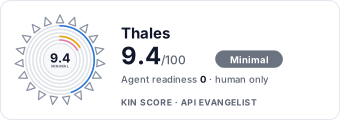 It updates itself when the score changes. Paste this where you link to your API docs:
<a href="https://apis.io/providers/thalesgroup/"><img src="https://apis.io/badge/thalesgroup/card.svg" alt="Thales on APIs.io — Kin Score by API Evangelist"></a>Other styles, a README pill and a shields.io endpoint are on the badge page.
Markets this provider is in provisional
The Kin Score Market layer reads a provider inside its market: its position, and how deep its integrations go. Depth is only comparable within a position. Provisional and unweighted: not part of the Kin Score or agent readiness.
| Market | Position | Depth | Registered MCP server | Declares compatibility |
|---|---|---|---|---|
| Infrastructure-as-Code Provider Registries (Terraform, OpenTofu, Pulumi) | undeclared | - | - | - |
| Common Criteria Certified Products (ISO/IEC 15408, NIAP Product Compliant List) | undeclared | - | - | - |
| Vulnerability Disclosure (CVE Numbering Authorities, FIRST member teams; CISA KEV exposure) | undeclared | - | - | - |
| Configuration-Management Content Registries (Ansible Galaxy, Chef Supermarket) | undeclared | - | - | - |
| OpenSSF Best Practices Badge Holders | undeclared | - | - | - |
| Red Hat Certified Ecosystem (certified partner containers + certified OpenShift operators) | undeclared | - | - | - |
| NIST CMVP FIPS 140 Validated Cryptographic Modules (FIPS 140-1 / 140-2 / 140-3) | undeclared | - | - | - |
Registered MCP server and declares compatibility are report only — not weighted. Undeclared means we found nothing we can read, so there is no number: we never infer integrations.
Security Posture 2
Authentication, domain security, vulnerability disclosure, and trust-center signals.
Resources
Documentation 1
Reference material describing how the API behaves
Agent Surfaces 1
MCP servers, agent skills, and machine-readable catalogs
Build 3
SDKs, sample code, and the tooling you integrate with
Access & Security 4
Authentication, authorization, and security posture
Company 2
The organization behind the API
Other 2
Properties that don't map to a standard resource type
Source (apis.yml)
Work with this as data
Every provider here is available over the APIs.io API and to AI agents over MCP.