Testerarmy
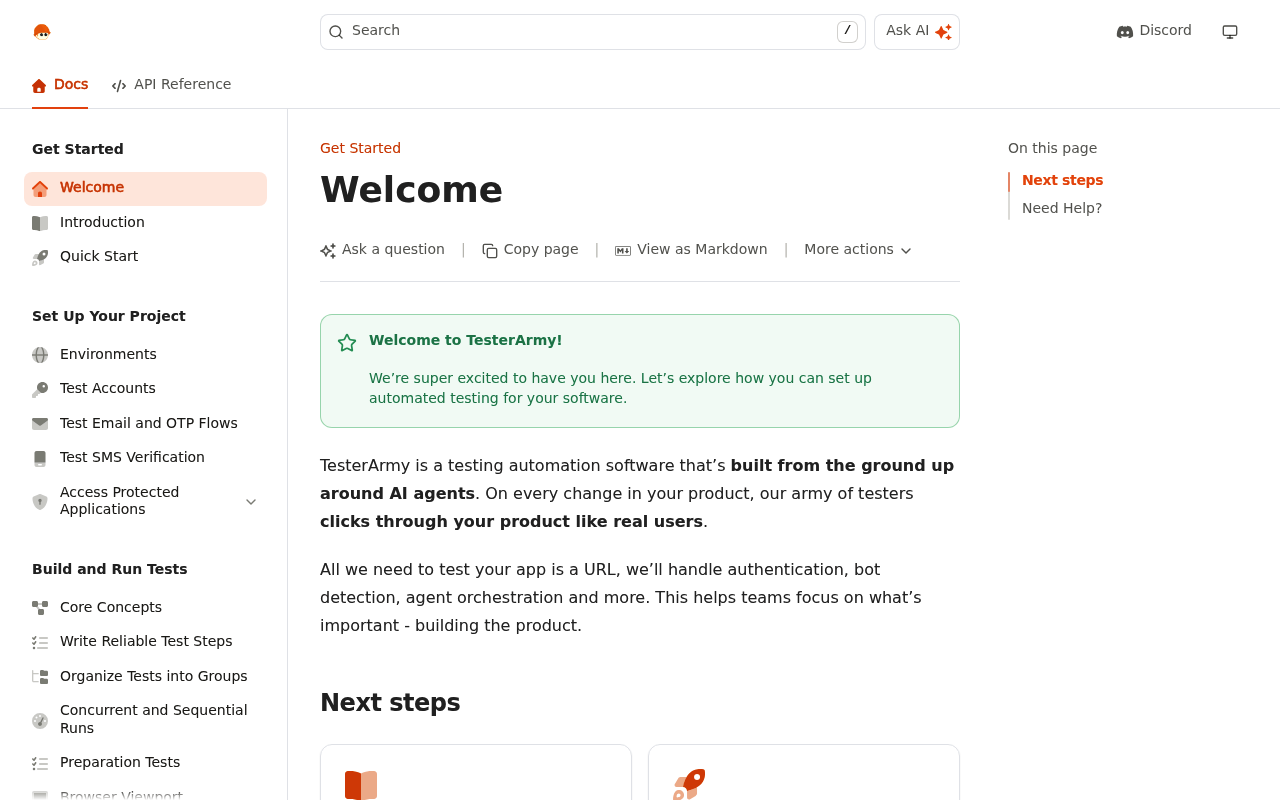
TesterArmy is an AI-powered QA testing platform (Y Combinator, batch P26) whose browser and mobile agents test web and mobile apps like a real user - navigating pages, filling forms, handling login, OAuth and OTP flows, and catching broken flows, rendering bugs and confusing UX. You describe tests in plain English and the agent runs them in the TesterArmy cloud (or locally), on every GitHub pull request or on a schedule, returning screenshots, recordings and actionable bug reports. It exposes a public REST API (bearer API-key auth), a first-party CLI (testerarmy / ta), inbound trigger webhooks, and mobile app upload and testing.
Testerarmy publishes 5 API contracts indexed on the APIs.io network, including Groups API, Projects API, Test Runs API, and 2 more. Tagged areas include Company, QA, Software Testing, Browser Automation, and AI Agents.
The Testerarmy catalog on APIs.io includes 1 event-driven AsyncAPI specification.
Testerarmy’s developer surface includes authentication, CLI, sandbox, documentation, API reference, getting-started guide, pricing, and 23 more developer resources.
What this lets a business do 1
Business capabilities this provider's published APIs can perform, derived from its own contracts. Browse all capabilities →
Kin Score
 Kin Score
How this is scored →
Kin Score
How this is scored →scored 2026-10-17 · rubric v0.24.0
APIs 5
Individual APIs this provider publishes, each with its own machine-readable definition.
Testerarmy Groups API
The Groups API from Testerarmy — 5 operation(s) for groups.
Testerarmy Projects API
The Projects API from Testerarmy — 13 operation(s) for projects.
Testerarmy Test Runs API
The Test Runs API from Testerarmy — 5 operation(s) for test runs.
Testerarmy Tests API
The Tests API from Testerarmy — 3 operation(s) for tests.
Testerarmy Webhooks API
The Webhooks API from Testerarmy — 2 operation(s) for webhooks.
Open Collections 6
Open, tool-agnostic API collections (OpenAPI-derived and Bruno).
API Collection
OPEN COLLECTIONTestArmy Groups API
OPEN COLLECTIONTestArmy Groups Projects API
OPEN COLLECTIONTestArmy Groups Test Runs API
OPEN COLLECTIONTestArmy Groups Tests API
OPEN COLLECTIONTestArmy Groups Webhooks API
OPEN COLLECTIONMCP Servers 1
Model Context Protocol servers that expose these APIs to AI agents.
Testerarmy MCP Server
Official hosted MCP server for TesterArmy documentation (Claude Code, Cursor, etc.). It serves docs/search; it is not a wrapper of the REST API.
MCP SERVEREvent Specifications 1
AsyncAPI definitions for this provider's event-driven and streaming APIs.
Testerarmy Webhooks
ASYNCAPIOpenAPI Overlays 1
Overlays applied on top of this provider's contracts. Each card says who wrote it: a document the provider publishes, or one API Evangelist derived or generated.
Testerarmy Openapi Overlay
UNRECORDEDSecurity Posture 2
Authentication, domain security, vulnerability disclosure, and trust-center signals.
Resources
Get Started 3
Portal, sign-up, and the first successful call
Documentation 2
Reference material describing how the API behaves
Agent Surfaces 4
MCP servers, agent skills, and machine-readable catalogs
Design & Contract 6
Pagination, idempotency, versioning, errors, and events
Build 4
SDKs, sample code, and the tooling you integrate with
Access & Security 2
Authentication, authorization, and security posture
Operate 1
Status, limits, changes, and where to get help
Commercial 3
Pricing, plans, and the legal terms of use
Company 3
The organization behind the API
Other 2
Properties that don't map to a standard resource type
Source (apis.yml)
Work with this as data
Every provider here is available over the APIs.io API and to AI agents over MCP.