Super.ai
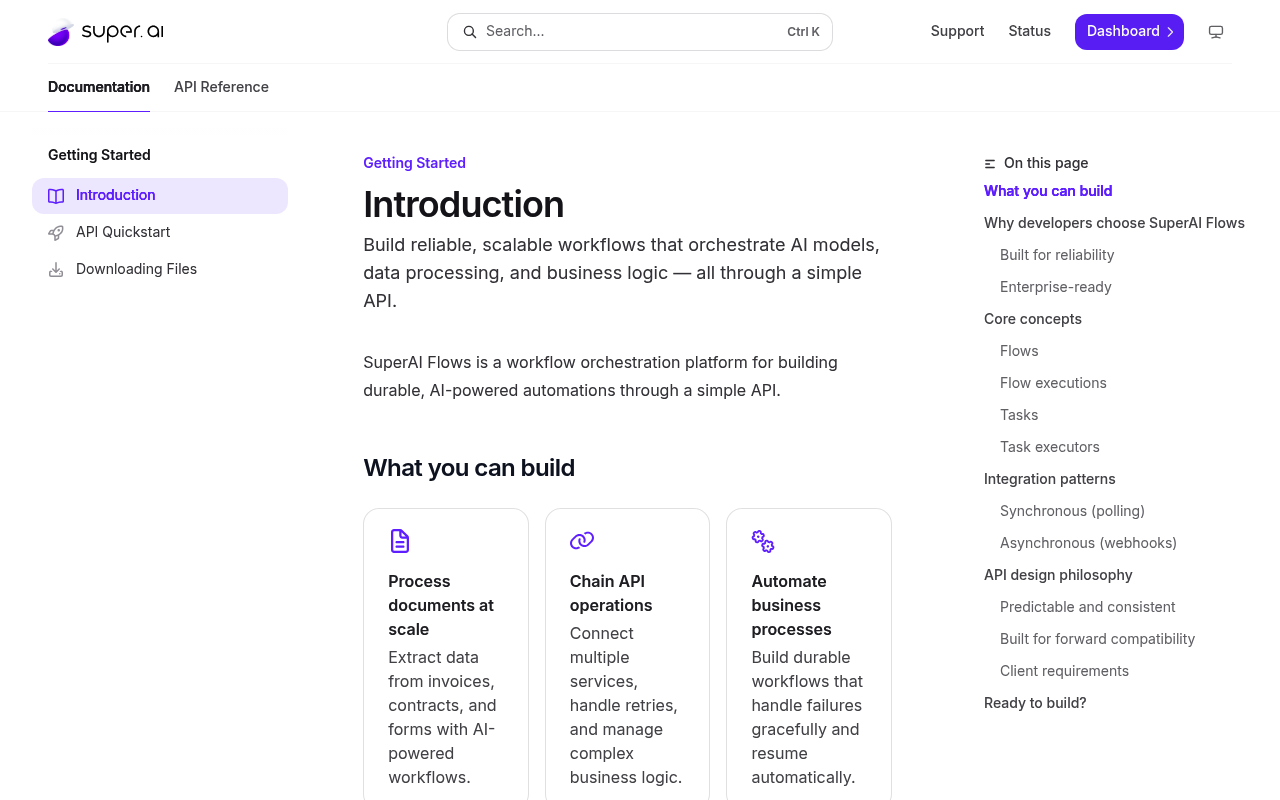
super.AI is an intelligent document processing (IDP) platform that automates the extraction and processing of complex, multi-page documents such as invoices, contracts, and bills of lading, improving accuracy as users correct its output. Its developer product, SuperAI Flows, is a workflow orchestration platform for building durable, AI-powered automations through a simple REST API: design flows that orchestrate AI models, data processing, human-review tasks, and business logic, then run them synchronously via polling or asynchronously via webhooks. The API covers flows, flow executions, task executions and outputs, human review, integrations (email, storage, databases), files, models, service accounts, SSO, and organization management, with JWT bearer and service-account API-key authentication. super.AI serves financial services, insurance, logistics, shared services, and testing/inspection/certification.
Super.ai publishes 19 API contracts indexed on the APIs.io network, including Auth API, Files API, Flow Executions API, and 16 more. Tagged areas include Company, Ai Enterprise Software, Intelligent Document Processing, Document Processing, and Workflow Orchestration.
The Super.ai catalog on APIs.io includes 1 event-driven AsyncAPI specification.
Super.ai’s developer surface includes documentation, API reference, getting-started guide, engineering blog, pricing, signup flow, CLI, and 27 more developer resources.
1 published contract
Business capabilities this provider's published APIs can perform, derived from its own
contracts. Browse all capabilities →
Individual APIs this provider publishes, each with its own machine-readable definition.
Open, tool-agnostic API collections (OpenAPI-derived and Bruno).
AsyncAPI definitions for this provider's event-driven and streaming APIs.
Overlays applied on top of this provider's contracts. Each card says who wrote it: a document the provider publishes, or one API Evangelist derived or generated.
Authentication, domain security, vulnerability disclosure, and trust-center signals.
x-docs-platform: mintlify
x-docs-platform-confidence: medium
x-docs-platform-checked: 2026-10-17
x-enrichment:
  date: '2026-07-21'
  status: enriched
  artifacts_added: 19
  pass: local-v1
aid: superai
name: Super.ai
description: 'super.AI is an intelligent document processing (IDP) platform that automates the extraction and processing of
  complex, multi-page documents such as invoices, contracts, and bills of lading, improving accuracy as users correct its
  output. Its developer product, SuperAI Flows, is a workflow orchestration platform for building durable, AI-powered automations
  through a simple REST API: design flows that orchestrate AI models, data processing, human-review tasks, and business logic,
  then run them synchronously via polling or asynchronously via webhooks. The API covers flows, flow executions, task executions
  and outputs, human review, integrations (email, storage, databases), files, models, service accounts, SSO, and organization
  management, with JWT bearer and service-account API-key authentication. super.AI serves financial services, insurance, logistics,
  shared services, and testing/inspection/certification.'
url: https://raw.githubusercontent.com/api-evangelist/superai/refs/heads/main/apis.yml
x-type: company
x-source: vc-portfolio
x-backed-by:
- hv-capital
x-tier: stub
x-tier-reason: portfolio-lead
deliveryModel:
  model: saas
  open_source: false
  commercial: true
  callable_host: true
  label: Hosted service · you call their endpoint
  confidence: high
  source:
  - openapi
  - pricing
  generated: '2026-08-28'
  method: derived
accessModel:
  pricing: unknown
  onboarding: unknown
  trial: false
  try_now: false
  public: false
  label: Unknown
  confidence: low
  source:
  - authentication
  - security
  generated: '2026-09-03'
  method: derived
image: https://super.ai/superai-logo.webp
specificationVersion: '0.23'
created: '2026-07-17'
modified: '2026-10-06'
tags:
- Company
- Ai Enterprise Software
- Intelligent Document Processing
- Document Processing
- Workflow Orchestration
- Automation
- Human-in-the-Loop
- Artificial Intelligence
- REST API
tags_raw:
- Company
- Ai Enterprise Software
- Intelligent Document Processing
- Document Processing
- Workflow Orchestration
- Automation
- Human In The Loop
- Artificial Intelligence
- REST API
apis:
- aid: superai:superai-auth-api
  name: Super.ai Auth API
  description: "Authentication operations for user authentication, authorization, and session management.\n\nAuthentication\
    \ endpoints handle user identity verification, token generation, and access control throughout the platform. The system\
    \ uses JWT (JSON Web Token) based authentication managed through core.flows.super.ai.\n\n**Authentication flow:**\n1.\
    \ Obtain credentials from your account at core.flows.super.ai\n2. Authenticate to receive JWT access token and refresh\
    \ token\n3. Include access token in API requests via Authorization header\n4. API validates tokens and extracts user identity\
    \ and organization context\n5. Tokens expire after 1 hour and must be refreshed\n\n**Key concepts:**\n- **Bearer Tokens**:\
    \ Short-lived JWT tokens (1 hour) used for API requests\n- **Anon-Key**: Long-lived API key used to authenticate to the\
    \ authentication API.\n- **Refresh Tokens**: Long-lived tokens used to obtain new access tokens\n- **Protected Routes**:\
    \ Most endpoints require valid authentication\n- **Public Endpoints**: Limited whitelisted paths accessible without auth\n\
    \n**Getting started with authentication:**\n\n1. **Obtain your Anonymous Key** (public endpoint - no authentication required):\n\
    \   ```bash\n   curl https://flows.super.ai/api/auth/anon-key\n   ```\n\n2. **Authenticate** to receive your tokens:\n\
    \   ```bash\n   curl -X POST 'https://core.flows.super.ai/auth/v1/token?grant_type=password' \\\n     -H 'Content-Type:\
    \ application/json' \\\n     -H 'apikey: ANON_KEY' \\\n     -d '{\"email\": \"you@example.com\", \"password\": \"your-password\"\
    }'\n   ```\n   This will return a JWT access token and refresh token.\n\n3. **Use the access token** in your requests:\n\
    \   ```bash\n   curl -H \"Authorization: Bearer YOUR_ACCESS_TOKEN\" \\\n        https://flows.super.ai/api/flows\n   ```\n\
    \n**Token management:**\n- Access tokens expire after 1 hour\n- Use refresh tokens to obtain new access tokens without\
    \ re-authenticating\n- Store tokens securely and never commit them to version control\n\nAll API endpoints (except whitelisted\
    \ public paths) require authentication. Include your bearer token in the Authorization header: `Bearer <token>`"
  humanURL: https://docs.flows.super.ai
  baseURL: https://flows.super.ai/api
  tags:
  - Authentication
  tags_raw:
  - auth
  properties:
  - type: OpenAPI
    url: openapi/superai-auth-api-openapi.yml
  - type: APIReference
    url: https://docs.flows.super.ai/api-reference
  - type: Authentication
    url: authentication/superai-authentication.yml
- aid: superai:superai-files-api
  name: Super.ai Files API
  description: "File download operations for retrieving files from gs:// storage URIs.\n\nWhen Super.AI Flows processes documents,\
    \ task outputs often include file references as `gs://` URIs pointing to Google Cloud Storage. These endpoints let you\
    \ download those files without needing to understand GCS internals or parse storage URLs.\n\n**The problem these endpoints\
    \ solve:**\n\nPreviously, downloading a file required:\n1. Recognizing the URL as a GCS reference\n2. Parsing out the\
    \ file key from the URI\n3. Calling a separate endpoint to get a signed URL\n4. Downloading using that signed URL\n\n\
    **Now it's simple:** Pass the `gs://` URI exactly as received and get your file.\n\n**Two ways to download:**\n\n1. **Direct\
    \ download** (`GET /files/download`): Returns a redirect to the file. Perfect for curl with `-L` flag.\n   ```\n   curl\
    \ -L -H \"X-API-Key: saf_xxx\" \"https://flows.super.ai/api/files/download?uri=gs://...\" -o file.pdf\n   ```\n\n2. **Resolve\
    \ first** (`POST /files/resolve`): Returns a JSON response with the download URL. Better for programmatic use and sensitive\
    \ files (keeps URI out of logs).\n   ```\n   curl -X POST \"https://flows.super.ai/api/files/resolve\" \\\n     -H \"\
    X-API-Key: saf_xxx\" \\\n     -H \"Content-Type: application/json\" \\\n     -d '{\"uri\": \"gs://...\"}'\n   ```\n\n\
    **Security:**\n- Files are organization-scoped: you can only download files from flows your organization owns\n- URIs\
    \ are validated to prevent path traversal attacks\n- Download URLs expire after 1 hour\n\n**Common use cases:**\n- Download\
    \ processed documents from completed flow executions\n- Retrieve extracted data files from task outputs\n- Integrate file\
    \ downloads into automated pipelines"
  humanURL: https://docs.flows.super.ai
  baseURL: https://flows.super.ai/api
  tags:
  - File
  tags_raw:
  - files
  properties:
  - type: OpenAPI
    url: openapi/superai-files-api-openapi.yml
  - type: APIReference
    url: https://docs.flows.super.ai/api-reference
  - type: Authentication
    url: authentication/superai-authentication.yml
- aid: superai:superai-flow-executions-api
  name: Super.ai Flow Executions API
  description: 'Flow execution operations for running and monitoring workflows.


    Flow executions represent runtime instances of flows. When you execute a flow, a new flow execution is created with its
    own unique ID, status, and execution context. Each execution is independent and maintains its own state, input data, and
    results.


    **Key concepts:**

    - **Execution Status**: Tracks the lifecycle (running, completed, failed, cancelled)

    - **Run Number**: Sequential identifier for executions of the same flow

    - **Execution Context**: Contains input parameters, user information, and metadata

    - **Task Results**: Stores outputs from each task within the execution


    **Use these endpoints to:**

    - Start new flow executions with custom input parameters

    - Monitor execution progress and status in real-time

    - Retrieve execution history and detailed results

    - Filter and search executions by status, date, or flow

    - Cancel running executions when needed

    - Access task-level execution details and outputs


    Flow executions transform flow definitions into actual work and deliverable results.'
  humanURL: https://docs.flows.super.ai
  baseURL: https://flows.super.ai/api
  tags:
  - flow-executions
  properties:
  - type: OpenAPI
    url: openapi/superai-flow-executions-api-openapi.yml
  - type: APIReference
    url: https://docs.flows.super.ai/api-reference
  - type: Authentication
    url: authentication/superai-authentication.yml
- aid: superai:superai-flows-api
  name: Super.ai Flows API
  description: 'Flow management operations for defining and organizing workflows.


    Flows represent workflow definitions with tasks, dependencies, and execution logic. They serve as reusable templates that
    can be executed multiple times with different inputs.


    **What is a flow?**

    A flow consists of:

    - **Tasks**: Individual units of work that perform specific actions

    - **Dependencies**: Relationships between tasks that define execution order

    - **Configuration**: Settings and parameters that control flow behavior


    **Use these endpoints to:**

    - Create new flow definitions from scratch or import from YAML

    - List and search existing flows in your organization

    - Retrieve detailed flow information including task definitions

    - Update flow configurations and task parameters

    - Delete flows that are no longer needed


    Flows are the foundation of your workflow automation—once defined, they can be executed via the flow-executions endpoints.'
  humanURL: https://docs.flows.super.ai
  baseURL: https://flows.super.ai/api
  tags:
  - Flow
  tags_raw:
  - flows
  properties:
  - type: OpenAPI
    url: openapi/superai-flows-api-openapi.yml
  - type: APIReference
    url: https://docs.flows.super.ai/api-reference
  - type: Authentication
    url: authentication/superai-authentication.yml
- aid: superai:superai-human-review-tasks-api
  name: Super.ai Human Review Tasks API
  description: Human review task operations for creating and managing human-in-the-loop review workflows.
  humanURL: https://docs.flows.super.ai
  baseURL: https://flows.super.ai/api
  tags:
  - human-review-tasks
  properties:
  - type: OpenAPI
    url: openapi/superai-human-review-tasks-api-openapi.yml
  - type: APIReference
    url: https://docs.flows.super.ai/api-reference
  - type: Authentication
    url: authentication/superai-authentication.yml
- aid: superai:superai-integrations-api
  name: Super.ai Integrations API
  description: 'Integration operations for connecting flows to external services and platforms.


    Integrations enable your workflows to interact with third-party services, databases, storage systems, and communication
    platforms. They provide a unified interface for managing credentials, testing connections, and configuring service-specific
    features.


    **Supported integration types:**

    - **Databases**: PostgreSQL, MySQL, and other SQL databases

    - **Storage**: SFTP, cloud storage, and file systems

    - **Communication**: Email (SMTP, SES), webhooks, notifications

    - **Collaboration**: SharePoint, Google Drive, document management

    - **Custom**: Plugin architecture for extending functionality


    **Key concepts:**

    - **Credentials**: Securely stored authentication information per integration

    - **Plugins**: Modular integration implementations with discovery and registration

    - **OAuth Flows**: Automated authorization for third-party services

    - **Webhooks**: Inbound event handling from external platforms

    - **Connection Testing**: Validate credentials and connectivity before use


    **Use these endpoints to:**

    - Configure and manage integration credentials

    - Test connections to external services

    - Handle OAuth authorization flows for cloud services

    - Set up and manage webhooks for inbound events

    - Discover available integration capabilities

    - Access integration-specific features (folders, schemas, etc.)


    Integrations bridge your workflows with the external world, enabling powerful automation across your entire technology
    stack.'
  humanURL: https://docs.flows.super.ai
  baseURL: https://flows.super.ai/api
  tags:
  - Integration
  tags_raw:
  - integrations
  properties:
  - type: OpenAPI
    url: openapi/superai-integrations-api-openapi.yml
  - type: APIReference
    url: https://docs.flows.super.ai/api-reference
  - type: Authentication
    url: authentication/superai-authentication.yml
- aid: superai:superai-models-api
  name: Super.ai Models API
  description: 'Model operations for querying available AI models and their configurations.


    Model endpoints provide information about the AI models available through the platform. These endpoints enable discovery
    of models, their capabilities, and regional availability.


    **Key features:**

    - **Model Discovery**: List all available AI models

    - **Regional Filtering**: Query models by geographic region (EU, Global)

    - **Model Metadata**: Access model information including provider, location, and capabilities


    **Use these endpoints to:**

    - Discover available AI models for your workflows

    - Filter models by region for compliance or latency requirements

    - Retrieve model metadata for configuration and selection

    - Build dynamic model selection UIs


    **Regional filtering:**

    - `eu`: Models deployed in European regions (West Europe, France Central, Germany, Sweden)

    - `global`: Models deployed in US and other global regions


    Model endpoints enable intelligent model selection and routing based on your requirements for compliance, performance,
    and cost.'
  humanURL: https://docs.flows.super.ai
  baseURL: https://flows.super.ai/api
  tags:
  - Models
  tags_raw:
  - models
  properties:
  - type: OpenAPI
    url: openapi/superai-models-api-openapi.yml
  - type: APIReference
    url: https://docs.flows.super.ai/api-reference
  - type: Authentication
    url: authentication/superai-authentication.yml
- aid: superai:superai-organizations-api
  name: Super.ai Organizations API
  description: Organization operations for viewing credit balance and organization-scoped information.
  humanURL: https://docs.flows.super.ai
  baseURL: https://flows.super.ai/api
  tags:
  - Organization
  tags_raw:
  - organizations
  properties:
  - type: OpenAPI
    url: openapi/superai-organizations-api-openapi.yml
  - type: APIReference
    url: https://docs.flows.super.ai/api-reference
  - type: Authentication
    url: authentication/superai-authentication.yml
- aid: superai:superai-plugins-api
  name: Super.ai Plugins API
  description: Plugin operations for managing integration plugin instances, OAuth flows, and webhooks.
  humanURL: https://docs.flows.super.ai
  baseURL: https://flows.super.ai/api
  tags:
  - Plugins
  tags_raw:
  - plugins
  properties:
  - type: OpenAPI
    url: openapi/superai-plugins-api-openapi.yml
  - type: APIReference
    url: https://docs.flows.super.ai/api-reference
  - type: Authentication
    url: authentication/superai-authentication.yml
- aid: superai:superai-profile-api
  name: Super.ai Profile API
  description: 'User profile operations for viewing and updating account information.


    Profile endpoints allow authenticated users to view and update their own account information and preferences. These endpoints
    operate on the currently authenticated user (determined from the JWT token) and do not require specifying a user ID.


    **Account information includes:**

    - **Personal Details**: First name, last name, email

    - **Organization**: Associated organization and role

    - **Status**: Account status and permissions

    - **Metadata**: Created/updated timestamps


    **Use these endpoints to:**

    - Retrieve current user information for display

    - Update personal details (name, preferences)

    - View organization membership and role

    - Access account metadata


    Profile endpoints provide self-service account management capabilities, reducing the need for administrative intervention
    for routine updates.


    **Note:** All profile endpoints are protected and automatically scope to the authenticated user. Email and organization
    changes require admin privileges.'
  humanURL: https://docs.flows.super.ai
  baseURL: https://flows.super.ai/api
  tags:
  - Profiles
  tags_raw:
  - profile
  properties:
  - type: OpenAPI
    url: openapi/superai-profile-api-openapi.yml
  - type: APIReference
    url: https://docs.flows.super.ai/api-reference
  - type: Authentication
    url: authentication/superai-authentication.yml
- aid: superai:superai-service-accounts-api
  name: Super.ai Service Accounts API
  description: Service account operations for managing programmatic API access credentials.
  humanURL: https://docs.flows.super.ai
  baseURL: https://flows.super.ai/api
  tags:
  - Service Accounts
  tags_raw:
  - service-accounts
  properties:
  - type: OpenAPI
    url: openapi/superai-service-accounts-api-openapi.yml
  - type: APIReference
    url: https://docs.flows.super.ai/api-reference
  - type: Authentication
    url: authentication/superai-authentication.yml
- aid: superai:superai-sso-api
  name: Super.ai SSO API
  description: Single Sign-On operations for configuring SAML-based SSO authentication.
  humanURL: https://docs.flows.super.ai
  baseURL: https://flows.super.ai/api
  tags:
  - SSO
  tags_raw:
  - sso
  properties:
  - type: OpenAPI
    url: openapi/superai-sso-api-openapi.yml
  - type: APIReference
    url: https://docs.flows.super.ai/api-reference
  - type: Authentication
    url: authentication/superai-authentication.yml
- aid: superai:superai-task-data-api
  name: Super.ai Task Data API
  description: 'Task data operations for flow validation, schema discovery, and dynamic configuration.


    The task-data endpoint analyzes flow definitions to extract task output schemas, dynamic configuration options, and validation
    errors. This is essential for building flow configuration UIs, validating flows before execution, and understanding task
    data structures.


    **Primary Use Cases:**

    - **Flow Builder UI**: Get task output schemas for validating downstream task inputs

    - **Schema Discovery**: Understand the structure of data each task produces

    - **Dynamic Configuration**: Retrieve runtime-dependent options (e.g., available spreadsheets, database tables)

    - **Flow Validation**: Validate flow definitions programmatically before saving or executing

    - **Custom Integrations**: Build tools that work with SuperAI Flows programmatically


    **What You Get:**

    - **Output Schemas**: JSON Schema definitions for each task''s output structure

    - **Dynamic Data**: Runtime-dependent configuration options (dropdown choices, conditional fields)

    - **Validation Errors**: Detailed error messages for invalid flow definitions


    **How It Works:**

    1. Submit a flow definition in SuperAI Flows DSL format

    2. The endpoint validates the structure and loads each task executor

    3. For each task, it extracts the output schema and any dynamic configuration data

    4. Returns all schemas, dynamic data, and any validation errors encountered


    **Key Concepts:**

    - **Output Schema**: JSON Schema describing the structure of data a task produces

    - **Dynamic Data**: Configuration options that depend on user credentials or external state (e.g., list of Google Sheets
    accessible with your credentials)

    - **Validation Levels**: Basic (structure only) vs Full (includes semantic validation)


    **Integration Notes:**

    - The flow builder frontend uses this endpoint to power the task configuration UI

    - Flows API uses this validation internally when creating/updating flows

    - Response includes validation errors even on HTTP 200 - always check `validation_errors` field

    - May make external API calls to fetch dynamic data, so response time varies (100ms-2s typical)


    **Related Endpoints:**

    - `GET /task-executors`: List available task executor types and their schemas

    - `POST /flows`: Create flow (uses task-data validation internally)

    - `PUT /flows/{flow_id}`: Update flow (uses task-data validation internally)'
  humanURL: https://docs.flows.super.ai
  baseURL: https://flows.super.ai/api
  tags:
  - TaskData
  tags_raw:
  - task-data
  properties:
  - type: OpenAPI
    url: openapi/superai-task-data-api-openapi.yml
  - type: APIReference
    url: https://docs.flows.super.ai/api-reference
  - type: Authentication
    url: authentication/superai-authentication.yml
- aid: superai:superai-task-executions-api
  name: Super.ai Task Executions API
  description: 'Task execution operations for tracking individual task runs within flow executions.


    Task executions represent individual task runs within a flow execution. Each task in a flow execution has its own task
    execution record that tracks its lifecycle, inputs, outputs, and status.


    **What is tracked:**

    - **Status**: Current state (pending, running, completed, failed, skipped)

    - **Input/Output**: Data passed to and produced by the task

    - **Timing**: Start time, end time, and duration

    - **Errors**: Failure details and error messages

    - **Tags**: Metadata and categorization


    **Use these endpoints to:**

    - Query task execution status for debugging

    - Retrieve task outputs for analysis

    - Debug task failures with detailed error information

    - Track task performance and timing

    - Monitor task execution progress within flows


    Task executions provide granular visibility into workflow execution, essential for debugging and optimization.'
  humanURL: https://docs.flows.super.ai
  baseURL: https://flows.super.ai/api
  tags:
  - Task Executions
  tags_raw:
  - task-executions
  properties:
  - type: OpenAPI
    url: openapi/superai-task-executions-api-openapi.yml
  - type: APIReference
    url: https://docs.flows.super.ai/api-reference
  - type: Authentication
    url: authentication/superai-authentication.yml
- aid: superai:superai-task-executors-api
  name: Super.ai Task Executors API
  description: 'Task executor operations for discovering available task types and their capabilities.


    Task executors define the available task types that can be used in flow definitions. Each executor specifies its input
    schema, execution behavior, and capabilities. This endpoint enables programmatic discovery of task types for building
    flows dynamically.


    **What task executors provide:**

    - **Input Schema**: JSON Schema defining required and optional parameters

    - **Output Schema**: Expected output structure and data types

    - **Description**: Human-readable explanation of functionality

    - **Agent Prompts**: Instructions for AI-powered flow generation


    **Use these endpoints to:**

    - Discover available task types for flow building

    - View task input/output schemas for validation

    - Understand task capabilities and requirements

    - Build flow builder UIs with dynamic task lists

    - Enable AI agents to select appropriate tasks


    Task executors enable dynamic, flexible workflow creation by providing a registry of available operations.'
  humanURL: https://docs.flows.super.ai
  baseURL: https://flows.super.ai/api
  tags:
  - task-executors
  properties:
  - type: OpenAPI
    url: openapi/superai-task-executors-api-openapi.yml
  - type: APIReference
    url: https://docs.flows.super.ai/api-reference
  - type: Authentication
    url: authentication/superai-authentication.yml
- aid: superai:superai-task-outputs-api
  name: Super.ai Task Outputs API
  description: 'Task output operations for storing and retrieving task execution results.


    Task outputs store the results produced by task executions in a structured, queryable format. While task executions track
    the full lifecycle (input, output, error, status), task outputs focus specifically on the final output data formatted
    for display, analysis, and downstream consumption.


    **Key characteristics:**

    - **Summary Field**: Structured output data ready for consumption

    - **Historical Record**: Permanent storage of task results

    - **Queryable**: Filter and search outputs by task, execution, or flow

    - **Linked**: Connected to parent flow execution and task execution


    **Use these endpoints to:**

    - Store task results after successful execution

    - Retrieve outputs for specific tasks or entire executions

    - Query historical outputs for analysis and reporting

    - Access formatted results for display in dashboards

    - Feed outputs to downstream tasks or external systems


    Task outputs provide the data foundation for workflow analytics, debugging, and result visualization.'
  humanURL: https://docs.flows.super.ai
  baseURL: https://flows.super.ai/api
  tags:
  - task-outputs
  properties:
  - type: OpenAPI
    url: openapi/superai-task-outputs-api-openapi.yml
  - type: APIReference
    url: https://docs.flows.super.ai/api-reference
  - type: Authentication
    url: authentication/superai-authentication.yml
- aid: superai:superai-task-tags-api
  name: Super.ai Task Tags API
  description: 'Task tag operations for categorizing and organizing tasks with metadata.


    Task tags provide metadata and categorization for tasks within flow executions. Tags enable flexible organization, filtering,
    and grouping of tasks beyond their structural relationships.


    **What tags enable:**

    - **Categorization**: Group related tasks across different flows

    - **Filtering**: Query executions by tag criteria

    - **Metadata**: Attach custom key-value pairs to tasks

    - **Organization**: Create logical groupings for reporting


    **Use these endpoints to:**

    - Manage task labels and categories

    - Add organizational metadata to tasks

    - Query tasks by tag criteria

    - Build custom views and dashboards


    Task tags provide flexible organization capabilities that enhance workflow management and analysis.'
  humanURL: https://docs.flows.super.ai
  baseURL: https://flows.super.ai/api
  tags:
  - Task Tags
  tags_raw:
  - task-tags
  properties:
  - type: OpenAPI
    url: openapi/superai-task-tags-api-openapi.yml
  - type: APIReference
    url: https://docs.flows.super.ai/api-reference
  - type: Authentication
    url: authentication/superai-authentication.yml
- aid: superai:superai-webhook-data-api
  name: Super.ai Webhook Data API
  description: Push data from external systems to a flow execution's waiting 'Wait for Webhook' task. A 2xx acknowledgment
    means the data is durably stored; identical redeliveries are idempotent.
  humanURL: https://docs.flows.super.ai
  baseURL: https://flows.super.ai/api
  tags:
  - webhook-data
  properties:
  - type: OpenAPI
    url: openapi/superai-webhook-data-api-openapi.yml
  - type: APIReference
    url: https://docs.flows.super.ai/api-reference
  - type: Authentication
    url: authentication/superai-authentication.yml
- aid: superai:superai-worker-groups-api
  name: Super.ai Worker Groups API
  description: The worker-groups API from Super.ai — 3 operation(s) for worker-groups.
  humanURL: https://docs.flows.super.ai
  baseURL: https://flows.super.ai/api
  tags:
  - Worker Groups
  tags_raw:
  - worker-groups
  properties:
  - type: OpenAPI
    url: openapi/superai-worker-groups-api-openapi.yml
  - type: APIReference
    url: https://docs.flows.super.ai/api-reference
  - type: Authentication
    url: authentication/superai-authentication.yml
maintainers:
- FN: Kin Lane
  email: kin@apievangelist.com
- FN: APIs.json
  email: info@apis.io
common:
- url: https://super.ai/feed.xml
  type: BlogRSS
- type: CapabilityMap
  url: capabilities/superai-capability-edges.yml
  name: Super.ai Business Capability Map
- type: Website
  url: https://www.super.ai/
- type: VulnerabilityDisclosure
  url: security/superai-vulnerability-disclosure.yml
- type: DomainSecurity
  url: security/superai-domain-security.yml
- type: DeveloperPortal
  url: https://docs.flows.super.ai
- type: Documentation
  url: https://docs.flows.super.ai
- type: APIReference
  url: https://docs.flows.super.ai/api-reference
- type: GettingStarted
  url: https://docs.flows.super.ai/quickstart
- type: Blog
  url: https://super.ai/blog
- type: Pricing
  url: https://super.ai/pricing
- type: SignUp
  url: https://flows.super.ai/login
- type: TermsOfService
  url: https://super.ai/terms_of_service.pdf
- type: PrivacyPolicy
  url: https://super.ai/trust/privacy-policy
- type: GitHubOrganization
  url: https://github.com/mysuperai
- type: StatusPage
  url: https://status.super.ai
- type: Security
  url: https://super.ai/trust/security
- type: TrustCenter
  url: https://super.ai/trust
- type: Compliance
  url: https://super.ai/trust/compliance
- type: Packages
  url: packages/superai-packages.yml
- type: SDKs
  url: packages/superai-packages.yml
- type: CLI
  url: cli/superai-cli.yml
- type: WellKnown
  url: well-known/superai-well-known.yml
- type: SecurityTxt
  url: well-known/superai-security.txt
- type: LLMsTxt
  url: llms/superai-llms.txt
- type: X-MCPServerCandidate
  url: mcp/superai-mcp.yml
  note: 'Renamed from MCPServer 2026-09-03 (roadmap#247): the manifest self-describes as status: candidate — a tool list derived
    from the published API contracts, not an existing server. The scorer already read the manifest and reported mcp_server
    correctly; the MCPServer type was crediting the artifact-type surfaces with a server that does not exist.'
- type: Overlay
  url: overlays/superai-flows-overlay.yaml
- type: Conformance
  url: conformance/superai-conformance.yml
- type: ErrorCatalog
  url: errors/superai-problem-types.yml
- type: Lifecycle
  url: lifecycle/superai-lifecycle.yml
- type: Conventions
  url: conventions/superai-conventions.yml
- type: DataModel
  url: data-model/superai-data-model.yml
- type: Webhooks
  url: asyncapi/superai-flows-webhooks.yml
- type: AgentSkill
  url: skills/_index.yml
Every provider here is available over the APIs.io API and to AI agents over MCP.
 Kin Score
How this is scored →
Kin Score
How this is scored →