Sigma360
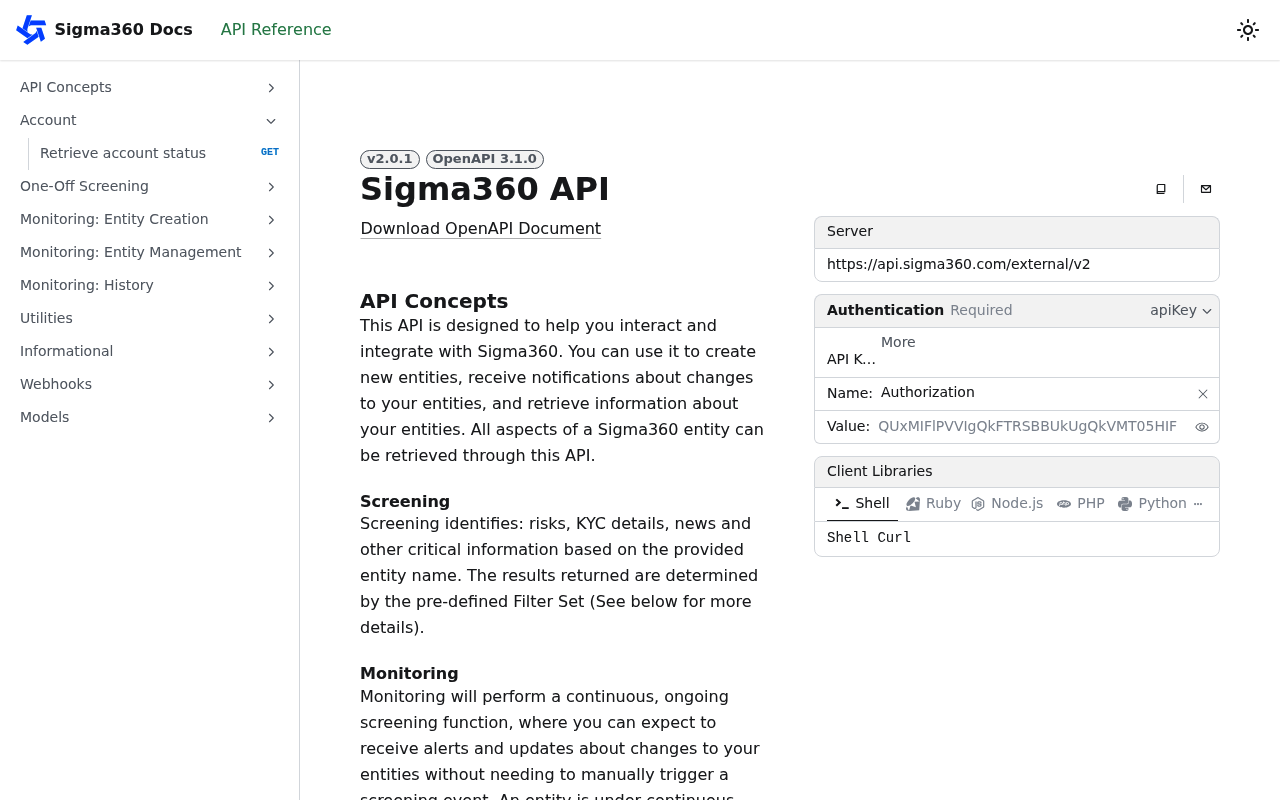
Sigma360 (formerly Sigma Ratings) is a financial-crime-compliance platform for sanctions and watchlist screening, AML investigations, adverse-media screening, enhanced due diligence, perpetual KYC, third-party risk management, country risk ratings, and counterparty credit-risk monitoring. Its REST API (OpenAPI 3.1, v2.0.1) lets you screen entities against risk data, enroll them for continuous monitoring, retrieve risk profiles and change history, and subscribe to webhook events — authenticated with an API key over https://api.sigma360.com/external/v2.
Sigma360 publishes 8 API contracts indexed on the APIs.io network, including Account API, Informational API, Monitoring: Entity Creation API, and 5 more. Tagged areas include Company, Compliance, Financial Crime, KYC, and AML.
The Sigma360 catalog on APIs.io includes 2 event-driven AsyncAPI specifications.
Sigma360’s developer surface includes documentation, API reference, getting-started guide, changelog, signup flow, support, authentication, and 22 more developer resources.
What this lets a business do 1
Business capabilities this provider's published APIs can perform, derived from its own contracts. Browse all capabilities →
Kin Score
 Kin Score
How this is scored →
Kin Score
How this is scored →scored 2026-10-17 · rubric v0.24.0
APIs 8
Individual APIs this provider publishes, each with its own machine-readable definition.
Sigma360 Account API
Account management
Sigma360 Informational API
Informational endpoints
Sigma360 Monitoring: Entity Creation API
Creating new 'My Entities'
Sigma360 Monitoring: Entity Management API
Browsing and retrieving monitored entities
Sigma360 Monitoring: History API
Retrieving monitoring history
Sigma360 One-Off Screening API
Screening against Sigma360's risk data
Sigma360 Utilities API
General utilities
Sigma360 Webhooks API
Webhooks that notify you of important events
Scroll for all 8
Open Collections 8
Open, tool-agnostic API collections (OpenAPI-derived and Bruno).
API Collection
OPEN COLLECTIONSigma360 Account API
OPEN COLLECTIONSigma360 Account Informational API
OPEN COLLECTIONSigma360 Account Monitoring: Entity Creation API
OPEN COLLECTIONSigma360 Account Monitoring: Entity Management API
OPEN COLLECTIONSigma360 Account Monitoring: History API
OPEN COLLECTIONSigma360 Account One-Off Screening API
OPEN COLLECTIONSigma360 Account Utilities API
OPEN COLLECTIONScroll for all 8
Event Specifications 2
AsyncAPI definitions for this provider's event-driven and streaming APIs.
Sigma360 Webhooks
Event surface for Sigma360; webhook callbacks are delivered to your registered HTTPS endpoint when monitored entities change. Derived from the OpenAPI 3.1 webhooks object publis...
ASYNCAPISigma Ratings Webhooks
ASYNCAPIOpenAPI Overlays 1
Overlays applied on top of this provider's contracts. Each card says who wrote it: a document the provider publishes, or one API Evangelist derived or generated.
Sigma Ratings Openapi Overlay
UNRECORDEDSecurity Posture 4
Authentication, domain security, vulnerability disclosure, and trust-center signals.
Resources
Get Started 4
Portal, sign-up, and the first successful call
Documentation 3
Reference material describing how the API behaves
Agent Surfaces 3
MCP servers, agent skills, and machine-readable catalogs
Design & Contract 6
Pagination, idempotency, versioning, errors, and events
Access & Security 6
Authentication, authorization, and security posture
Operate 3
Status, limits, changes, and where to get help
Commercial 1
Pricing, plans, and the legal terms of use
Company 1
The organization behind the API
Other 2
Properties that don't map to a standard resource type
Source (apis.yml)
Work with this as data
Every provider here is available over the APIs.io API and to AI agents over MCP.