Seventh Sense website screenshot

Seventh Sense

Seventh Sense AI is a Singapore-based deep-tech company building privacy-preserving, face-based identity and biometric verification technology. Its OpenCV Face Recognition (OpenCV FR) platform — ranked among the top 10 facial recognition algorithms globally by NIST — provides face detection, matching, liveness detection, search and person/collection management through a multi-region REST API and Python/C++ SDKs. Seventh Sense also develops the SenseCrypt suite (eID, PKI and self-sovereign identity built on distributed ledgers, "0% biometrics, 100% privacy") and SenseVantage multimodal video AI. The company is SOC, ISO 27001 certified and GDPR compliant, serving enterprise and government customers.

Seventh Sense publishes 5 API contracts indexed on the APIs.io network, including Collections API, Face Anti-Spoofing / Liveness API, Face Verification API, and 2 more. Tagged areas include Company, Face Recognition, Biometrics, Identity Verification, and Liveness Detection.

The Seventh Sense catalog on APIs.io includes 1 Spectral governance ruleset.

Seventh Sense’s developer surface includes authentication, documentation, signup flow, and 15 more developer resources.

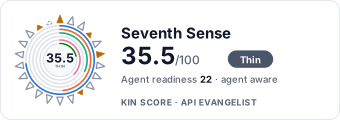
35.5/100 thin ▬ flat Agent 22/100 agent aware Front door AI 5/6 prominent saas Full breakdown ↓
scored 2026-11-06 · rubric v0.27.0 · Show this score on your site →
1 published contract 2 Agent Skills
CompanyFace RecognitionBiometricsIdentity VerificationLiveness DetectionArtificial IntelligenceComputer VisionSecurity

Kin Score

Kin Score Kin Score How this is scored →
scored 2026-11-06 · rubric v0.27.0
Regulatory Posture applies to this provider. Its tags matched the AI & Biometrics regime, so Regulatory Posture carries 15 points of the composite. If this regime is wrong for your business, say so on your provider repo — the applicability map is public and we will correct it.
Create-or-Update Ergonomics applies to this provider. This API accepts writes, so it carries 10 points of the composite. It is scored from the published contracts themselves: whether a caller can create-or-update in one call, whether the write accepts a key the caller already holds, and whether the response says which branch ran. Without that, every write needs a search-and-branch in front of it, and the first time that check is skipped a duplicate record is created. Scored against the observed mean rather than raw — a provider at the catalog average is unchanged by this facet, not penalised by it.
The six quality facets above are damped to 75 points between them, because the conditional facet above carries the other 25. That is why each facet's contribution is shown against a damped maximum: raising a quality facet moves the composite by 75% of its nominal weight, not 100%. The full arithmetic is at apis.io/rating/.
Show this score on your site. Kin Score badge preview for Seventh Sense It updates itself when the score changes. Paste this where you link to your API docs:
<a href="https://apis.io/providers/seventh-sense/"><img src="https://apis.io/badge/seventh-sense/card.svg" alt="Seventh Sense on APIs.io — Kin Score by API Evangelist"></a>
Other styles, a README pill and a shields.io endpoint are on the badge page.
Raise your score.
Agent readiness — checks not met, largest first (exact, from this profile):
  • MCP Server +12 pts — deployment.mode + probe verdict on the mcp/ manifest, not the pointer; an unprobed slug falls back to authorship
  • Agentic Access Contract +10 pts — agentic_access artifact present (x-agentic-access), graded by author
  • Idempotency +9 pts — OpenAPI mutating operations declare an idempotency key — a header, a request-body property, or a named de-duplication token whose own description says so (verified); else common[].type matches /idempoten/i (documented)
  • A2A Agent Card +8 pts — a2a/-a2a.yml manifest, graded on conformance.grade against A2A 1.0.0
  • Rate-Limit Signaling +7 pts — OpenAPI responses document X-RateLimit-* / RateLimit headers (verified), else a rate_limits artifact or RateLimits link (documented)
  • Request/Response Examples +7 pts — share of operations carrying request/response examples; else an Examples / Code Samples link
10 more unmet checks in the Agent Readiness table above.
Kin Score — facets with the most composite points still available (weight × headroom):
Each check links to what satisfies it. Publish the artifact, or tell us where it already lives, and the score moves on the next scoring run.
Improve this rating by publishing the missing artifacts — every area above can be raised, and the full rubric is at apis.io/rating/. Every facet and dimension name above is a link: it opens that measurement's own page — what it means, the exact checks that feed it, how the whole catalog distributes on it, and the providers at the top of it. This rating is computed from the provider profile at artifacts.apis.io/seventh-sense/apis.yml: open an issue on github.com/api-evangelist/seventh-sense to ask a question or point us at an artifact you publish. Submit an artifact on GitHub — free → Manage your own listing — the Influence plan, $499/mo →

Markets this provider is in provisional

The Kin Score Market layer reads a provider inside its market: its position, and how deep its integrations go. Depth is only comparable within a position. Provisional and unweighted: not part of the Kin Score or agent readiness.

Registered MCP server and declares compatibility are report only — not weighted. Undeclared means we found nothing we can read, so there is no number: we never infer integrations.

Standards implemented 1

Standards this provider implements or carries. De facto ones are profiled and measured by the API Commons; formal ones come from the standards directory and are linked by the provider's own tags. The evidence column says how each claim was established — not that it was made.

measured — observed by APIs.io (published)

APIs 5

Individual APIs this provider publishes, each with its own machine-readable definition.

Seventh Sense Collections API

Collections are groups of registered `Persons`. You can use collections to organize your registered persons and to search for persons within a specific collection. You can also ...

Seventh Sense Face Anti-Spoofing / Liveness API

The `/liveness` endpoint allows you to determine if a face image is of a real person or a spoofed image (eg. a printed image of a face, or an image captured from a tablet's scre...

Seventh Sense Face Verification API

The `/compare` endpoint allows you to compare two sets of face images to determine if they correspond to the same person. A score higher than 0.81 is a good indicator that the t...

Seventh Sense Persons API

Persons are registered persons that you can later search for using face images. Registering a person allows you to search for them later using the `/search` endpoint. You can al...

Seventh Sense Search API

The endpoints below allow you to search for previously registered persons using a face image obtained at a later time. The search is performed using a deep learning model traine...

Open Collections 5

Open, tool-agnostic API collections (OpenAPI-derived and Bruno).

Agent Skills 2

Packaged agent skills for driving this provider's APIs from an AI assistant.

Spectral Rules 1

Spectral governance rulesets for linting and validating these APIs.

Seventh Sense API Rules

51 rules · 49 errors 1 warnings 1 info

SPECTRAL

OpenAPI Overlays 1

Overlays applied on top of this provider's contracts. Each card says who wrote it: a document the provider publishes, or one API Evangelist derived or generated.

Seventh Sense Opencv Fr Overlay

2 actions · update · seventh-sense-opencv-fr-openapi.json

DERIVED

Security Posture 2

Authentication, domain security, vulnerability disclosure, and trust-center signals.

Seventh Sense Authentication

apiKey · 1 scheme

SECURITY

Seventh Sense Domain Security

TLSv1.3 · HSTS · DMARC

SECURITY

Resources

Get Started 2

Portal, sign-up, and the first successful call

Documentation 1

Reference material describing how the API behaves

Agent Surfaces 3

MCP servers, agent skills, and machine-readable catalogs

Design & Contract 5

Pagination, idempotency, versioning, errors, and events

Build 2

SDKs, sample code, and the tooling you integrate with

Access & Security 3

Authentication, authorization, and security posture

Company 1

The organization behind the API

Other 1

Properties that don't map to a standard resource type

Source (apis.yml)

apis.yml Raw ↑
aid: seventh-sense
deliveryModel:
  model: saas
  open_source: false
  commercial: true
  callable_host: true
  label: Hosted service · you call their endpoint
  confidence: high
  source:
  - openapi
  - pricing
  generated: '2026-08-28'
  method: derived
accessModel:
  pricing: unknown
  onboarding: unknown
  trial: false
  try_now: false
  public: false
  label: Unknown
  confidence: low
  source:
  - authentication
  - security
  generated: '2026-11-06'
  method: derived
image: https://kinlane-images.s3.amazonaws.com/shared/apis-json/icons/seventh-sense.png
name: Seventh Sense
description: Seventh Sense AI is a Singapore-based deep-tech company building privacy-preserving, face-based identity and
  biometric verification technology. Its OpenCV Face Recognition (OpenCV FR) platform — ranked among the top 10 facial recognition
  algorithms globally by NIST — provides face detection, matching, liveness detection, search and person/collection management
  through a multi-region REST API and Python/C++ SDKs. Seventh Sense also develops the SenseCrypt suite (eID, PKI and self-sovereign
  identity built on distributed ledgers, "0% biometrics, 100% privacy") and SenseVantage multimodal video AI. The company
  is SOC, ISO 27001 certified and GDPR compliant, serving enterprise and government customers.
url: https://raw.githubusercontent.com/api-evangelist/seventh-sense/refs/heads/main/apis.yml
x-type: company
x-source: vc-portfolio
x-backed-by:
- 500-global
x-tier: stub
x-tier-reason: portfolio-lead
specificationVersion: '0.23'
created: '2026-07-17'
modified: '2026-07-21'
tags:
- Company
- Face Recognition
- Biometrics
- Identity Verification
- Liveness Detection
- Artificial Intelligence
- Computer Vision
- Security
tags_raw:
- Company
- Face Recognition
- Biometrics
- Identity Verification
- Liveness Detection
- Artificial Intelligence
- Computer Vision
- Security
- Computer-Vision
apis:
- aid: seventh-sense:seventh-sense-collections-api
  name: Seventh Sense Collections API
  description: Collections are groups of registered `Persons`. You can use collections to organize your registered persons
    and to search for persons within a specific collection. You can also use collections to manage access to your registered
    persons. For example, you can create a collection for each of your customers/organization sub-units and only allow them
    to search for persons in their own collection.
  humanURL: https://us.opencv.fr/docs
  baseURL: https://us.opencv.fr
  tags:
  - Collection
  tags_raw:
  - Collections
  properties:
  - type: OpenAPI
    url: openapi/seventh-sense-collections-api-openapi.yml
  - type: Documentation
    url: https://docs.opencv.fr
  - type: APIReference
    url: https://us.opencv.fr/docs
- aid: seventh-sense:seventh-sense-face-anti-spoofing-liveness-api
  name: Seventh Sense Face Anti-Spoofing / Liveness API
  description: The `/liveness` endpoint allows you to determine if a face image is of a real person or a spoofed image (eg.
    a printed image of a face, or an image captured from a tablet's screen). The endpoint returns a score between 0 and 1,
    where 1 is a real person and 0 is a spoofed image, the threshold for the image to be considered live is >= 0.5.<br/><br/>
    Our liveness achieved Attack Presentation Classification Error Rate (APCER) of 0% and reached iBeta Level 2 compliance
    in accordance with ISO 30107-3. <br/><br/>**Note:** The `/liveness` endpoint does not store any information on our servers.
    It is a one-time classification of an image using a deep learning model. If you want to store the images and search for
    them later, use the `/person` endpoint to register persons for a later search using the `/search` endpoint.<br/><br/>To
    ensure fraudsters cannot use high-resolution print outs, masks or video playbacks to spoof face recognition systems, liveness
    image has a higher requirement on image:<br/><br/>Liveness image requirement:<br/> <ul> <li>There should only be one main
    face on the image. It should be fully visible within a frame and fully open without any occlusions. No crop is allowed.
    Small faces in the background are not taken into account.</li> <li>The minimum size of a face box that can be processed
    is 224x224 pixels.</li> <li>The padding between the face box and the image's borders should be at least 25 pixels.</li>
    <li>The distance between the pupils on the face should be at least 80 pixels.</li> <li>The out-of-plane rotation angle
    (face pitch and yaw) should be no more than ±30 degrees.</li> <li>Fish-eye lenses and sunglass images are not supported.</li>
    </ul>
  humanURL: https://us.opencv.fr/docs
  baseURL: https://us.opencv.fr
  tags:
  - Face Anti-Spoofing / Liveness
  properties:
  - type: OpenAPI
    url: openapi/seventh-sense-face-anti-spoofing-liveness-api-openapi.yml
  - type: Documentation
    url: https://docs.opencv.fr
  - type: APIReference
    url: https://us.opencv.fr/docs
- aid: seventh-sense:seventh-sense-face-verification-api
  name: Seventh Sense Face Verification API
  description: The `/compare` endpoint allows you to compare two sets of face images to determine if they correspond to the
    same person. A score higher than 0.81 is a good indicator that the two sets of images belong to the same person. You can
    also use a score of 0.75 or higher if the images are of the same person but taken at different times (years apart). The
    score is a number between 0 and 1, where 1 is a perfect match and 0 is a perfect mismatch. The score is calculated using
    a deep learning model trained on millions of face images. <br/><br/>**Note:** The `/compare` endpoint does not store any
    information on our servers. It is a one-time comparison of two sets of images. If you want to store the images and search
    for them later, use the `/person` endpoints to manage persons for a later search using the `/search` endpoint.
  humanURL: https://us.opencv.fr/docs
  baseURL: https://us.opencv.fr
  tags:
  - Face Verification
  properties:
  - type: OpenAPI
    url: openapi/seventh-sense-face-verification-api-openapi.yml
  - type: Documentation
    url: https://docs.opencv.fr
  - type: APIReference
    url: https://us.opencv.fr/docs
- aid: seventh-sense:seventh-sense-persons-api
  name: Seventh Sense Persons API
  description: Persons are registered persons that you can later search for using face images. Registering a person allows
    you to search for them later using the `/search` endpoint. You can also use the `/person` endpoint(s) to update the registered
    person's name and/or add additional images to the registered person. Registering a person stores thumbnail face images
    and information on our servers. You can delete a registered person using the `DELETE /person/{person_id}` endpoint.
  humanURL: https://us.opencv.fr/docs
  baseURL: https://us.opencv.fr
  tags:
  - Persons
  properties:
  - type: OpenAPI
    url: openapi/seventh-sense-persons-api-openapi.yml
  - type: Documentation
    url: https://docs.opencv.fr
  - type: APIReference
    url: https://us.opencv.fr/docs
- aid: seventh-sense:seventh-sense-search-api
  name: Seventh Sense Search API
  description: The endpoints below allow you to search for previously registered persons using a face image obtained at a
    later time. The search is performed using a deep learning model trained on millions of face images. The search results
    are ranked by the similarity score, which is a number between 0 and 1, where 1 is a perfect match and 0 is a perfect mismatch.
    The search results are returned in order of decreasing similarity score, but above the specified `min_score` threshold
    (default is 0.81). The `max_results` parameter is optional and allows you to control the maximum number of returned results.
    By default, it is set to 10, but you can customize this number for your specific use case. The maximum value you can set
    is 100.<br/><br/>**Note:** The `/search` endpoint does not store any information on our servers. It is a one-time search
    of a set of images against registered persons. If you want to store the images and search for them later, use the `/person`
    endpoint to register persons for a later search using the endpoints below.
  humanURL: https://us.opencv.fr/docs
  baseURL: https://us.opencv.fr
  tags:
  - Search
  properties:
  - type: OpenAPI
    url: openapi/seventh-sense-search-api-openapi.yml
  - type: Documentation
    url: https://docs.opencv.fr
  - type: APIReference
    url: https://us.opencv.fr/docs
maintainers:
- FN: Kin Lane
  email: kin@apievangelist.com
- FN: APIs.json
  email: info@apis.io
x-enrichment:
  date: '2026-07-21'
  status: enriched
  artifacts_added: 13
  pass: local-v1
common:
- type: Overlay
  url: overlays/seventh-sense-opencv-fr-overlay.yaml
- type: DomainSecurity
  url: security/seventh-sense-domain-security.yml
- type: Authentication
  url: authentication/seventh-sense-authentication.yml
- type: Packages
  url: packages/seventh-sense-packages.yml
- type: SDKs
  url: packages/seventh-sense-packages.yml
- type: Conventions
  url: conventions/seventh-sense-conventions.yml
- type: Conformance
  url: conformance/seventh-sense-conformance.yml
- type: Compliance
  url: conformance/seventh-sense-conformance.yml
- type: ErrorCatalog
  url: errors/seventh-sense-problem-types.yml
- type: Lifecycle
  url: lifecycle/seventh-sense-lifecycle.yml
- type: DataModel
  url: data-model/seventh-sense-data-model.yml
- type: X-MCPServerCandidate
  url: mcp/seventh-sense-mcp.yml
  note: 'Renamed from MCPServer 2026-09-03 (roadmap#247): the manifest self-describes as status: candidate — a tool list derived
    from the published API contracts, not an existing server. The scorer already read the manifest and reported mcp_server
    correctly; the MCPServer type was crediting the artifact-type surfaces with a server that does not exist.'
- type: LLMsTxt
  url: llms/seventh-sense-llms.txt
- type: AgentSkill
  url: skills/_index.yml
- type: Website
  url: https://seventhsense.ai
- type: DeveloperPortal
  url: https://developer.opencv.fr
- type: Documentation
  url: https://docs.opencv.fr
- type: SignUp
  url: https://developer.opencv.fr/ui/#/onboard/register?details=true

Seventh Sense API — frequently asked questions

Does Seventh Sense have an API?

Yes. APIs.io lists 5 APIs from Seventh Sense, including Seventh Sense Collections API, Seventh Sense Face Anti-Spoofing / Liveness API and Seventh Sense Face Verification API, and 2 more.

Is there an OpenAPI specification for the Seventh Sense API?

Yes. APIs.io indexes 5 OpenAPI specifications for Seventh Sense, each linked for download from this page.

How do I authenticate with the Seventh Sense API?

Seventh Sense uses bearer-token authentication (apiKey · 1 scheme). The details are profiled on APIs.io as Seventh Sense Authentication.

Is the Seventh Sense API ready for AI agents?

Seventh Sense has a Kin Score of 35.5 out of 100 (thin) and an Agent Readiness score of 21.9 (agent-aware), scored by API Evangelist on 2026-11-06.

Work with this as data

Every provider here is available over the APIs.io API and to AI agents over MCP.

MCP server

One button, every client — Claude, Cursor, VS Code and the rest.

https://apis.io/mcp

Tools for providers

9 MCP tools reach this
  • find_providersBrowse and filter every provider in the catalog.
  • get_provider_artifactsEvery artifact this provider publishes, grouped by type.
  • get_provider_operationsEvery operation across all of their OpenAPIs — one call instead of parsing every spec.
  • get_provider_toolsEvery MCP tool they ship, with the operation each wraps.
  • get_provider_evidenceHow each part of their score was established. Free — the basis for a claim should not sit behind it.
  • get_provider_ratingPRO — composite, band, trend and facet scores.
  • apis_io_searchSTART HERE — APIs, providers and tags for one query, each with its total.
  • resolveTurn a domain, URL or GitHub org into the provider it belongs to.
  • find_cohortsEvery scored population of providers in the catalog.
All 92 tools →

Call it yourself

curl for this page
This provider
curl "https://apis.io/api/v1/providers/seventh-sense"
All providers
curl "https://apis.io/api/v1/providers?limit=25"
Every operation they expose
curl "https://apis.io/api/v1/providers/seventh-sense/operations?limit=25"
How their score was established
curl "https://apis.io/api/v1/providers/seventh-sense/evidence"

Calls without X-API-Key need no key. Calls with it need a paid plan — get a key.

Get an API key

Free tier, no form to fill in. Signing in shares your email address with us — we store it to create your key and to recognise you if you sign in with another provider. See our Privacy Policy and Terms.

A second provider on the same verified email joins the account you already have.
