
Sevalla
Sevalla is an application, database, and static-site hosting platform-as-a-service by Kinsta, built on Google Cloud Platform and Cloudflare. It lets teams deploy apps from Git or Docker, provision managed databases (PostgreSQL, MySQL, MariaDB, MongoDB, Redis, Valkey), host static sites on a global edge, and run S3-compatible object storage. The public REST API (base https://api.sevalla.com/v3, Bearer API token) exposes 200+ endpoints to manage the entire platform programmatically.
Sevalla publishes 7 API contracts indexed on the APIs.io network, including Applications API, Company API, Databases API, and 4 more. Tagged areas include Hosting, Platform-as-a-Service, Cloud, Deployment, and Database.
Sevalla’s developer surface includes authentication, documentation, engineering blog, and 9 more developer resources.
What this lets a business do 2
Business capabilities this provider's published APIs can perform, derived from its own contracts. Browse all capabilities →
Kin Score
 Kin Score
How this is scored →
Kin Score
How this is scored →scored 2026-10-23 · rubric v0.25.0
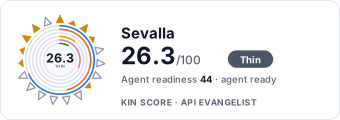 It updates itself when the score changes. Paste this where you link to your API docs:
<a href="https://apis.io/providers/sevalla/"><img src="https://apis.io/badge/sevalla/card.svg" alt="Sevalla on APIs.io — Kin Score by API Evangelist"></a>Other styles, a README pill and a shields.io endpoint are on the badge page.
Markets this provider is in provisional
The Kin Score Market layer reads a provider inside its market: its position, and how deep its integrations go. Depth is only comparable within a position. Provisional and unweighted: not part of the Kin Score or agent readiness.
| Market | Position | Depth | Registered MCP server | Declares compatibility |
|---|---|---|---|---|
| Raycast Store Extensions (first-party publishers + community-wrapped products) | undeclared | - | 1 | 1 |
Registered MCP server and declares compatibility are report only — not weighted. Undeclared means we found nothing we can read, so there is no number: we never infer integrations.
Standards implemented 1
Standards this provider implements or carries. De facto ones are profiled and measured by the API Commons; formal ones come from the standards directory and are linked by the provider's own tags. The evidence column says how each claim was established — not that it was made.
APIs 7
Individual APIs this provider publishes, each with its own machine-readable definition.
Sevalla Applications API
Deploy and manage applications from Git or Docker.
Sevalla Company API
Company users, projects, usage, and API keys.
Sevalla Databases API
Provision and manage managed databases.
Sevalla Deployments API
Trigger, inspect, and roll back deployments.
Sevalla Object Storage API
S3-compatible object storage buckets.
Sevalla Pipelines API
Multi-stage promotion pipelines and preview environments.
Sevalla Static Sites API
Build and deploy Git-backed static sites to the edge.
Scroll for all 7
Open Collections 8
Open, tool-agnostic API collections (OpenAPI-derived and Bruno).
Sevalla Applications API
OPEN COLLECTIONSevalla Applications Company API
OPEN COLLECTIONSevalla Applications Databases API
OPEN COLLECTIONSevalla Applications Deployments API
OPEN COLLECTIONSevalla Applications Object Storage API
OPEN COLLECTIONSevalla Applications Pipelines API
OPEN COLLECTIONSevalla Applications Static Sites API
OPEN COLLECTIONSevalla API
OPEN COLLECTIONScroll for all 8
MCP Servers 1
Model Context Protocol servers that expose these APIs to AI agents.
Pricing Plans 1
Published pricing tiers and plan structures.
Rate Limits 1
Documented rate limits and quota policies.
Sevalla Rate Limits
RATE LIMITSFinOps 1
Cost, billing, and metering signals for API financial operations.
Sevalla Finops
FINOPSSecurity Posture 2
Authentication, domain security, vulnerability disclosure, and trust-center signals.
Agentic Access 1
Recommended x-agentic-access execution contracts for AI agents.
Resources
Documentation 1
Reference material describing how the API behaves
Agent Surfaces 1
MCP servers, agent skills, and machine-readable catalogs
Build 1
SDKs, sample code, and the tooling you integrate with
Access & Security 2
Authentication, authorization, and security posture
Operate 1
Status, limits, changes, and where to get help
Commercial 2
Pricing, plans, and the legal terms of use
Company 3
The organization behind the API
Other 1
Properties that don't map to a standard resource type
Source (apis.yml)
Work with this as data
Every provider here is available over the APIs.io API and to AI agents over MCP.