
Semgrep
Semgrep is a fast, open-source static analysis engine and an associated AppSec Platform (Semgrep Code, Semgrep Supply Chain, and Semgrep Secrets) that finds bugs, security issues, and policy violations across source code, dependencies, and credentials. The open-source CLI runs pattern-based rules locally or in CI; the AppSec Platform layers a managed control plane on top with organization-wide policy, triage workflows, findings management, and an OpenAPI-described REST API for deployments, projects, findings, scans, secrets, and supply chain data. Editor, CI, and SCM integrations (VS Code, JetBrains, GitHub, GitLab, Bitbucket, Azure DevOps) round out the developer surface.
Semgrep is listed with 6 APIs on the APIs.io network. Tagged areas include Static Analysis, SAST, Application Security, Supply Chain, and Secrets Detection.
Semgrep’s developer surface includes engineering blog, documentation, GitHub presence, and 15 more developer resources.
Kin Score
 Kin Score
How this is scored →
scored 2026-10-23 · rubric v0.25.0
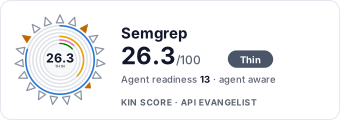 It updates itself when the score changes. Paste this where you link to your API docs:
<a href="https://apis.io/providers/semgrep/"><img src="https://apis.io/badge/semgrep/card.svg" alt="Semgrep on APIs.io — Kin Score by API Evangelist"></a>Other styles, a README pill and a shields.io endpoint are on the badge page.
Markets this provider is in provisional
The Kin Score Market layer reads a provider inside its market: its position, and how deep its integrations go. Depth is only comparable within a position. Provisional and unweighted: not part of the Kin Score or agent readiness.
| Market | Position | Depth | Registered MCP server | Declares compatibility |
|---|---|---|---|---|
| Software Supply Chain (SBOM, Signing, Open Source Security) | undeclared | - | - | - |
| IDE Extension Marketplaces (JetBrains, VS Code, Open VSX, Docker Verified Publishers, PyPI orgs) | undeclared | - | - | - |
Registered MCP server and declares compatibility are report only — not weighted. Undeclared means we found nothing we can read, so there is no number: we never infer integrations.
Standards implemented 1
Standards this provider implements or carries. De facto ones are profiled and measured by the API Commons; formal ones come from the standards directory and are linked by the provider's own tags. The evidence column says how each claim was established — not that it was made.
APIs 6
Individual APIs this provider publishes, each with its own machine-readable definition.
Semgrep AppSec Platform REST API
OpenAPI-described REST API for the Semgrep AppSec Platform. Lists deployments, projects, findings, scans, secrets, and supply chain data, and supports CI/CD and triage automatio...
Semgrep CLI
Open-source command-line static analysis engine. Runs locally and in CI to scan code with community and custom rules, emit SARIF/JSON output, and enforce policies. Authored prim...
Semgrep Community Rules
Community and Semgrep-maintained rule packs covering security, correctness, best-practice, and supply chain findings across many languages and frameworks. Consumed by the CLI an...
Semgrep VS Code Extension
Visual Studio Code extension that surfaces Semgrep findings inline while developers edit code, with quick-fix and triage actions tied to the AppSec Platform.
Semgrep Interfaces
Shared interface definitions (ATD-generated types) used between the Semgrep CLI, AppSec Platform, and language-specific clients to keep output schemas in sync.
Semgrep Documentation
Source for the Semgrep product documentation site, including CLI reference, rule-writing guides, AppSec Platform docs, and API reference.
MCP Servers 1
Model Context Protocol servers that expose these APIs to AI agents.
Pricing Plans 1
Published pricing tiers and plan structures.
Rate Limits 1
Documented rate limits and quota policies.
Semgrep Rate Limits
RATE LIMITSFinOps 1
Cost, billing, and metering signals for API financial operations.
Semgrep Finops
FINOPSSecurity Posture 4
Authentication, domain security, vulnerability disclosure, and trust-center signals.
Resources
Documentation 2
Reference material describing how the API behaves
Agent Surfaces 1
MCP servers, agent skills, and machine-readable catalogs
Build 2
SDKs, sample code, and the tooling you integrate with
Access & Security 4
Authentication, authorization, and security posture
Operate 3
Status, limits, changes, and where to get help
Commercial 3
Pricing, plans, and the legal terms of use
Company 3
The organization behind the API
Source (apis.yml)
Work with this as data
Every provider here is available over the APIs.io API and to AI agents over MCP.