
Rybbit
Rybbit is an open-source, privacy-friendly web and product analytics platform positioned as a cookieless alternative to Google Analytics and Plausible. It ingests pageviews, custom events, autocaptured interactions, performance samples and JavaScript errors through a lightweight tracking script and an HTTP /api/track endpoint, and exposes a Bearer-key-authenticated Stats and Management API covering sites, sessions, users, goals, funnels, web vitals, session replays, organizations and teams. Since v2.8.0 Rybbit also runs a first-party hosted Model Context Protocol server at https://app.rybbit.io/api/mcp — 38 tools behind an OAuth 2.1 authorization server with PKCE, dynamic client registration and a 29-scope resource:action permission model — making it directly callable by AI agents. Rybbit publishes no OpenAPI. It can be self-hosted under AGPL-3.0, which ships the identical REST and MCP surface, or consumed as a managed cloud service.
Rybbit publishes 3 API contracts indexed on the APIs.io network: Analytics API, Event Tracking API, and Sessions API. Tagged areas include Analytics, Web Analytics, Product Analytics, Privacy, and Open Source.
Rybbit’s developer surface includes authentication, engineering blog, documentation, changelog, sandbox, API reference, getting-started guide, and 42 more developer resources.
What this lets a business do 1
Business capabilities this provider's published APIs can perform, derived from its own contracts. Browse all capabilities →
What people ask Rybbit 3
The questions people put to an LLM, and the jobs they hand an agent, that Rybbit's APIs answer — each one linked to the operation that does it. Generated by API Evangelist
Kin Score
 Kin Score
How this is scored →
Kin Score
How this is scored →scored 2026-10-23 · rubric v0.25.0
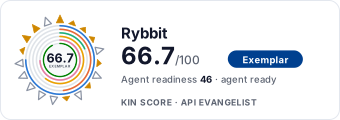 It updates itself when the score changes. Paste this where you link to your API docs:
<a href="https://apis.io/providers/rybbit/"><img src="https://apis.io/badge/rybbit/card.svg" alt="Rybbit on APIs.io — Kin Score by API Evangelist"></a>Other styles, a README pill and a shields.io endpoint are on the badge page.
APIs 3
Individual APIs this provider publishes, each with its own machine-readable definition.
Rybbit Analytics API
Stats API for events and reporting per site.
Rybbit Event Tracking API
Public ingestion endpoint for pageviews and custom events.
Rybbit Sessions API
Session-level analytics and cohort retention.
Open Collections 4
Open, tool-agnostic API collections (OpenAPI-derived and Bruno).
Rybbit Analytics API
OPEN COLLECTIONRybbit Analytics Event Tracking API
OPEN COLLECTIONRybbit Analytics Sessions API
OPEN COLLECTIONRybbit API
OPEN COLLECTIONMCP Servers 1
Model Context Protocol servers that expose these APIs to AI agents.
Rybbit MCP Server
Rybbit ships a first-party HOSTED (remote) Model Context Protocol server as part of the product — the same server code is in the AGPL-3.0 repository, so a self-hosted instance e...
MCP SERVERPricing Plans 1
Published pricing tiers and plan structures.
Rybbit Plans Pricing
PLANSRate Limits 1
Documented rate limits and quota policies.
Rybbit Rate Limits
RATE LIMITSFinOps 1
Cost, billing, and metering signals for API financial operations.
Rybbit Finops
FINOPSOpenAPI Overlays 6
Overlays applied on top of this provider's contracts. Each card says who wrote it: a document the provider publishes, or one API Evangelist derived or generated.
Rybbit Analytics Api Overlay
DERIVEDRybbit Analytics Api Phrasing Overlay
GENERATEDRybbit Sessions Api Overlay
DERIVEDRybbit Sessions Api Phrasing Overlay
GENERATEDSecurity Posture 4
Authentication, domain security, vulnerability disclosure, and trust-center signals.
Scopes 1
OAuth scopes governing access to this provider's APIs.
Agentic Access 1
Recommended x-agentic-access execution contracts for AI agents.
Resources
Get Started 5
Portal, sign-up, and the first successful call
Documentation 2
Reference material describing how the API behaves
Agent Surfaces 5
MCP servers, agent skills, and machine-readable catalogs
Design & Contract 6
Pagination, idempotency, versioning, errors, and events
Build 5
SDKs, sample code, and the tooling you integrate with
Access & Security 8
Authentication, authorization, and security posture
Scroll for all 8
Operate 5
Status, limits, changes, and where to get help
Commercial 6
Pricing, plans, and the legal terms of use
Company 3
The organization behind the API
Other 4
Properties that don't map to a standard resource type
Source (apis.yml)
Work with this as data
Every provider here is available over the APIs.io API and to AI agents over MCP.