Runware
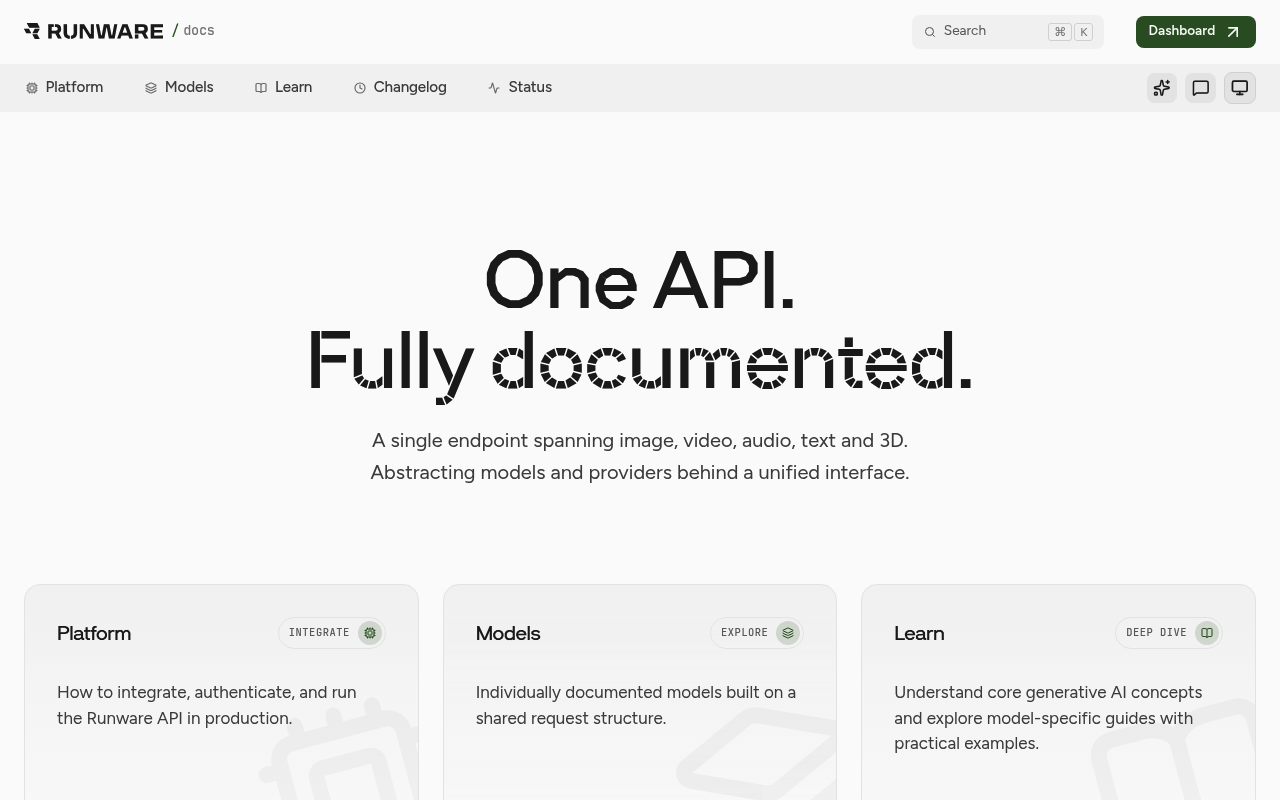
Runware is a unified AI inference platform — "one API for all AI" — that gives developers a single endpoint for image, video, audio, 3D, and text (LLM) generation across 400K+ open and closed-source models. Every request is a task object (taskType, taskUUID, model identifier, and modality parameters) posted to a single HTTP endpoint, with WebSocket and Server-Sent Events transports for low-latency and streaming workloads. Models are addressed by a creator:family@version identifier and billed pay-per-request with no subscriptions — serverless open models bill on optimized compute time while closed partner models use fixed per-request rates. Runware ships official TypeScript and Python SDKs, a static-binary CLI, a hosted Model Context Protocol (MCP) server, published Agent Skills, a Vercel AI SDK provider, and an OpenAI-compatibility layer, so the same inference surface is reachable from code, terminal, and agents.
Runware is listed with 1 API on the APIs.io network. Tagged areas include Company, Artificial Intelligence, Machine Learning, Inference, and Image Generation.
Runware’s developer surface includes documentation, API reference, getting-started guide, engineering blog, changelog, pricing, signup flow, and 26 more developer resources.
Kin Score
 Kin Score
How this is scored →
Kin Score
How this is scored →scored 2026-10-17 · rubric v0.24.0
Standards implemented 1
Standards this provider implements or carries. De facto ones are profiled and measured by the API Commons; formal ones come from the standards directory and are linked by the provider's own tags. The evidence column says how each claim was established — not that it was made.
APIs 1
Individual APIs this provider publishes, each with its own machine-readable definition.
Runware Inference API
Single task-based endpoint for image, video, audio, 3D, and text inference across 400K+ models, reachable over HTTP, WebSocket, and Server-Sent Events.
MCP Servers 1
Model Context Protocol servers that expose these APIs to AI agents.
Pricing Plans 1
Published pricing tiers and plan structures.
Security Posture 4
Authentication, domain security, vulnerability disclosure, and trust-center signals.
Resources
Get Started 3
Portal, sign-up, and the first successful call
Documentation 2
Reference material describing how the API behaves
Agent Surfaces 3
MCP servers, agent skills, and machine-readable catalogs
Design & Contract 4
Pagination, idempotency, versioning, errors, and events
Build 4
SDKs, sample code, and the tooling you integrate with
Access & Security 6
Authentication, authorization, and security posture
Operate 4
Status, limits, changes, and where to get help
Commercial 4
Pricing, plans, and the legal terms of use
Company 3
The organization behind the API
Source (apis.yml)
Work with this as data
Every provider here is available over the APIs.io API and to AI agents over MCP.