Redis is an open source, in-memory data structure store used as a database, cache, message broker, and streaming engine. It supports strings, hashes, lists, sets, sorted sets, streams, JSON, and more. Redis is used by millions of developers for caching, session management, leaderboards, pub/sub messaging, real-time analytics, and event streaming. The Redis project is governed by the Redis Community and maintained by Redis Inc.
Redis publishes 28 API contracts indexed on the APIs.io network, including Account API, Actuator API, Agent Memory - Stores API, and 25 more. Tagged areas include Cache, Database, In-Memory, Key-Value Store, and NoSQL.
The Redis catalog on APIs.io includes 1 JSON-LD context and 2 Spectral governance rulesets.
Redis’ developer surface includes documentation, engineering blog, YouTube channel, support, and 19 more developer resources.
Regulatory Posture applies to this provider. Its tags matched the
Horizontal (data, software, accessibility, platform) regime, so
Regulatory Posture carries 15 points of the composite.
If this regime is wrong for your business, say so on your
provider repo — the
applicability map is public and we will correct it.
Create-or-Update Ergonomics applies to this provider. This API accepts writes, so it
carries 10 points of the composite. It is scored from the published contracts
themselves: whether a caller can create-or-update in one call, whether the write accepts a key the caller already
holds, and whether the response says which branch ran. Without that, every write needs a search-and-branch in
front of it, and the first time that check is skipped a duplicate record is created.
Scored against the observed mean rather than raw — a provider at the catalog average is unchanged by this facet,
not penalised by it.
The six quality facets above are damped to 75 points between them,
because the conditional facet above carries the other
25. That is why each facet's contribution is shown against a damped
maximum: raising a quality facet moves the composite by 75% of its nominal
weight, not 100%. The full arithmetic is at apis.io/rating/.
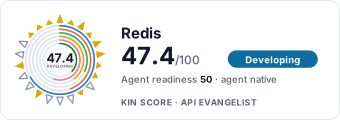
Show this score on your site.
It updates itself when the score changes. Paste this where you link to your API docs:
<a href="https://apis.io/providers/redis/"><img src="https://apis.io/badge/redis/card.svg" alt="Redis on APIs.io — Kin Score by API Evangelist"></a>
Other styles, a README pill and a shields.io endpoint are on the badge page.
Raise your score.
Agent readiness — checks not met, largest first (exact, from this profile):
A2A Agent Card+8 pts — a2a/-a2a.yml manifest, graded on conformance.grade against A2A 1.0.0
Delegated User Identity+6 pts — a served discovery document listing authorization_code in grant_types_supported (served), else an oauth2 authorizationCode flow or openIdConnect declared in an OpenAPI (documented)
Typed Event Surface+6 pts — AsyncAPI document, OR webhooks/callbacks objects in the as-published OpenAPI, OR common[].type includes Webhooks
Documented Reversibility+6 pts — a reversal operation in the contract, graded up when a window is documented too
Agentic Commerce Well-Known Document+5 pts — a parsing /.well-known/ucp.json or acp.json declaring a version and at least one service, OR (0.27) a live x402 payment challenge from _data/x402-adoption.json — `self` when its endpoints are on the provider's own domain, `platform` when they are on a vendor's
2 more unmet checks in the Agent Readiness table above.
Kin Score — facets with the most composite points still available (weight × headroom):
The Kin Score Market layer reads a provider inside its market:
its position, and how deep its integrations go. Depth is only comparable within a position. Provisional and unweighted:
not part of the Kin Score or agent readiness.
Registered MCP server and declares compatibility are report only — not weighted.
Undeclared means we found nothing we can read, so there is no number: we never infer integrations.
Standards this provider implements or carries. De facto ones are profiled and measured by the API Commons; formal ones come from the standards directory and are linked by the provider's own tags. The evidence column says how each claim was established — not that it was made.
Core Redis commands and data structure operations. Redis supports strings, hashes, lists, sets, sorted sets, streams, and more. The primary interface is the Redis Serialization ...
The Redis Cloud REST API for managing subscriptions, databases, cloud accounts, access control, and logs on the Redis Cloud platform. Available at api.redislabs.com/v1 with API ...
REST API for managing Redis Enterprise Software clusters. Provides endpoints for cluster configuration, database creation and management, user access control, and monitoring. Av...
All operations for [Role-based Access Control](https://redis.io/docs/latest/operate/rc/security/access-control/data-access-control/role-based-access-control/) (RBAC).
Tracks asynchronous background operations. See [API request lifecycle](https://redis.io/docs/latest/operate/rc/api/get-started/process-lifecycle/) for more information.
Not yet checked against Redis's own pricing page. Compiled by API Evangelist on 2026-05-04 from redis.io/pricing/; confirm before you rely on a figure. A free plan or tier is listed.
Plan
Price
Free freemium
Free
Essentials paid
$0.007 per per hour · $5.00 per monthly minimum / month
Pro paid
$0.014 per per hour · $200.00 per monthly minimum / month
Overlays applied on top of this provider's contracts. Each card says who wrote it: a document the provider publishes, or one API Evangelist derived or generated.
Calls without X-API-Key need no key. Calls with it need a paid plan — get a key.
Get an API key
Free tier, no form to fill in. Signing in shares your email address with us — we
store it to create your key and to recognise you if you sign in with another
provider. See our Privacy Policy and
Terms.
 Kin Score
How this is scored →
 It updates itself when the score changes. Paste this where you link to your API docs: