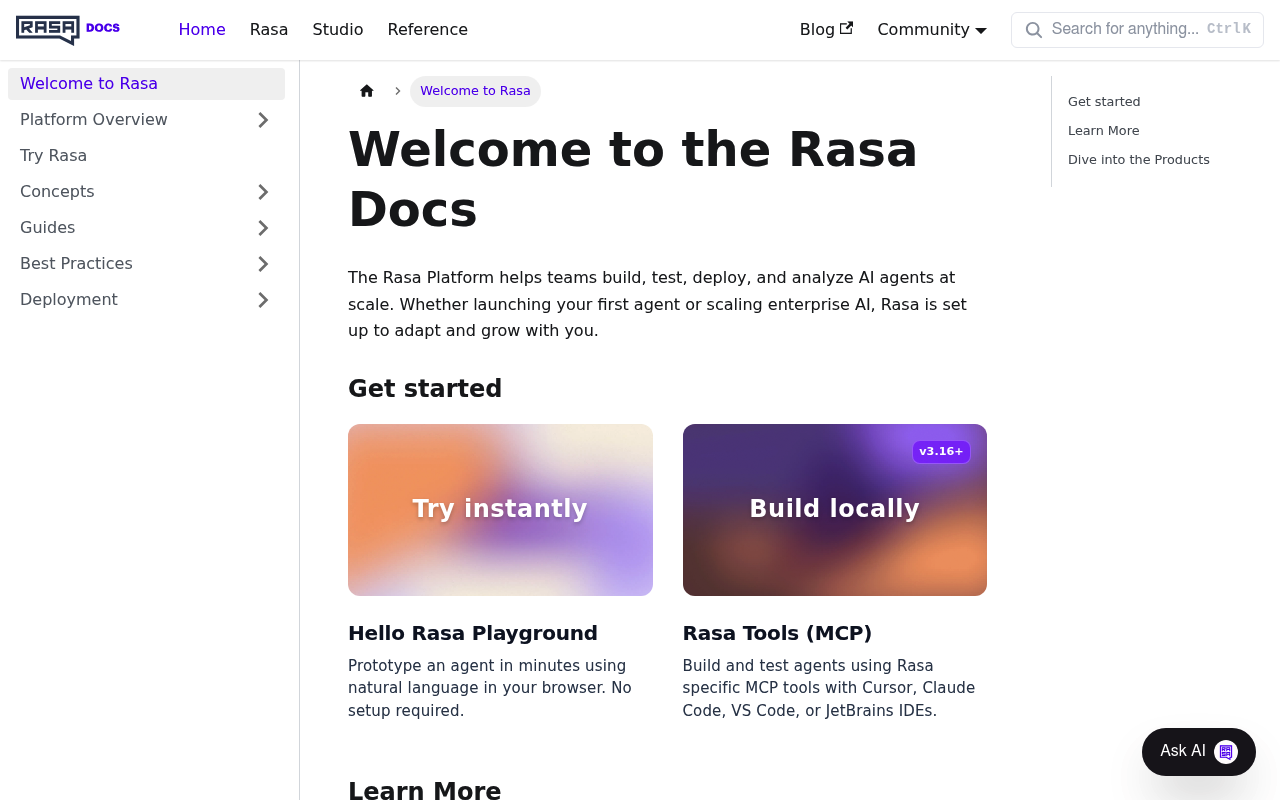
Rasa
Rasa is an open-core conversational AI framework for enterprises, built by Rasa Technologies GmbH, that natively leverages generative AI through CALM (Conversational AI with Language Models) to build reliable text and voice assistants. Rasa Pro is the pro-code framework (with Flows, custom actions, channel connectors, multi-LLM routing, observability and Kubernetes deployment); Rasa Studio is the companion no-code UI; and Rasa Open Source provides the underlying NLU and dialogue-management framework. The self-hosted runtime exposes an HTTP API for managing conversation trackers and training, testing and loading models, plus a Python SDK action server for custom actions.
Rasa publishes 5 API contracts indexed on the APIs.io network, including Domain API, Model API, SDK Action Server Endpoint API, and 2 more. Tagged areas include Company, Artificial Intelligence, Conversational AI, Chatbots, and Voice Assistant.
Rasa’s developer surface includes engineering blog, authentication, CLI, sandbox, changelog, documentation, API reference, and 23 more developer resources.
What this lets a business do 1
Business capabilities this provider's published APIs can perform, derived from its own contracts. Browse all capabilities →
Kin Score
 Kin Score
How this is scored →
Kin Score
How this is scored →scored 2026-10-17 · rubric v0.24.0
APIs 5
Individual APIs this provider publishes, each with its own machine-readable definition.
Rasa Domain API
The Domain API from Rasa — 1 operation(s) for domain.
Rasa Model API
The Model API from Rasa — 6 operation(s) for model.
Rasa SDK Action Server Endpoint API
The Rasa SDK Action Server Endpoint API from Rasa — 1 operation(s) for rasa sdk action server endpoint.
Rasa Server Information API
The Server Information API from Rasa — 3 operation(s) for server information.
Rasa Tracker API
The Tracker API from Rasa — 7 operation(s) for tracker.
Open Collections 6
Open, tool-agnostic API collections (OpenAPI-derived and Bruno).
API Collection
OPEN COLLECTIONRasa SDK - Action Server Endpoint Domain API
OPEN COLLECTIONRasa SDK - Action Server Endpoint Domain Model API
OPEN COLLECTIONRasa SDK - Action Server Endpoint Domain Tracker API
OPEN COLLECTIONPricing Plans 1
Published pricing tiers and plan structures.
Rasa Plans Pricing
PLANSOpenAPI Overlays 2
Overlays applied on top of this provider's contracts. Each card says who wrote it: a document the provider publishes, or one API Evangelist derived or generated.
Rasa Action Server Overlay
UNRECORDEDRasa Http Api Overlay
UNRECORDEDSecurity Posture 2
Authentication, domain security, vulnerability disclosure, and trust-center signals.
Agentic Access 1
Recommended x-agentic-access execution contracts for AI agents.
Resources
Get Started 4
Portal, sign-up, and the first successful call
Documentation 2
Reference material describing how the API behaves
Agent Surfaces 5
MCP servers, agent skills, and machine-readable catalogs
Design & Contract 3
Pagination, idempotency, versioning, errors, and events
Build 4
SDKs, sample code, and the tooling you integrate with
Access & Security 2
Authentication, authorization, and security posture
Operate 3
Status, limits, changes, and where to get help
Commercial 2
Pricing, plans, and the legal terms of use
Company 3
The organization behind the API
Other 2
Properties that don't map to a standard resource type
Source (apis.yml)
Work with this as data
Every provider here is available over the APIs.io API and to AI agents over MCP.