Quantum Machines is a Tel Aviv, Israel-based quantum control company that builds the Quantum Orchestration Platform (QOP) — a unified hardware and software stack for controlling quantum processors at the pulse level. Its hardware portfolio centers on the OPX+ and OPX1000 controllers, which are built around a custom Pulse Processing Unit (PPU) architecture that executes classical control and real-time feedback alongside arbitrary waveform generation, with sub-microsecond classical-quantum round trips and 160 ns active reset latency. The platform is programmed in QUA, the company's domain-specific pulse-level language, exposed to developers through the qm-qua Python SDK and an extensive open-source ecosystem under the qua-platform GitHub organization (QUAlibrate, QUAM, qua-libs, py-qua-tools, qua-dashboards). Quantum Machines also ships peripheral hardware including the Octave up/down converter (to 18 GHz), QDAC-II ultra-low-noise DACs, QSwitch, QBox, and the QCage/QBoard/QFilter cryogenic line. The platform is qubit-modality agnostic, supporting superconducting, semiconductor spin, trapped-ion, neutral-atom, and color-center systems, and is used by university labs (MIT, Caltech, Harvard, Princeton, Weizmann) and quantum startups (Alice & Bob, Diraq, EeroQ). Quantum Machines has partnered with NVIDIA on the DGX Quantum hybrid quantum-classical compute platform and acquired the Delft-based QHarbor Bioscience team as a European R&D hub. Quantum Machines does not currently publish a public REST API, OpenAPI specification, or self-service developer signup; the QOP control surface is reached exclusively via the qm-qua Python SDK against an OPX/OPX1000 controller (hardware or qm-saas cloud simulator).
Quantum Machines is listed with 13 APIs on the APIs.io network. Tagged areas include Quantum Computing, Quantum Control, Pulse Level Programming, QUA, and OPX.
Quantum Machines’ developer surface includes documentation, GitHub presence, engineering blog, product news, support, YouTube channel, and 17 more developer resources.
Regulatory Posture applies to this provider. Its tags matched the
Horizontal (data, software, accessibility, platform) regime, so
Regulatory Posture carries 15 points of the composite.
If this regime is wrong for your business, say so on your
provider repo — the
applicability map is public and we will correct it.
Create-or-Update Ergonomics could not be measured. We hold no machine-readable contract for
this provider to read, so there is nothing to measure a write surface against. Excluded rather than scored zero:
never-measured and measured-empty are different facts. Publishing an OpenAPI is what makes this facet — and
several others — scorable at all.
The six quality facets above are damped to 85 points between them,
because the conditional facet above carries the other
15. That is why each facet's contribution is shown against a damped
maximum: raising a quality facet moves the composite by 85% of its nominal
weight, not 100%. The full arithmetic is at apis.io/rating/.
Show this score on your site.
It updates itself when the score changes. Paste this where you link to your API docs:
<a href="https://apis.io/providers/quantum-machines/"><img src="https://apis.io/badge/quantum-machines/card.svg" alt="Quantum Machines on APIs.io — Kin Score by API Evangelist"></a>
Other styles, a README pill and a shields.io endpoint are on the badge page.
Raise your score.
Agent readiness — checks not met, largest first (exact, from this profile):
Machine-Readable Auth+10 pts — a served openid-configuration/oauth-authorization-server carrying `issuer` (served), else the securitySchemes class in the provider OpenAPIs — bound (mutualTLS, DPoP, Signature) > negotiable (oauth2 authorizationCode/clientCredentials, openIdConnect) > bearer (http bearer, apiKey)
Idempotency+9 pts — OpenAPI mutating operations declare an idempotency key — a header, a request-body property, or a named de-duplication token whose own description says so (verified); else common[].type matches /idempoten/i (documented)
Stable Error Semantics+8 pts — OpenAPI $refs a shared error schema across 4xx/5xx responses (verified), else common[].type includes ErrorCatalog / ErrorCodes / DeclineCodes
13 more unmet checks in the Agent Readiness table above.
Kin Score — facets with the most composite points still available (weight × headroom):
The Kin Score Market layer reads a provider inside its market:
its position, and how deep its integrations go. Depth is only comparable within a position. Provisional and unweighted:
not part of the Kin Score or agent readiness.
Registered MCP server and declares compatibility are report only — not weighted.
Undeclared means we found nothing we can read, so there is no number: we never infer integrations.
Official Python SDK for the QUA pulse-level programming language. Provides the QuantumMachinesManager client, qua DSL (program, declare, play, measure, wait, save, stream_proces...
Cloud-hosted OPX simulator distributed as the qm-saas Python package. Allows developers to author and validate QUA programs without physical OPX hardware; mirrors the qm-qua cli...
High-level libraries and reference experiments built over QUA. Covers superconducting, semiconductor, NV, and other qubit modalities with ready-to-run calibration scripts and ex...
Toolbox of Python utilities for QUA experiments — analog filters, mixer calibration, plotting, calibration helpers, and integrations with common lab instruments. Distributed on ...
Framework for abstracting and managing quantum programming environments on top of QUA. Provides an object model for qubits, resonators, pulses, and configuration; serializes to ...
User-programmable calibration software for large-scale quantum computers. Orchestrates calibration graphs (calibration nodes and their dependencies) on top of QUA/QUAM.
aid: quantum-machines
name: Quantum Machines
description: Quantum Machines is a Tel Aviv, Israel-based quantum control company that builds the Quantum Orchestration Platform
  (QOP) — a unified hardware and software stack for controlling quantum processors at the pulse level. Its hardware portfolio
  centers on the OPX+ and OPX1000 controllers, which are built around a custom Pulse Processing Unit (PPU) architecture that
  executes classical control and real-time feedback alongside arbitrary waveform generation, with sub-microsecond classical-quantum
  round trips and 160 ns active reset latency. The platform is programmed in QUA, the company's domain-specific pulse-level
  language, exposed to developers through the qm-qua Python SDK and an extensive open-source ecosystem under the qua-platform
  GitHub organization (QUAlibrate, QUAM, qua-libs, py-qua-tools, qua-dashboards). Quantum Machines also ships peripheral hardware
  including the Octave up/down converter (to 18 GHz), QDAC-II ultra-low-noise DACs, QSwitch, QBox, and the QCage/QBoard/QFilter
  cryogenic line. The platform is qubit-modality agnostic, supporting superconducting, semiconductor spin, trapped-ion, neutral-atom,
  and color-center systems, and is used by university labs (MIT, Caltech, Harvard, Princeton, Weizmann) and quantum startups
  (Alice & Bob, Diraq, EeroQ). Quantum Machines has partnered with NVIDIA on the DGX Quantum hybrid quantum-classical compute
  platform and acquired the Delft-based QHarbor Bioscience team as a European R&D hub. Quantum Machines does not currently
  publish a public REST API, OpenAPI specification, or self-service developer signup; the QOP control surface is reached exclusively
  via the qm-qua Python SDK against an OPX/OPX1000 controller (hardware or qm-saas cloud simulator).
type: Index
deliveryModel:
  model: unknown
  license_evidence:
    not_product:
    - qua-platform/py-qua-tools
    - qua-platform/qua-dashboards
    - qua-platform/qua-libs
    - qua-platform/qualibrate
    - qua-platform/qualibrate-app
  open_source: unknown
  commercial: false
  callable_host: false
  label: Delivery model not determined — needs a product licence on record
  confidence: low
  source:
  - repository-not-product
  generated: '2026-09-25'
  method: derived
accessModel:
  pricing: unknown
  onboarding: unknown
  trial: false
  try_now: false
  public: false
  label: Unknown
  confidence: low
  source:
  - security
  generated: '2026-11-06'
  method: derived
position: Producing
access: 3rd-Party
image: https://kinlane-images.s3.amazonaws.com/shared/apis-json/icons/quantum-machines.png
tags:
- Quantum Computing
- Quantum Control
- Pulse Level Programming
- QUA
- OPX
- OPX1000
- QOP
- Quantum Orchestration Platform
- Pulse Processing Unit
- Real Time Feedback
- Arbitrary Waveform Generation
- Superconducting Qubits
- Trapped Ions
- Neutral Atom
- Color Centers
- Cryogenic Electronics
- Hardware
- Israel
tags_raw:
- Quantum Computing
- Quantum Control
- Pulse Level Programming
- QUA
- OPX
- OPX1000
- QOP
- Quantum Orchestration Platform
- Pulse Processing Unit
- Real Time Feedback
- Arbitrary Waveform Generation
- Superconducting Qubits
- Trapped Ions
- Neutral Atoms
- Color Centers
- Cryogenic Electronics
- Hardware
- Israel
url: https://raw.githubusercontent.com/api-evangelist/quantum-machines/refs/heads/main/apis.yml
created: '2026-05-24'
modified: '2026-05-24'
specificationVersion: '0.23'
apis:
- aid: quantum-machines:qm-qua-python-sdk
  name: qm-qua Python SDK
  description: Official Python SDK for the QUA pulse-level programming language. Provides the QuantumMachinesManager client,
    qua DSL (program, declare, play, measure, wait, save, stream_processing, math, casting, random), Configuration API, Results,
    Simulator, and Octave APIs to compile and execute QUA programs against an OPX+, OPX1000, or the qm-saas cloud simulator.
    Communicates with the controller over gRPC; not a public REST API.
  tags:
  - Quantum Computing
  - SDK
  - Python
  - QUA
  - QOP
  humanURL: https://docs.quantum-machines.co/latest/docs/API_references/qua/dsl_main/
  properties:
  - url: https://docs.quantum-machines.co/latest/docs/API_references/qua/dsl_main/
    type: Documentation
  - url: https://pypi.org/project/qm-qua/
    type: PyPI
  - url: https://docs.quantum-machines.co/latest/docs/API_references/
    type: APIReference
  - url: https://docs.quantum-machines.co/latest/docs/Releases/qm-qua_releases/
    type: ReleaseNotes
- aid: quantum-machines:qm-saas
  name: qm-saas Cloud Simulator
  description: Cloud-hosted OPX simulator distributed as the qm-saas Python package. Allows developers to author and validate
    QUA programs without physical OPX hardware; mirrors the qm-qua client surface against a managed simulator backend.
  tags:
  - Quantum Computing
  - Simulator
  - Cloud
  - QUA
  humanURL: https://pypi.org/project/qm-saas/
  properties:
  - url: https://pypi.org/project/qm-saas/
    type: PyPI
  - url: https://docs.quantum-machines.co/latest/docs/Guides/simulator/
    type: Documentation
- aid: quantum-machines:qua-libs
  name: QUA Libraries (qua-libs)
  description: High-level libraries and reference experiments built over QUA. Covers superconducting, semiconductor, NV, and
    other qubit modalities with ready-to-run calibration scripts and example sequences.
  tags:
  - Quantum Computing
  - Library
  - Example
  - QUA
  tags_raw:
  - Quantum Computing
  - Libraries
  - Examples
  - QUA
  humanURL: https://github.com/qua-platform/qua-libs
  properties:
  - url: https://github.com/qua-platform/qua-libs
    type: SourceCode
- aid: quantum-machines:py-qua-tools
  name: py-qua-tools
  description: Toolbox of Python utilities for QUA experiments — analog filters, mixer calibration, plotting, calibration
    helpers, and integrations with common lab instruments. Distributed on PyPI as qualang-tools.
  tags:
  - Quantum Computing
  - Tools
  - Python
  - QUA
  humanURL: https://github.com/qua-platform/py-qua-tools
  properties:
  - url: https://github.com/qua-platform/py-qua-tools
    type: SourceCode
  - url: https://pypi.org/project/qualang-tools/
    type: PyPI
- aid: quantum-machines:quam
  name: Quantum Abstract Machine (QUAM)
  description: Framework for abstracting and managing quantum programming environments on top of QUA. Provides an object model
    for qubits, resonators, pulses, and configuration; serializes to JSON and generates QUA configuration dictionaries.
  tags:
  - Quantum Computing
  - Framework
  - QUA
  - Abstraction
  humanURL: https://github.com/qua-platform/quam
  properties:
  - url: https://github.com/qua-platform/quam
    type: SourceCode
  - url: https://qua-platform.github.io/quam/
    type: Documentation
- aid: quantum-machines:quam-builder
  name: QUAM Builder
  description: Builder tool for generating QUAM state from hardware wiring and configuration inputs.
  tags:
  - Quantum Computing
  - QUAM
  - Builder
  humanURL: https://github.com/qua-platform/quam-builder
  properties:
  - url: https://github.com/qua-platform/quam-builder
    type: SourceCode
- aid: quantum-machines:qualibrate
  name: QUAlibrate
  description: User-programmable calibration software for large-scale quantum computers. Orchestrates calibration graphs (calibration
    nodes and their dependencies) on top of QUA/QUAM.
  tags:
  - Quantum Computing
  - Calibration
  - QUA
  humanURL: https://github.com/qua-platform/qualibrate
  properties:
  - url: https://github.com/qua-platform/qualibrate
    type: SourceCode
  - url: https://qua-platform.github.io/qualibrate/
    type: Documentation
- aid: quantum-machines:qualibrate-app
  name: QUAlibrate App
  description: TypeScript front-end web application for running and visualizing QUAlibrate calibration graphs.
  tags:
  - Quantum Computing
  - Calibration
  - Web App
  tags_raw:
  - Quantum Computing
  - Calibration
  - WebApp
  humanURL: https://github.com/qua-platform/qualibrate-app
  properties:
  - url: https://github.com/qua-platform/qualibrate-app
    type: SourceCode
- aid: quantum-machines:qualibrate-core
  name: QUAlibrate Core
  description: Core Python library that defines the calibration node and graph abstractions used by QUAlibrate.
  tags:
  - Quantum Computing
  - Calibration
  - Library
  humanURL: https://github.com/qua-platform/qualibrate-core
  properties:
  - url: https://github.com/qua-platform/qualibrate-core
    type: SourceCode
- aid: quantum-machines:qualibrate-runner
  name: QUAlibrate Runner
  description: Execution service that runs QUAlibrate calibration nodes and graphs.
  tags:
  - Quantum Computing
  - Calibration
  - runner
  tags_raw:
  - Quantum Computing
  - Calibration
  - Runner
  humanURL: https://github.com/qua-platform/qualibrate-runner
  properties:
  - url: https://github.com/qua-platform/qualibrate-runner
    type: SourceCode
- aid: quantum-machines:qualibrate-config
  name: QUAlibrate Config
  description: Configuration management package for QUAlibrate deployments.
  tags:
  - Quantum Computing
  - Calibration
  - Configuration
  humanURL: https://github.com/qua-platform/qualibrate-config
  properties:
  - url: https://github.com/qua-platform/qualibrate-config
    type: SourceCode
- aid: quantum-machines:qualibration-libs
  name: QUAlibration Libraries
  description: Collection of calibration graph building blocks (qubit spectroscopy, Rabi, T1, T2, readout calibration, etc.)
    for QUAlibrate.
  tags:
  - Quantum Computing
  - Calibration
  - Library
  tags_raw:
  - Quantum Computing
  - Calibration
  - Libraries
  humanURL: https://github.com/qua-platform/qualibration-libs
  properties:
  - url: https://github.com/qua-platform/qualibration-libs
    type: SourceCode
- aid: quantum-machines:qua-dashboards
  name: QUA Dashboards
  description: Interactive dashboards (Plotly Dash / Streamlit) for visualizing QUA experiment results and live data streams.
  tags:
  - Quantum Computing
  - Dashboards
  - Visualization
  humanURL: https://github.com/qua-platform/qua-dashboards
  properties:
  - url: https://github.com/qua-platform/qua-dashboards
    type: SourceCode
common:
- type: DomainSecurity
  url: security/quantum-machines-domain-security.yml
- type: Website
  url: https://www.quantum-machines.co
- type: Documentation
  url: https://docs.quantum-machines.co/latest/
- type: QOP
  url: https://www.quantum-machines.co/products/qop/
- type: OPX1000
  url: https://www.quantum-machines.co/products/opx1000/
- type: OPXPlus
  url: https://www.quantum-machines.co/products/opx/
- type: Octave
  url: https://www.quantum-machines.co/products/octave/
- type: QUA
  url: https://docs.quantum-machines.co/latest/docs/Introduction/qua_overview/
- type: QUAlibrate
  url: https://qua-platform.github.io/qualibrate/
- type: PythonSDK
  url: https://pypi.org/project/qm-qua/
- type: CloudSimulator
  url: https://pypi.org/project/qm-saas/
- type: GitHub
  url: https://github.com/qua-platform
- type: Blog
  url: https://www.quantum-machines.co/blog/
- type: News
  url: https://www.quantum-machines.co/news/
- type: Customers
  url: https://www.quantum-machines.co/customers/
- type: Partners
  url: https://www.quantum-machines.co/partners/
- type: Company
  url: https://www.quantum-machines.co/about/
- type: Careers
  url: https://www.quantum-machines.co/careers/
- type: Contact
  url: https://www.quantum-machines.co/contact/
- type: Support
  url: https://www.quantum-machines.co/support/
- type: LinkedIn
  url: https://www.linkedin.com/company/quantum-machines/
- type: Twitter
  url: https://twitter.com/QM_quantum
- type: YouTube
  url: https://www.youtube.com/@QuantumMachines
maintainers:
- FN: Kin Lane
  email: kin@apievangelist.com
Quantum Machines API — frequently asked questions
Does Quantum Machines have an API?
Yes. APIs.io lists 13 APIs from Quantum Machines, including qm-qua Python SDK, qm-saas Cloud Simulator and QUA Libraries (qua-libs), and 10 more.
Is the Quantum Machines API ready for AI agents?
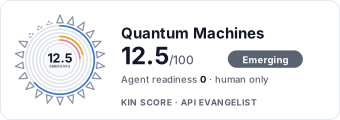
Quantum Machines has a Kin Score of 12.5 out of 100 (emerging) and an Agent Readiness score of 0.0 (human-only), scored by API Evangelist on 2026-11-06.
Calls without X-API-Key need no key. Calls with it need a paid plan — get a key.
Get an API key
Free tier, no form to fill in. Signing in shares your email address with us — we
store it to create your key and to recognise you if you sign in with another
provider. See our Privacy Policy and
Terms.
 Kin Score
How this is scored →
 It updates itself when the score changes. Paste this where you link to your API docs: