PulseMCP
PulseMCP is a community platform and directory dedicated to the Model Context Protocol (MCP) — the open protocol for connecting AI assistants and agents to external tools, data, and systems. Founded by Tadas Antanavicius (MCP Steering Committee) and Mike Coughlin in early 2025, PulseMCP curates searchable directories of MCP servers and clients, publishes use cases, runs the "Agentic Loop" newsletter, and operates a Discord community for builders. It also exposes a public PulseMCP Registry API (api.pulsemcp.com, v0.1) implementing the Generic MCP Registry API specification with PulseMCP-specific enriched metadata such as popularity, security analyses, and compatibility data. The PulseMCP GitHub organization additionally maintains MCP servers, the AIR collaboration framework, and shared agentic-engineering templates and artifacts. Access to the API requires contacting PulseMCP for a key and tenant ID; the directory and content are free to browse.
PulseMCP is listed with 1 API on the APIs.io network. Tagged areas include MCP, AI Agents, Agentic Engineering, Directory, and Registry.
PulseMCP’s developer surface includes CLI, changelog, engineering blog, documentation, support, GitHub presence, and 27 more developer resources.
Kin Score
 Kin Score
How this is scored →
Kin Score
How this is scored →scored 2026-10-23 · rubric v0.25.0
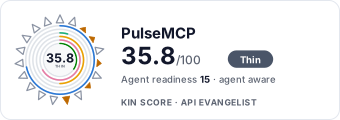 It updates itself when the score changes. Paste this where you link to your API docs:
<a href="https://apis.io/providers/pulsemcp/"><img src="https://apis.io/badge/pulsemcp/card.svg" alt="PulseMCP on APIs.io — Kin Score by API Evangelist"></a>Other styles, a README pill and a shields.io endpoint are on the badge page.
Markets this provider is in provisional
The Kin Score Market layer reads a provider inside its market: its position, and how deep its integrations go. Depth is only comparable within a position. Provisional and unweighted: not part of the Kin Score or agent readiness.
| Market | Position | Depth | Registered MCP server | Declares compatibility |
|---|---|---|---|---|
| Agent Skills (SKILL.md packages) | undeclared | - | - | 1 |
| Raycast Store Extensions (first-party publishers + community-wrapped products) | undeclared | - | - | 1 |
Registered MCP server and declares compatibility are report only — not weighted. Undeclared means we found nothing we can read, so there is no number: we never infer integrations.
APIs 1
Individual APIs this provider publishes, each with its own machine-readable definition.
PulseMCP Registry API
Public v0.1 API for browsing MCP servers, server versions, and ecosystem metadata in the PulseMCP Registry. Implements the Generic MCP Registry API specification with PulseMCP e...
MCP Servers 1
Model Context Protocol servers that expose these APIs to AI agents.
PulseMCP MCP Server
PulseMCP authors and maintains 32 MCP servers — 4 "productionized" under the @pulsemcp/ npm scope and 28 "experimental" under unscoped npm names. EVERY ONE OF THEM IS A LOCAL ST...
MCP SERVERPricing Plans 1
Published pricing tiers and plan structures.
Rate Limits 1
Documented rate limits and quota policies.
Pulsemcp Rate Limits
RATE LIMITSSecurity Posture 2
Authentication, domain security, vulnerability disclosure, and trust-center signals.
Resources
Get Started 1
Portal, sign-up, and the first successful call
Documentation 1
Reference material describing how the API behaves
Agent Surfaces 3
MCP servers, agent skills, and machine-readable catalogs
Design & Contract 1
Pagination, idempotency, versioning, errors, and events
Build 7
SDKs, sample code, and the tooling you integrate with
Scroll for all 7
Access & Security 2
Authentication, authorization, and security posture
Operate 5
Status, limits, changes, and where to get help
Commercial 3
Pricing, plans, and the legal terms of use
Company 5
The organization behind the API
Other 5
Properties that don't map to a standard resource type
Source (apis.yml)
Work with this as data
Every provider here is available over the APIs.io API and to AI agents over MCP.