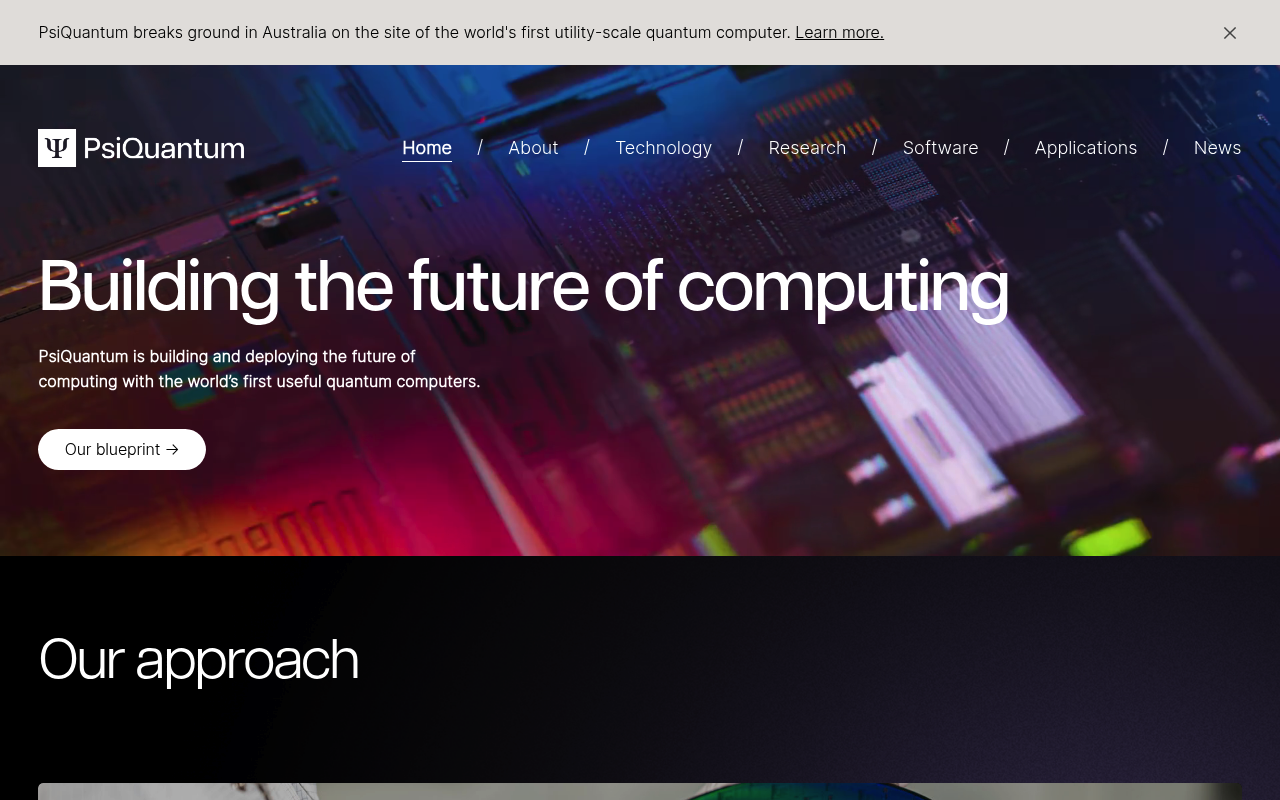
PsiQuantum website screenshot

PsiQuantum

PsiQuantum is a Palo Alto, California photonic quantum computing company founded in 2016 by Jeremy O'Brien, Terry Rudolph, Pete Shadbolt, and Mark Thompson, building utility-scale, fault-tolerant quantum computers based on single-photon qubits at telecom wavelength. Its Omega chipset — a silicon photonic system integrating on-chip single-photon sources, superconducting nanowire single-photon detectors, barium-titanate optical switches, and low-loss fiber couplers — is manufactured on 300mm wafers at GlobalFoundries' flagship fab in Malta, NY, leveraging mature semiconductor processes rather than exotic cryogenic fabrication. The company is constructing two utility- scale, million-qubit, fault-tolerant quantum computing sites: one at Moreton Bay, Queensland, Australia (in partnership with the Australian and Queensland governments) and one at the Illinois Quantum and Microelectronics Park in Chicago, Illinois (with additional R&D at PsiLabs in Daresbury, UK and assembly at PsiFactory in Milpitas, CA). PsiQuantum exposes a developer surface aimed at fault-tolerant quantum algorithm researchers: Construct, an enterprise platform for FTQC algorithm development, resource analysis, and training; Circuit Designer, a free web tool for prototyping and visualizing fault-tolerant quantum circuits; Circuit Hub, a shared library of `.circuit` files; and two open-source Python projects on GitHub — Bartiq, a symbolic quantum resource estimator that compiles subroutine-level costs to global T-gate, Toffoli, qubit, and circuit-volume estimates, and QREF, an open JSON-Schema-based format for representing quantum algorithms as hierarchical DAGs with a Pydantic validation library and a `qref-render` visualization tool. NVIDIA's CUDA-Q is integrated into Construct for accelerated simulation. PsiQuantum does not currently publish a commercial cloud-access REST API, OpenAPI specification, or a general-purpose quantum-execution SDK comparable to those of gate-model quantum cloud providers — its public developer artifacts are confined to FTQC resource-estimation tooling and algorithm-design surfaces — and there is no public pricing or self-serve tier for the underlying quantum hardware.

PsiQuantum is profiled on the APIs.io network. Tagged areas include Quantum Computing, Photonic Quantum Computing, Fault-Tolerant Quantum Computing, FTQC, and Single Photon Qubits.

PsiQuantum’s developer surface includes GitHub presence, product news, YouTube channel, and 18 more developer resources.

4.1/100 minimal ▬ flat Agent 0/100 human only Front door AI 1/6 silent Full breakdown ↓
scored 2026-09-25 · rubric v0.23.0
0 APIs
Quantum ComputingPhotonic Quantum ComputingFault-Tolerant Quantum ComputingFTQCSingle Photon QubitsSilicon PhotonicsQuantum Resource EstimationQuantum AlgorithmsQuantum SoftwareOmega ChipsetConstructCircuit DesignerBartiqQREFSemiconductorsHardware

Kin Score

Kin Score Kin Score How this is scored →
scored 2026-09-25 · rubric v0.23.0
Regulatory Posture applies to this provider. Its tags matched the Horizontal (data, software, accessibility, platform) regime, so Regulatory Posture carries 15 points of the composite. If this regime is wrong for your business, say so on your provider repo — the applicability map is public and we will correct it.
Create-or-Update Ergonomics could not be measured. We hold no machine-readable contract for this provider to read, so there is nothing to measure a write surface against. Excluded rather than scored zero: never-measured and measured-empty are different facts. Publishing an OpenAPI is what makes this facet — and several others — scorable at all.
The six quality facets above are damped to 85 points between them, because the conditional facet above carries the other 15. That is why each facet's contribution is shown against a damped maximum: raising a quality facet moves the composite by 85% of its nominal weight, not 100%. The full arithmetic is at apis.io/rating/.
Improve this rating by publishing the missing artifacts — every area above can be raised, and the full rubric is at apis.io/rating/. Every facet and dimension name above is a link: it opens that measurement's own page — what it means, the exact checks that feed it, how the whole catalog distributes on it, and the providers at the top of it. This rating is computed from github.com/api-evangelist/psiquantum: open an issue to ask a question, or submit a pull request to add artifacts. Submit an artifact on GitHub — free → Manage your own listing — the Influence plan, $499/mo →

Security Posture 1

Authentication, domain security, vulnerability disclosure, and trust-center signals.

Psiquantum Domain Security

TLSv1.3 · HSTS · DMARC

SECURITY

Resources

Documentation 2

Reference material describing how the API behaves

Build 1

SDKs, sample code, and the tooling you integrate with

Access & Security 1

Authentication, authorization, and security posture

Learn 1

Tutorials, courses, talks, and written guidance

Operate 1

Status, limits, changes, and where to get help

Company 7

The organization behind the API

Scroll for all 7

Other 8

Properties that don't map to a standard resource type

Scroll for all 8

Source (apis.yml)

apis.yml Raw ↑
aid: psiquantum
name: PsiQuantum
description: 'PsiQuantum is a Palo Alto, California photonic quantum computing company founded in 2016 by Jeremy O''Brien,
  Terry Rudolph, Pete Shadbolt, and Mark Thompson, building utility-scale, fault-tolerant quantum computers based on single-photon
  qubits at telecom wavelength. Its Omega chipset — a silicon photonic system integrating on-chip single-photon sources, superconducting
  nanowire single-photon detectors, barium-titanate optical switches, and low-loss fiber couplers — is manufactured on 300mm
  wafers at GlobalFoundries'' flagship fab in Malta, NY, leveraging mature semiconductor processes rather than exotic cryogenic
  fabrication. The company is constructing two utility- scale, million-qubit, fault-tolerant quantum computing sites: one
  at Moreton Bay, Queensland, Australia (in partnership with the Australian and Queensland governments) and one at the Illinois
  Quantum and Microelectronics Park in Chicago, Illinois (with additional R&D at PsiLabs in Daresbury, UK and assembly at
  PsiFactory in Milpitas, CA). PsiQuantum exposes a developer surface aimed at fault-tolerant quantum algorithm researchers:
  Construct, an enterprise platform for FTQC algorithm development, resource analysis, and training; Circuit Designer, a free
  web tool for prototyping and visualizing fault-tolerant quantum circuits; Circuit Hub, a shared library of `.circuit` files;
  and two open-source Python projects on GitHub — Bartiq, a symbolic quantum resource estimator that compiles subroutine-level
  costs to global T-gate, Toffoli, qubit, and circuit-volume estimates, and QREF, an open JSON-Schema-based format for representing
  quantum algorithms as hierarchical DAGs with a Pydantic validation library and a `qref-render` visualization tool. NVIDIA''s
  CUDA-Q is integrated into Construct for accelerated simulation. PsiQuantum does not currently publish a commercial cloud-access
  REST API, OpenAPI specification, or a general-purpose quantum-execution SDK comparable to those of gate-model quantum cloud
  providers — its public developer artifacts are confined to FTQC resource-estimation tooling and algorithm-design surfaces
  — and there is no public pricing or self-serve tier for the underlying quantum hardware.'
type: Index
deliveryModel:
  model: unknown
  open_source: false
  commercial: false
  callable_host: false
  label: Delivery model not determined — needs a product licence on record
  confidence: low
  source:
  - none
  generated: '2026-08-28'
  method: derived
accessModel:
  pricing: unknown
  onboarding: unknown
  trial: false
  try_now: false
  public: false
  label: Unknown
  confidence: low
  source: []
  generated: '2026-07-22'
  method: derived
position: Producing
access: 3rd-Party
image: https://kinlane-images.s3.amazonaws.com/shared/apis-json/icons/psiquantum.png
tags:
- Quantum Computing
- Photonic Quantum Computing
- Fault-Tolerant Quantum Computing
- FTQC
- Single Photon Qubits
- Silicon Photonics
- Quantum Resource Estimation
- Quantum Algorithms
- Quantum Software
- Omega Chipset
- Construct
- Circuit Designer
- Bartiq
- QREF
- Semiconductors
- Hardware
tags_raw:
- Quantum Computing
- Photonic Quantum Computing
- Fault Tolerant Quantum Computing
- FTQC
- Single Photon Qubits
- Silicon Photonics
- Quantum Resource Estimation
- Quantum Algorithms
- Quantum Software
- Omega Chipset
- Construct
- Circuit Designer
- Bartiq
- QREF
- Semiconductor
- Hardware
url: https://raw.githubusercontent.com/api-evangelist/psiquantum/refs/heads/main/apis.yml
created: '2026-05-24'
modified: '2026-05-24'
specificationVersion: '0.23'
apis: []
common:
- type: DomainSecurity
  url: security/psiquantum-domain-security.yml
- type: Website
  url: https://www.psiquantum.com
- type: About
  url: https://www.psiquantum.com/about
- type: Technology
  url: https://www.psiquantum.com/technology
- type: Research
  url: https://www.psiquantum.com/research
- type: Applications
  url: https://www.psiquantum.com/applications
- type: Software
  url: https://www.psiquantum.com/psiquantum-software
- type: CircuitDesigner
  url: https://circuits.psiquantum.com
- type: Bartiq
  url: https://github.com/PsiQ/bartiq
- type: BartiqDocs
  url: https://psiq.github.io/bartiq/
- type: QREF
  url: https://github.com/PsiQ/qref
- type: QREFDocs
  url: https://psiq.github.io/qref/
- type: CircuitHub
  url: https://github.com/PsiQ/circuit-hub
- type: GitHub
  url: https://github.com/PsiQ
- type: News
  url: https://www.psiquantum.com/news
- type: PressMaterials
  url: https://www.psiquantum.com/press-materials
- type: Careers
  url: https://www.psiquantum.com/careers
- type: Contact
  url: https://www.psiquantum.com/contact-us
- type: LinkedIn
  url: https://www.linkedin.com/company/psiquantum
- type: Twitter
  url: https://twitter.com/PsiQuantum
- type: YouTube
  url: https://www.youtube.com/@psiquantum
maintainers:
- FN: Kin Lane
  email: kin@apievangelist.com

Work with this as data

Every provider here is available over the APIs.io API and to AI agents over MCP.

MCP server

One button, every client — Claude, Cursor, VS Code and the rest.

https://apis.io/mcp

Tools for providers

9 MCP tools reach this
  • find_providersBrowse and filter every provider in the catalog.
  • get_provider_artifactsEvery artifact this provider publishes, grouped by type.
  • get_provider_operationsEvery operation across all of their OpenAPIs — one call instead of parsing every spec.
  • get_provider_toolsEvery MCP tool they ship, with the operation each wraps.
  • get_provider_evidenceHow each part of their score was established. Free — the basis for a claim should not sit behind it.
  • get_provider_ratingPRO — composite, band, trend and facet scores.
  • apis_io_searchSTART HERE — APIs, providers and tags for one query, each with its total.
  • resolveTurn a domain, URL or GitHub org into the provider it belongs to.
  • find_cohortsEvery scored population of providers in the catalog.
All 92 tools →

Call it yourself

curl for this page
This provider
curl "https://apis.io/api/v1/providers/psiquantum"
All providers
curl "https://apis.io/api/v1/providers?limit=25"
Every operation they expose
curl "https://apis.io/api/v1/providers/psiquantum/operations?limit=25"
How their score was established
curl "https://apis.io/api/v1/providers/psiquantum/evidence"

Discovery needs no key. Ratings and market analysis are Pro.

Get an API key

Free tier, no form to fill in. Signing in shares your email address with us — we store it to create your key and to recognise you if you sign in with another provider. See our Privacy Policy and Terms.

A second provider on the same verified email joins the account you already have.
