PPL
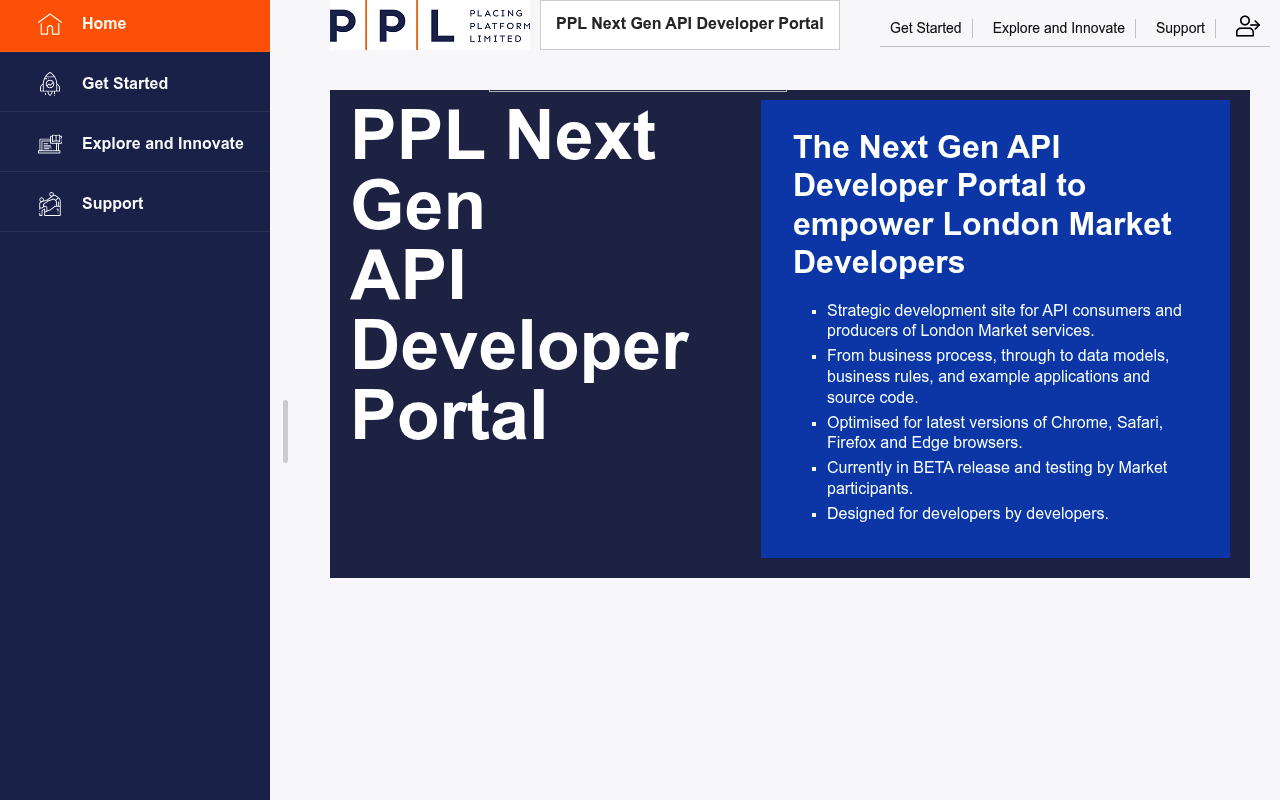
PPL (Placing Platform Limited) is the London Market's not-for-profit electronic placing platform, incorporated in England and Wales in 2013 and trading since the first risk was bound on the platform in July 2016. Owned collectively by the market it serves, PPL lets brokers and carriers quote, negotiate, bind and renew open-market (re)insurance risks electronically across almost all classes of business written in London, and is used by roughly 200 carriers and 200 broking firms. It is market infrastructure rather than a carrier or a broker - it writes no insurance and carries no risk - and it is one of the accredited placing platforms underpinning Lloyd's Blueprint Two, generating the Core Data Record for bound business. Its API posture is unusual for insurance and genuinely good: the PPL Next Gen API Developer Portal at developer.pplnextgen.com is publicly readable and publishes a real API catalogue of five REST collections - Organisations, Placements, Submissions, Documents and Events - each with a downloadable OpenAPI 3.0 document and a Postman collection, built on REST standards and the ACORD GRLC (Global Reinsurance and Large Commercial) data model. Actually calling the APIs is market-gated rather than self-serve: consumers must be onboarded by PPL, subscribe to LIMOSS API Common Services, be guested into the Microsoft Entra ID (Azure AD) tenant of the LIMOSS API Gateway, and register an X.509 certificate per environment. The surface covers quote and bind (submission negotiation, contract negotiation, participations, firm order) and contract issuance via the Market Reform Contract document set; there is no claims or FNOL API, and no webhook or event-push surface - the Events API is pull-based.
PPL publishes 13 API contracts indexed on the APIs.io network, including Contract API, Document API, Health API, and 10 more. Tagged areas include Insurance, United Kingdom, London Market, Lloyd’s of London, and Reinsurance.
PPL’s developer surface includes authentication, sandbox, getting-started guide, documentation, API reference, signup flow, support, and 37 more developer resources.
What this lets a business do 1
Business capabilities this provider's published APIs can perform, derived from its own contracts. Browse all capabilities →
Kin Score
 Kin Score
How this is scored →
Kin Score
How this is scored →scored 2026-10-17 · rubric v0.24.0
Markets this provider is in provisional
The Kin Score Market layer reads a provider inside its market: its position, and how deep its integrations go. Depth is only comparable within a position. Provisional and unweighted: not part of the Kin Score or agent readiness.
| Market | Position | Depth | Registered MCP server | Declares compatibility |
|---|---|---|---|---|
| Insurance and Insurtech | undeclared | - | - | - |
Registered MCP server and declares compatibility are report only — not weighted. Undeclared means we found nothing we can read, so there is no number: we never infer integrations.
Standards implemented 1
Standards this provider implements or carries. De facto ones are profiled and measured by the API Commons; formal ones come from the standards directory and are linked by the provider's own tags. The evidence column says how each claim was established — not that it was made.
APIs 13
Individual APIs this provider publishes, each with its own machine-readable definition.
PPL Contract API
Enables the creation and management of Contract structured data.
PPL Document API
The document API from PPL — 6 operation(s) for document.
PPL Health API
The health API from PPL — 1 operation(s) for health.
PPL Negotiation API
Enables the creation and management of the flow of negotiations from a Broker to an Underwriter. Negotiations shown will be those which (1) have been formally communicated to th...
PPL Notification API
The notification API from PPL — 3 operation(s) for notification.
PPL Organisation API
The organisation API from PPL — 5 operation(s) for organisation.
PPL Participation API
Enables the creation, management and processing of Open Market Underwriters and Facility Panel Underwriters that are willing to participate in the underwriting of an insured's a...
PPL Placement API
Enables the creation and management of the Placement structure that comprises of Programmes and Contracts.
PPL Programme API
Enables the creation and management of Programme structures within a Placement. This also includes the capability to add existing Contracts into a programme.
PPL Section API
Enables the creation and management of Contract sections, as structured data. Each Section represents of a specific partition of the overall risk to be insured. A section can be...
PPL Submission API
Enables the retrieval of Submissions for Underwriters.
PPL Transaction API
The transaction API from PPL — 2 operation(s) for transaction.
PPL Version API
The version API from PPL — 1 operation(s) for version.
Scroll for all 13
Open Collections 5
Open, tool-agnostic API collections (OpenAPI-derived and Bruno).
document
OPEN COLLECTIONevent
OPEN COLLECTIONorganisation
OPEN COLLECTIONplacement
OPEN COLLECTIONsubmission
OPEN COLLECTIONOpenAPI Overlays 5
Overlays applied on top of this provider's contracts. Each card says who wrote it: a document the provider publishes, or one API Evangelist derived or generated.
Ppl London Market Documents Overlay
GENERATEDPpl London Market Events Overlay
GENERATEDPpl London Market Organisations Overlay
GENERATEDPpl London Market Placements Overlay
GENERATEDPpl London Market Submissions Overlay
GENERATEDSecurity Posture 2
Authentication, domain security, vulnerability disclosure, and trust-center signals.
Scopes 1
OAuth scopes governing access to this provider's APIs.
Agentic Access 1
Recommended x-agentic-access execution contracts for AI agents.
Resources
Get Started 5
Portal, sign-up, and the first successful call
Documentation 6
Reference material describing how the API behaves
Agent Surfaces 5
MCP servers, agent skills, and machine-readable catalogs
Design & Contract 6
Pagination, idempotency, versioning, errors, and events
Build 3
SDKs, sample code, and the tooling you integrate with
Access & Security 4
Authentication, authorization, and security posture
Operate 3
Status, limits, changes, and where to get help
Commercial 2
Pricing, plans, and the legal terms of use
Company 4
The organization behind the API
Other 6
Properties that don't map to a standard resource type
Source (apis.yml)
Work with this as data
Every provider here is available over the APIs.io API and to AI agents over MCP.