Pinokio
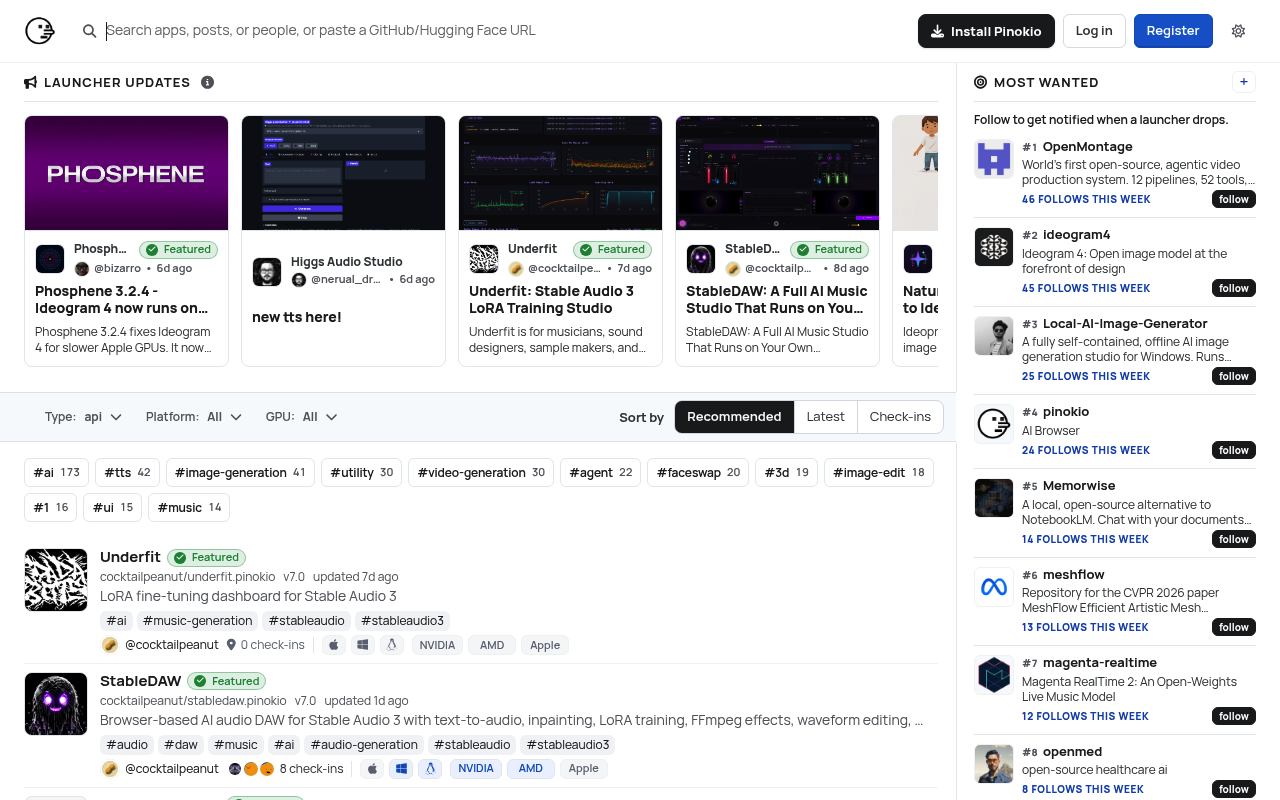
Pinokio is an open-source desktop application — self-described as an "AI Browser" — that acts as a 1-click launcher for any open-source AI project. Built by independent developer Cocktail Peanut (cocktailpeanut), Pinokio packages a terminal, package managers (Conda, Homebrew, Pip, NPM), and a graphical UI into a single MIT-licensed desktop app for macOS, Windows, and Linux with NVIDIA, AMD, and Apple Silicon GPU support. Users install AI apps with one click from a curated "Discover" directory of 160+ vetted scripts spanning image generation, video generation, text-to-speech and voice cloning, large language models, 3D generation, music and audio generation, and face swap. Pinokio is driven by a JSON-based scripting language designed to be both human and machine readable, with primitives like shell.run, fs, input, log, jump, hf (Hugging Face), notify, browser, and json that let publishers describe install and launch flows declaratively. Each script is sandboxed under ~/pinokio with isolated paths and Python virtual environments, and featured scripts must transfer ownership to the Pinokio Factory GitHub organization for admin review. Pinokio is purely client-side open source — there is no public REST API, no hosted commercial offering, and no developer SDK beyond the local script syntax and the desktop app itself.
Pinokio is profiled on the APIs.io network. Tagged areas include AI Launcher, AI Browser, Local AI, Open Source, and Desktop Application.
Pinokio’s developer surface includes documentation, GitHub presence, release notes, privacy policy, and 19 more developer resources.
Kin Score
 Kin Score
How this is scored →
Kin Score
How this is scored →scored 2026-10-17 · rubric v0.24.0
Security Posture 1
Authentication, domain security, vulnerability disclosure, and trust-center signals.
Resources
Documentation 3
Reference material describing how the API behaves
Build 2
SDKs, sample code, and the tooling you integrate with
Access & Security 1
Authentication, authorization, and security posture
Operate 2
Status, limits, changes, and where to get help
Commercial 3
Pricing, plans, and the legal terms of use
Company 4
The organization behind the API
Other 8
Properties that don't map to a standard resource type
Scroll for all 8
Source (apis.yml)
Work with this as data
Every provider here is available over the APIs.io API and to AI agents over MCP.