
Patlytics
Patlytics is an AI-powered patent intelligence platform purpose-built for intellectual-property work, applying generative AI and large language models across the full patent lifecycle: invention harvesting and disclosure, patent application drafting, office-action analysis, prior-art and novelty search, infringement detection, invalidity contentions, claim-chart generation, portfolio pruning, vault and classification, and transactional IP due diligence. Founded in 2023 and headquartered in New York, the company raised a $40M Series B led by SignalFire in April 2026 (roughly $65M total) and counts more than 40% of the Am Law 100 among its customers. Its machine-readable surface is a hosted, OAuth-protected Model Context Protocol server at mcp.patlytics.ai that exposes read-only semantic patent search, patent/claims lookup, non-patent-literature search over OpenAlex, and access to an organization's private Patlytics portfolios and vault; there is no public REST OpenAPI, and the platform API at api.patlytics.ai is fully authentication-gated.
Patlytics is listed with 1 API on the APIs.io network. Tagged areas include Company, Intellectual Property, Patents, Legal Tech, and Artificial Intelligence.
Patlytics’ developer surface includes documentation, API reference, getting-started guide, authentication, engineering blog, support, signup flow, and 20 more developer resources.
Kin Score
 Kin Score
How this is scored →
Kin Score
How this is scored →scored 2026-10-23 · rubric v0.25.0
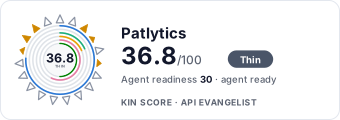 It updates itself when the score changes. Paste this where you link to your API docs:
<a href="https://apis.io/providers/patlytics/"><img src="https://apis.io/badge/patlytics/card.svg" alt="Patlytics on APIs.io — Kin Score by API Evangelist"></a>Other styles, a README pill and a shields.io endpoint are on the badge page.
APIs 1
Individual APIs this provider publishes, each with its own machine-readable definition.
Patlytics Patent Search (MCP)
The Patlytics Patent Search connector — a hosted Model Context Protocol server (Streamable HTTP) that brings concept-level, AI-native patent intelligence into MCP clients such a...
MCP Servers 1
Model Context Protocol servers that expose these APIs to AI agents.
Patlytics MCP Server
Concept-level, AI-native patent intelligence inside an MCP client. Describe an invention in plain language and get semantically similar patents, look up a specific patent's clai...
MCP SERVERSecurity Posture 3
Authentication, domain security, vulnerability disclosure, and trust-center signals.
Scopes 1
OAuth scopes governing access to this provider's APIs.
Resources
Get Started 4
Portal, sign-up, and the first successful call
Documentation 2
Reference material describing how the API behaves
Agent Surfaces 3
MCP servers, agent skills, and machine-readable catalogs
Design & Contract 4
Pagination, idempotency, versioning, errors, and events
Build 1
SDKs, sample code, and the tooling you integrate with
Access & Security 5
Authentication, authorization, and security posture
Operate 2
Status, limits, changes, and where to get help
Commercial 2
Pricing, plans, and the legal terms of use
Company 4
The organization behind the API
Source (apis.yml)
Work with this as data
Every provider here is available over the APIs.io API and to AI agents over MCP.