Pangea
Pangea delivers security as a set of composable, API-first services - authentication (AuthN/AuthZ), tamper-proof Secure Audit Log, Redact, Vault, File Scan, URL/Domain/IP Intel, Embargo, Sanitize, and AI Guard / Prompt Guard - that developers call over REST with a Bearer service token to add security guardrails to applications and AI workloads.
Pangea publishes 8 API contracts indexed on the APIs.io network, including AI Guard API, AuthN API, Domain Intel API, and 5 more. Tagged areas include Security, AI Security, Authentication, Audit Logs, and Data Protection.
Pangea’s developer surface includes authentication, engineering blog, documentation, and 10 more developer resources.
What this lets a business do 1
Business capabilities this provider's published APIs can perform, derived from its own contracts. Browse all capabilities →
Kin Score
 Kin Score
How this is scored →
Kin Score
How this is scored →scored 2026-10-23 · rubric v0.25.0
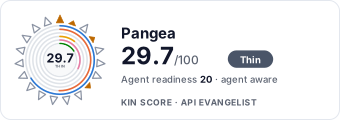 It updates itself when the score changes. Paste this where you link to your API docs:
<a href="https://apis.io/providers/pangea/"><img src="https://apis.io/badge/pangea/card.svg" alt="Pangea on APIs.io — Kin Score by API Evangelist"></a>Other styles, a README pill and a shields.io endpoint are on the badge page.
Markets this provider is in provisional
The Kin Score Market layer reads a provider inside its market: its position, and how deep its integrations go. Depth is only comparable within a position. Provisional and unweighted: not part of the Kin Score or agent readiness.
| Market | Position | Depth | Registered MCP server | Declares compatibility |
|---|---|---|---|---|
| Cloud Security Attestation and Secure-by-Design | undeclared | - | - | - |
| Vulnerability Disclosure (CVE Numbering Authorities, FIRST member teams; CISA KEV exposure) | undeclared | - | - | - |
Registered MCP server and declares compatibility are report only — not weighted. Undeclared means we found nothing we can read, so there is no number: we never infer integrations.
APIs 8
Individual APIs this provider publishes, each with its own machine-readable definition.
Pangea AI Guard API
Detect and redact malicious content in LLM inputs and outputs.
Pangea AuthN API
Hosted authentication, user lifecycle, and session management.
Pangea Domain Intel API
Domain and URL reputation lookups.
Pangea File Scan API
Scan files for malicious content.
Pangea IP Intel API
IP reputation, geolocation, and VPN/proxy enrichment.
Pangea Redact API
Detect and remove sensitive information from text and structured data.
Pangea Secure Audit Log API
Tamper-proof, cryptographically verifiable audit logging.
Pangea Vault API
Secrets and cryptographic key management.
Scroll for all 8
Open Collections 9
Open, tool-agnostic API collections (OpenAPI-derived and Bruno).
Pangea Security Services AI Guard API
OPEN COLLECTIONPangea Security Services AI Guard AuthN API
OPEN COLLECTIONPangea Security Services AI Guard Domain Intel API
OPEN COLLECTIONPangea Security Services AI Guard File Scan API
OPEN COLLECTIONPangea Security Services AI Guard IP Intel API
OPEN COLLECTIONPangea Security Services AI Guard Redact API
OPEN COLLECTIONPangea Security Services AI Guard Secure Audit Log API
OPEN COLLECTIONPangea Security Services AI Guard Vault API
OPEN COLLECTIONPangea Security Services API
OPEN COLLECTIONScroll for all 9
Pricing Plans 1
Published pricing tiers and plan structures.
Pangea Plans Pricing
PLANSRate Limits 1
Documented rate limits and quota policies.
Pangea Rate Limits
RATE LIMITSFinOps 1
Cost, billing, and metering signals for API financial operations.
Pangea Finops
FINOPSSecurity Posture 3
Authentication, domain security, vulnerability disclosure, and trust-center signals.
Agentic Access 1
Recommended x-agentic-access execution contracts for AI agents.
Resources
Documentation 1
Reference material describing how the API behaves
Agent Surfaces 1
MCP servers, agent skills, and machine-readable catalogs
Build 1
SDKs, sample code, and the tooling you integrate with
Access & Security 3
Authentication, authorization, and security posture
Operate 1
Status, limits, changes, and where to get help
Commercial 2
Pricing, plans, and the legal terms of use
Company 3
The organization behind the API
Other 1
Properties that don't map to a standard resource type
Source (apis.yml)
Work with this as data
Every provider here is available over the APIs.io API and to AI agents over MCP.