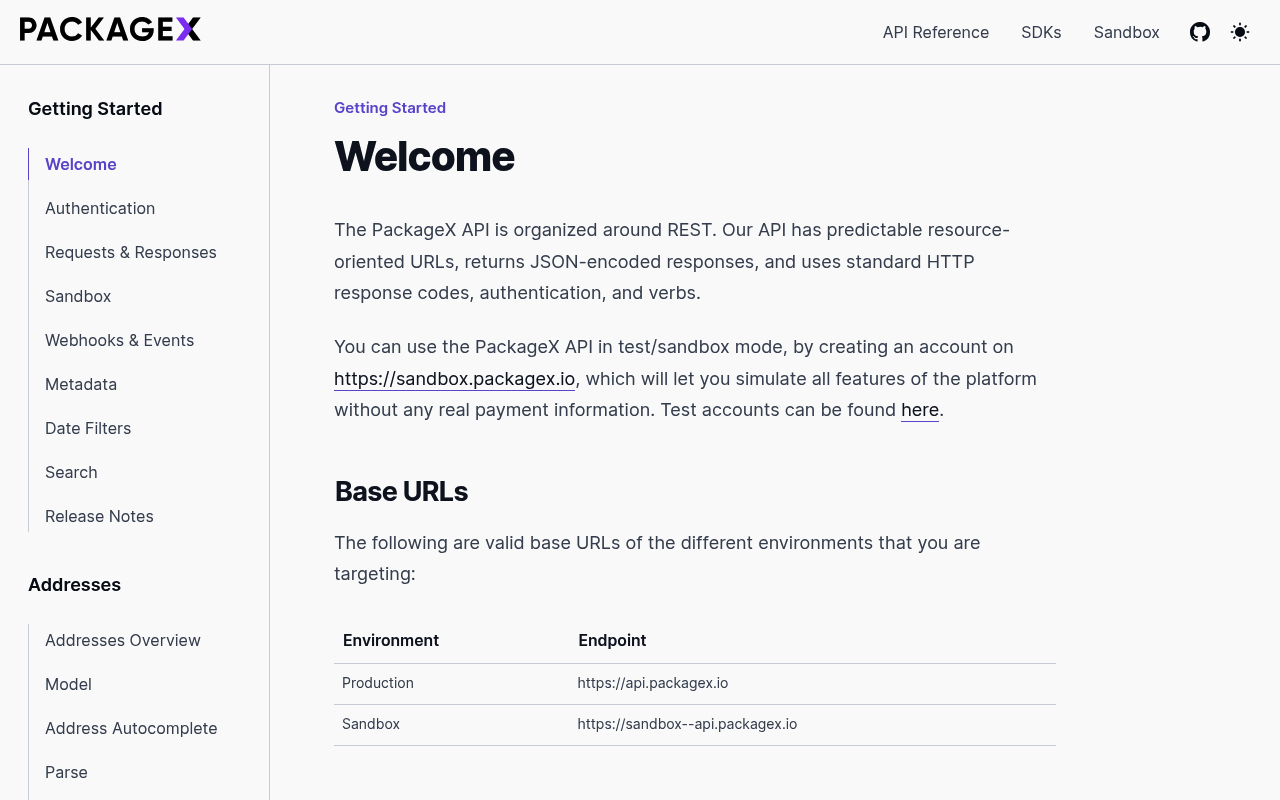
PackageX website screenshot

PackageX

PackageX provides vision-AI powered logistics execution — software that turns any camera or device into an intelligent scanning agent to automate receiving, inventory management, fulfillment and dispatch across warehouses, retail and building logistics. Its REST API and mobile Vision SDKs expose shipments, deliveries, tracking, addresses, containers, manifests, documents and vision inferences (shipping-label OCR, bill-of-lading parsing, item segmentation). Authentication is API-key based via the PX-API-KEY header, with separate sandbox and production environments. Customers include WeWork, Subaru, Ricoh, Medtronic, Toyota and On Running.

PackageX publishes 1 API on the APIs.io network: shipments API. Tagged areas include Company, Logistics, Shipping, Supply Chain, and Computer-Vision.

The PackageX catalog on APIs.io includes 1 event-driven AsyncAPI specification.

PackageX’s developer surface includes documentation, getting-started guide, API reference, support, engineering blog, authentication, changelog, and 22 more developer resources.

47.0/100 developing ▬ flat Agent 30/100 agent ready saas Full breakdown ↓
scored 2026-09-08 · rubric v0.20.0
1 APIs
CompanyLogisticsShippingSupply ChainComputer-VisionOCRPackage TrackingFulfillment

Kin Score

Kin Score Kin Score How this is scored →
scored 2026-09-08 · rubric v0.20.0
Create-or-Update Ergonomics applies to this provider. This API accepts writes, so it carries 10 points of the composite. It is scored from the published contracts themselves: whether a caller can create-or-update in one call, whether the write accepts a key the caller already holds, and whether the response says which branch ran. Without that, every write needs a search-and-branch in front of it, and the first time that check is skipped a duplicate record is created. Scored against the observed mean rather than raw — a provider at the catalog average is unchanged by this facet, not penalised by it.
Improve this rating by publishing the missing artifacts — every area above can be raised, and the full rubric is at apis.io/rating/. Every facet and dimension name above is a link: it opens that measurement's own page — what it means, the exact checks that feed it, how the whole catalog distributes on it, and the providers at the top of it. This rating is computed from github.com/api-evangelist/packagex: open an issue to ask a question, or submit a pull request to add artifacts. Submit an artifact on GitHub — free → Manage your own listing — the Influence plan, $499/mo →

APIs 1

Individual APIs this provider publishes, each with its own machine-readable definition.

PackageX shipments API

The shipments API from PackageX — 2 operation(s) for shipments.

Open Collections 2

Open, tool-agnostic API collections (OpenAPI-derived and Bruno).

API Collection

OPEN COLLECTION

API Title shipments API

OPEN COLLECTION

Event Specifications 1

AsyncAPI definitions for this provider's event-driven and streaming APIs.

Security Posture 2

Authentication, domain security, vulnerability disclosure, and trust-center signals.

Packagex Authentication

apiKey · 1 scheme

SECURITY

Packagex Domain Security

TLSv1.3 · HSTS · DNSSEC · DMARC

SECURITY

Agentic Access 1

Recommended x-agentic-access execution contracts for AI agents.

Packagex Agentic Access

4 operations · 2 acting

4 operations · 2 acting

AGENTIC

Resources

Get Started 3

Portal, sign-up, and the first successful call

Documentation 2

Reference material describing how the API behaves

Agent Surfaces 4

MCP servers, agent skills, and machine-readable catalogs

Design & Contract 6

Pagination, idempotency, versioning, errors, and events

Build 3

SDKs, sample code, and the tooling you integrate with

Access & Security 2

Authentication, authorization, and security posture

Operate 4

Status, limits, changes, and where to get help

Commercial 2

Pricing, plans, and the legal terms of use

Company 2

The organization behind the API

Other 1

Properties that don't map to a standard resource type

Source (apis.yml)

apis.yml Raw ↑
aid: packagex
name: PackageX
description: PackageX provides vision-AI powered logistics execution — software that turns any camera or device into an intelligent
  scanning agent to automate receiving, inventory management, fulfillment and dispatch across warehouses, retail and building
  logistics. Its REST API and mobile Vision SDKs expose shipments, deliveries, tracking, addresses, containers, manifests,
  documents and vision inferences (shipping-label OCR, bill-of-lading parsing, item segmentation). Authentication is API-key
  based via the PX-API-KEY header, with separate sandbox and production environments. Customers include WeWork, Subaru, Ricoh,
  Medtronic, Toyota and On Running.
deliveryModel:
  model: saas
  open_source: false
  commercial: true
  callable_host: true
  label: Hosted service · you call their endpoint
  confidence: high
  source:
  - openapi
  - pricing
  generated: '2026-08-28'
  method: derived
accessModel:
  pricing: unknown
  onboarding: unknown
  trial: false
  try_now: false
  public: false
  label: Unknown
  confidence: low
  source:
  - authentication
  - security
  - sandbox
  generated: '2026-09-03'
  method: derived
image: https://cdn.prod.website-files.com/68d230940fd846bdd01f1867/6989c29e1ae181a811f47ac1_OG.webp
url: https://raw.githubusercontent.com/api-evangelist/packagex/refs/heads/main/apis.yml
x-type: company
x-source: vc-portfolio
x-backed-by:
- bullpen-capital
- sierra-ventures
x-tier: stub
x-tier-reason: portfolio-lead
specificationVersion: '0.23'
created: '2026-07-17'
modified: '2026-07-20'
tags:
- Company
- Logistics
- Shipping
- Supply Chain
- Computer-Vision
- OCR
- Package Tracking
- Fulfillment
tags_raw:
- Company
- Logistics
- Shipping
- Supply Chain
- Computer Vision
- OCR
- Package Tracking
- Fulfillment
apis:
- aid: packagex:packagex-shipments-api
  name: PackageX shipments API
  description: The shipments API from PackageX — 2 operation(s) for shipments.
  humanURL: https://docs.packagex.io/apis/getting-started/welcome
  baseURL: https://api.packagex.io
  tags:
  - Shipments
  tags_raw:
  - shipments
  properties:
  - type: OpenAPI
    url: openapi/packagex-shipments-api-openapi.yml
  - type: APIReference
    url: https://docs.packagex.io/apis/getting-started/welcome
maintainers:
- FN: Kin Lane
  email: kin@apievangelist.com
- FN: APIs.json
  email: info@apis.io
common:
- type: DeveloperPortal
  url: https://docs.packagex.io/apis/getting-started/welcome
- type: Documentation
  url: https://docs.packagex.io/apis/getting-started/welcome
- type: GettingStarted
  url: https://docs.packagex.io/apis/getting-started/welcome
- type: APIReference
  url: https://docs.packagex.io/apis/getting-started/welcome
- type: Support
  url: https://help.packagex.io/en/knowledge
- type: Blog
  url: https://packagex.io/blog
- type: GitHubOrganization
  url: https://github.com/packagex-io
- type: TermsOfService
  url: https://packagex.io/terms
- type: PrivacyPolicy
  url: https://packagex.io/privacy-policy
- type: StatusPage
  url: https://packagex.statuspage.io
- type: Authentication
  url: authentication/packagex-authentication.yml
- type: Packages
  url: packages/packagex-packages.yml
- type: SDKs
  url: packages/packagex-packages.yml
- type: X-MCPServerCandidate
  url: mcp/packagex-mcp.yml
  note: 'Renamed from MCPServer 2026-09-03 (roadmap#247): the manifest self-describes as status: candidate — a tool list derived
    from the published API contracts, not an existing server. The scorer already read the manifest and reported mcp_server
    correctly; the MCPServer type was crediting the artifact-type surfaces with a server that does not exist.'
- type: LLMsTxt
  url: llms/packagex-llms.txt
- type: Overlay
  url: overlays/packagex-openapi-overlay.yaml
- type: Conformance
  url: conformance/packagex-conformance.yml
- type: ErrorCatalog
  url: errors/packagex-problem-types.yml
- type: Lifecycle
  url: lifecycle/packagex-lifecycle.yml
- type: Deprecation
  url: lifecycle/packagex-lifecycle.yml
- type: ChangeLog
  url: changelog/packagex-changelog.yml
- type: Sandbox
  url: sandbox/packagex-sandbox.yml
- type: Conventions
  url: conventions/packagex-conventions.yml
- type: DataModel
  url: data-model/packagex-data-model.yml
- type: Webhooks
  url: asyncapi/packagex-webhooks.yml
- type: AgentSkill
  url: skills/_index.yml
- type: AgenticAccess
  url: agentic-access/packagex-agentic-access.yml
- type: DomainSecurity
  url: security/packagex-domain-security.yml
- type: Website
  url: https://packagex.io
x-enrichment:
  date: '2026-07-20'
  status: enriched
  artifacts_added: 18
  pass: local-v1

Work with this as data

Every provider here is available over the APIs.io API and to AI agents over MCP.

MCP server

One button, every client — Claude, Cursor, VS Code and the rest.

https://apis.io/mcp

Tools for providers

9 MCP tools reach this
  • find_providersBrowse and filter every provider in the catalog.
  • get_provider_artifactsEvery artifact this provider publishes, grouped by type.
  • get_provider_operationsEvery operation across all of their OpenAPIs — one call instead of parsing every spec.
  • get_provider_toolsEvery MCP tool they ship, with the operation each wraps.
  • get_provider_evidenceHow each part of their score was established. Free — the basis for a claim should not sit behind it.
  • get_provider_ratingPRO — composite, band, trend and facet scores.
  • apis_io_searchSTART HERE — APIs, providers and tags for one query, each with its total.
  • resolveTurn a domain, URL or GitHub org into the provider it belongs to.
  • find_cohortsEvery scored population of providers in the catalog.
All 92 tools →

Call it yourself

curl for this page
This provider
curl "https://apis.io/api/v1/providers/packagex"
All providers
curl "https://apis.io/api/v1/providers?limit=25"
Every operation they expose
curl "https://apis.io/api/v1/providers/packagex/operations?limit=25"
How their score was established
curl "https://apis.io/api/v1/providers/packagex/evidence"

Discovery needs no key. Ratings and market analysis are Pro.

Get an API key

Free tier, no form to fill in. Signing in shares your email address with us — we store it to create your key and to recognise you if you sign in with another provider. See our Privacy Policy and Terms.

A second provider on the same verified email joins the account you already have.
