Nitric
Nitric is an open-source cloud framework and infrastructure-from-code SDK plus CLI for building cloud applications in TypeScript, Python, Go, or Dart. You declare resources - APIs, schedules, queues, topics, buckets, key-value stores, secrets, and websockets - directly in your application code, and Nitric provisions them across AWS, Google Cloud, or Azure via pluggable Pulumi or Terraform providers. Nitric is a framework / IaC tool, not a hosted REST API - the APIs you build are deployed to your own cloud.
Nitric publishes 11 API contracts indexed on the APIs.io network, including API Resource, Schedule Resource, Queue Resource, and 8 more. Tagged areas include Infrastructure from Code, Cloud Framework, SDK, CLI, and Serverless.
Nitric’s developer surface includes documentation and 7 more developer resources.
Kin Score
 Kin Score
How this is scored →
scored 2026-11-13 · rubric v0.28.0
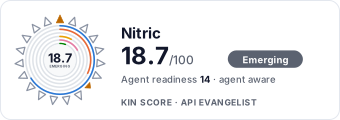 It updates itself when the score changes. Paste this where you link to your API docs:
<a href="https://apis.io/providers/nitric/"><img src="https://apis.io/badge/nitric/card.svg" alt="Nitric on APIs.io — Kin Score by API Evangelist"></a>Other styles, a README pill and a shields.io endpoint are on the badge page.
- MCP Server +12 pts — deployment.mode + probe verdict on the mcp/ manifest, not the pointer; an unprobed slug falls back to authorship Ask about this →
- Agentic Access Contract +10 pts — agentic_access artifact present (x-agentic-access), graded by author Ask about this →
- Machine-Readable Auth +10 pts — a served openid-configuration/oauth-authorization-server carrying `issuer` (served), else the securitySchemes class in the provider OpenAPIs — bound (mutualTLS, DPoP, Signature) > negotiable (oauth2 authorizationCode/clientCredentials, openIdConnect) > bearer (http bearer, apiKey) Ask about this →
- Idempotency +9 pts — OpenAPI mutating operations declare an idempotency key — a header, a request-body property, or a named de-duplication token whose own description says so (verified); else common[].type matches /idempoten/i (documented) Ask about this →
- Stable Error Semantics +8 pts — OpenAPI $refs a shared error schema across 4xx/5xx responses (verified), else common[].type includes ErrorCatalog / ErrorCodes / DeclineCodes Ask about this →
- A2A Agent Card +8 pts — a2a/
-a2a.yml manifest, graded on conformance.grade against A2A 1.0.0 Ask about this →
- Access Clarity scores 4.3 — up to +19.1 composite points Ask about this →
- Contract Quality scores 32.1 — up to +17.0 composite points Ask about this →
- Developer Ergonomics scores 16.7 — up to +16.7 composite points Ask about this →
Markets this provider is in provisional
The Kin Score Market layer reads a provider inside its market: its position, and how deep its integrations go. Depth is only comparable within a position. Provisional and unweighted: not part of the Kin Score or agent readiness.
| Market | Position | Depth | Registered MCP server | Declares compatibility |
|---|---|---|---|---|
| Cloud Native (Kubernetes, CNCF, FinOps) | standard | 34.5 (thin) | - | - |
Registered MCP server and declares compatibility are report only — not weighted. Undeclared means we found nothing we can read, so there is no number: we never infer integrations.
Standards implemented 1
Standards this provider implements or carries. De facto ones are profiled and measured by the API Commons; formal ones come from the standards directory and are linked by the provider's own tags. The evidence column says how each claim was established — not that it was made.
APIs 11
Individual APIs this provider publishes, each with its own machine-readable definition.
Nitric API Resource
SDK resource for declaring HTTP APIs and routes in code. Nitric provisions the API gateway (e.g. AWS API Gateway, GCP API Gateway, Azure API Management) and wires routes to your...
Nitric Schedule Resource
SDK resource for declaring time-based and cron schedules in code. Nitric provisions the underlying scheduler in your target cloud and triggers your handler on the defined cadenc...
Nitric Queue Resource
SDK resource for declaring durable message queues for batch and deferred processing. Nitric maps it to a cloud queue service (e.g. AWS SQS) with enqueue and dequeue semantics. F...
Nitric Topic Resource
SDK resource for declaring publish/subscribe topics for event-driven architectures. Nitric provisions the cloud pub/sub service (e.g. AWS SNS, GCP Pub/Sub) and wires subscribers...
Nitric Bucket Resource
SDK resource for declaring object/file storage buckets with read, write, delete, signed URLs, and bucket-event triggers. Nitric maps it to cloud storage (e.g. AWS S3, GCS, Azure...
Nitric Key-Value Resource
SDK resource for declaring key-value stores with get, set, delete, and query operations. Nitric maps it to a cloud key-value service (e.g. AWS DynamoDB). Framework primitive, no...
Nitric Secret Resource
SDK resource for declaring and accessing secrets with versioning. Nitric maps it to a cloud secrets manager (e.g. AWS Secrets Manager). Framework primitive, not a hosted API.
Nitric Websocket Resource
SDK resource for declaring realtime bidirectional websocket endpoints with connect, disconnect, and message handlers. Nitric provisions the cloud websocket service. Framework pr...
Nitric SQL Database Resource
SDK resource for declaring managed relational (Postgres) databases with migrations. Nitric provisions the cloud database (e.g. AWS RDS, GCP Cloud SQL). Framework primitive, not ...
Nitric CLI
The Nitric command-line tool (nitric new, nitric start, nitric stack new, nitric up, nitric down) that scaffolds projects, runs local emulation with a dashboard, and deploys or ...
Nitric Provider Plugins
Pluggable provider implementations that translate declared Nitric resources into cloud infrastructure on AWS, Google Cloud, or Azure using Pulumi (direct deploy) or Terraform (g...
Scroll for all 11
Open Collections 1
Open, tool-agnostic API collections (OpenAPI-derived and Bruno).
Nitric Framework
OPEN COLLECTIONNitric API pricing
Not yet checked against Nitric's own pricing page. Compiled by API Evangelist on 2026-06-20 from nitric.io; confirm before you rely on a figure. A free plan or tier is listed.
| Plan | Price |
|---|---|
| Open Source (Apache 2.0) free | — |
| Suga / Nitric Cloud enterprise | — |
Plan details, limits and sources →
Rate limits
- Framework Rate Limits: not applicable requests
- Cloud Provider Service Quotas: see target cloud documentation requests
Compiled by API Evangelist, not yet checked against Nitric's documentation. Rate-limit details →
Pricing Plans 1
Published pricing tiers and plan structures.
Nitric Plans Pricing
PLANSRate Limits 1
Documented rate limits and quota policies.
Nitric Rate Limits
RATE LIMITSFinOps 1
Cost, billing, and metering signals for API financial operations.
Nitric Finops
FINOPSSecurity Posture 1
Authentication, domain security, vulnerability disclosure, and trust-center signals.
Resources
Documentation 1
Reference material describing how the API behaves
Build 1
SDKs, sample code, and the tooling you integrate with
Access & Security 1
Authentication, authorization, and security posture
Operate 1
Status, limits, changes, and where to get help
Commercial 2
Pricing, plans, and the legal terms of use
Company 2
The organization behind the API
Source (apis.yml)
Nitric API — frequently asked questions
Does Nitric have an API?
Yes. APIs.io lists 11 APIs from Nitric, including Nitric API Resource, Nitric Schedule Resource and Nitric Queue Resource, and 8 more.
Is there an OpenAPI specification for the Nitric API?
Yes. APIs.io indexes 11 OpenAPI specifications for Nitric, each linked for download from this page.
How much does the Nitric API cost?
APIs.io lists 2 pricing plans for Nitric, with each plan's price, limits and inclusions under Pricing on this page.
Is the Nitric API ready for AI agents?
Nitric has a Kin Score of 17.8 out of 100 (emerging) and an Agent Readiness score of 13.6 (agent-aware), scored by API Evangelist on 2026-11-13.
Work with this as data
Every provider here is available over the APIs.io API and to AI agents over MCP.