Moovit is a Tel Aviv-founded urban mobility company acquired by Intel in May 2020 for approximately $900M and now part of Mobileye's Mobility-as-a- Service (MaaS) business. The Moovit consumer app provides public transit trip planning, real-time arrivals, and service alerts to more than 1.5 billion users across 3,500+ cities in 112+ countries, sourcing both official agency data and crowdsourced transit reports from its global community. Moovit's commercial offering is the Public Transit API suite — a thin, volume-metered HTTP API exposing six API families (Trip Plan, Nearby, Stops, Lines, Real-Time, Service Alerts) plus GTFS-Realtime feeds and a search API. The APIs power Microsoft (Azure Maps), Uber, Lyft, Cubic, and city/transit-agency MaaS deployments. Authentication is HMAC-SHA256 with a metro-scoped request header (USER_LOC or MOOVIT_METRO_ID). Pricing and rate limits are negotiated per customer; there is no self-service developer signup — credentials are issued by helpdesk@moovit.com.
Moovit publishes 9 API contracts indexed on the APIs.io network, including General API, GTFSRealtime API, Lines API, and 6 more. Tagged areas include Transit, Public Transit, Mobility, Mobility As A Service, and MaaS.
The Moovit catalog on APIs.io includes 1 Spectral governance ruleset.
Moovit’s developer surface includes authentication, developer portal, documentation, engineering blog, support, YouTube channel, and 31 more developer resources.
Regulatory Posture applies to this provider. Its tags matched the
Horizontal (data, software, accessibility, platform) regime, so
Regulatory Posture carries 15 points of the composite.
If this regime is wrong for your business, say so on your
provider repo — the
applicability map is public and we will correct it.
Create-or-Update Ergonomics does not apply to this provider. The published contracts declare
no write operations, and a read-only API cannot create-or-update. The facet is excluded from this provider's
denominator entirely — not scored zero. A reference or data API is not deficient for being unable to
upsert.
The six quality facets above are damped to 85 points between them,
because the conditional facet above carries the other
15. That is why each facet's contribution is shown against a damped
maximum: raising a quality facet moves the composite by 85% of its nominal
weight, not 100%. The full arithmetic is at apis.io/rating/.
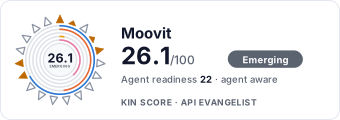
Show this score on your site.
It updates itself when the score changes. Paste this where you link to your API docs:
<a href="https://apis.io/providers/moovit/"><img src="https://apis.io/badge/moovit/card.svg" alt="Moovit on APIs.io — Kin Score by API Evangelist"></a>
Other styles, a README pill and a shields.io endpoint are on the badge page.
Raise your score.
Agent readiness — checks not met, largest first (exact, from this profile):
MCP Server+12 pts — deployment.mode + probe verdict on the mcp/ manifest, not the pointer; an unprobed slug falls back to authorship Ask about this →
Stable Error Semantics+8 pts — OpenAPI $refs a shared error schema across 4xx/5xx responses (verified), else common[].type includes ErrorCatalog / ErrorCodes / DeclineCodes Ask about this →
Rate-Limit Signaling+7 pts — OpenAPI responses document X-RateLimit-* / RateLimit headers (verified), else a rate_limits artifact or RateLimits link (documented) Ask about this →
Each check links to what satisfies it. Publish the artifact, or tell us where it already lives, and the score moves on the next scoring run.
Not sure how this applies to your stack? Ask about any one item. Kin Lane reads every question, looks at your profile and your situation, and replies with what a fix would take — scoped to that one area, priced up front, yours whether you ship it or not. Ask a question →
The Kin Score Market layer reads a provider inside its market:
its position, and how deep its integrations go. Depth is only comparable within a position. Provisional and unweighted:
not part of the Kin Score or agent readiness.
Registered MCP server and declares compatibility are report only — not weighted.
Undeclared means we found nothing we can read, so there is no number: we never infer integrations.
Standards this provider implements or carries. De facto ones are profiled and measured by the API Commons; formal ones come from the standards directory and are linked by the provider's own tags. The evidence column says how each claim was established — not that it was made.
Calls without X-API-Key need no key. Calls with it need a paid plan — get a key.
Get an API key
Free tier, no form to fill in. Signing in shares your email address with us — we
store it to create your key and to recognise you if you sign in with another
provider. See our Privacy Policy and
Terms.
 Kin Score
How this is scored →
 It updates itself when the score changes. Paste this where you link to your API docs: