Monad
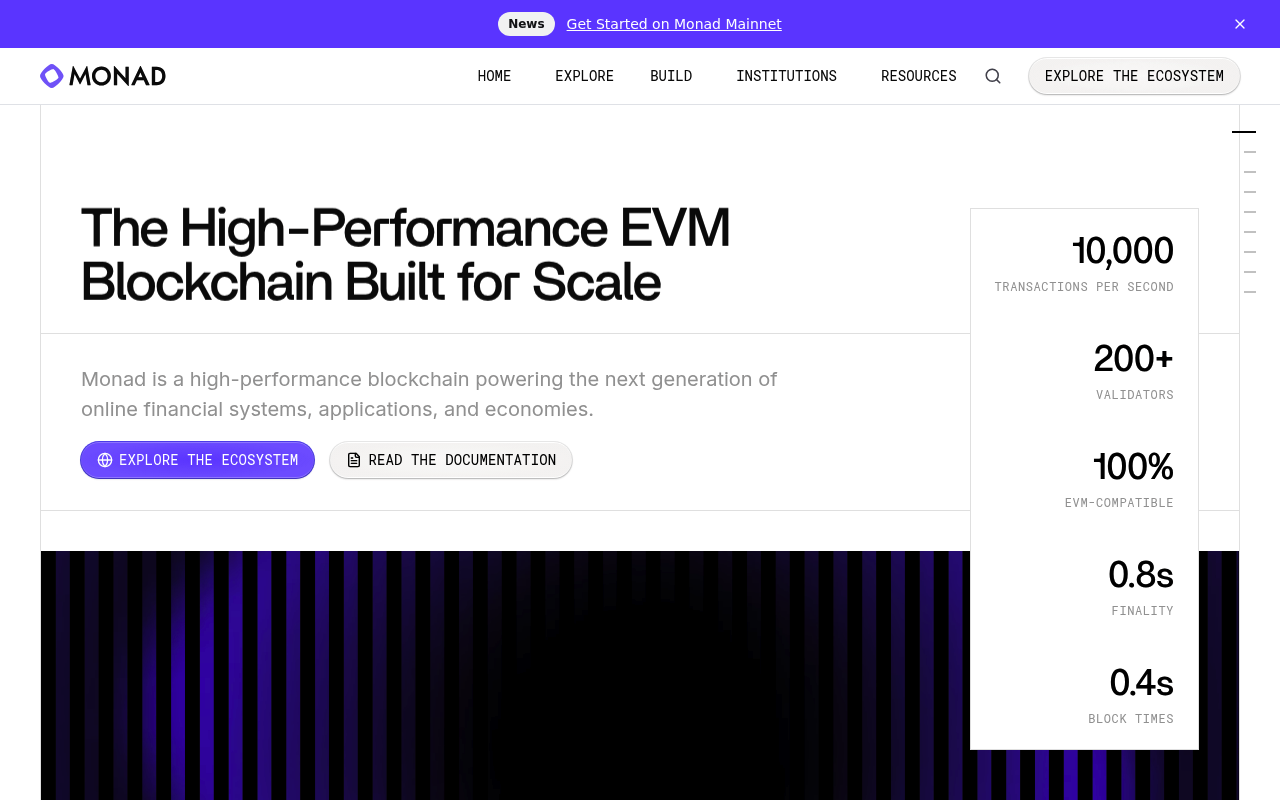
Monad is a high-performance EVM-compatible Layer 1 blockchain designed for parallel execution and pipelined consensus, targeting 10,000 TPS with 1-second block time and single-slot finality while remaining fully Ethereum bytecode-compatible. Mainnet (chain ID 143, native token MON) launched on November 24, 2025 alongside a long-running public testnet. Developer surfaces include public JSON-RPC endpoints (rpc.monad.xyz, testnet-rpc.monad.xyz), an Ethereum-compatible JSON-RPC plus Monad-specific extensions, MonadVision, Monadscan, and Socialscan explorers, native EVM tooling (Foundry, Hardhat, Remix), indexers (GhostGraph, QuickNode Streams, Envio HyperIndex), and a Staking API and Machine Payments Protocol.
Monad publishes 13 API contracts indexed on the APIs.io network, including JSON RPC API, and 12 more. Tagged areas include Blockchain, Layer 1, EVM, High Performance, and Parallel Execution.
The Monad catalog on APIs.io includes 1 Spectral governance ruleset.
Monad’s developer surface includes documentation, getting-started guide, API reference, GitHub presence, engineering blog, and 16 more developer resources.
Kin Score
 Kin Score
How this is scored →
scored 2026-11-13 · rubric v0.28.0
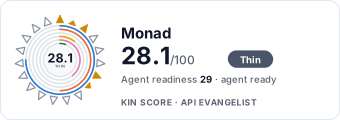 It updates itself when the score changes. Paste this where you link to your API docs:
<a href="https://apis.io/providers/monad/"><img src="https://apis.io/badge/monad/card.svg" alt="Monad on APIs.io — Kin Score by API Evangelist"></a>Other styles, a README pill and a shields.io endpoint are on the badge page.
- Machine-Readable Auth +10 pts — a served openid-configuration/oauth-authorization-server carrying `issuer` (served), else the securitySchemes class in the provider OpenAPIs — bound (mutualTLS, DPoP, Signature) > negotiable (oauth2 authorizationCode/clientCredentials, openIdConnect) > bearer (http bearer, apiKey) Ask about this →
- Idempotency +9 pts — OpenAPI mutating operations declare an idempotency key — a header, a request-body property, or a named de-duplication token whose own description says so (verified); else common[].type matches /idempoten/i (documented) Ask about this →
- Stable Error Semantics +8 pts — OpenAPI $refs a shared error schema across 4xx/5xx responses (verified), else common[].type includes ErrorCatalog / ErrorCodes / DeclineCodes Ask about this →
- A2A Agent Card +8 pts — a2a/
-a2a.yml manifest, graded on conformance.grade against A2A 1.0.0 Ask about this → - Registration Without a Human +6 pts — a `registration_endpoint` in the served RFC 8414 / OIDC discovery document Ask about this →
- Delegated User Identity +6 pts — a served discovery document listing authorization_code in grant_types_supported (served), else an oauth2 authorizationCode flow or openIdConnect declared in an OpenAPI (documented) Ask about this →
- Access Clarity scores 4.3 — up to +19.1 composite points Ask about this →
- Contract Quality scores 49.6 — up to +12.6 composite points Ask about this →
- Operational Transparency scores 9.5 — up to +11.8 composite points Ask about this →
Markets this provider is in provisional
The Kin Score Market layer reads a provider inside its market: its position, and how deep its integrations go. Depth is only comparable within a position. Provisional and unweighted: not part of the Kin Score or agent readiness.
| Market | Position | Depth | Registered MCP server | Declares compatibility |
|---|---|---|---|---|
| x402 Micropayments & Agentic Pay-per-Call | standard | 17.2 (thin) | - | - |
Registered MCP server and declares compatibility are report only — not weighted. Undeclared means we found nothing we can read, so there is no number: we never infer integrations.
Standards implemented 4
Standards this provider implements or carries. De facto ones are profiled and measured by the API Commons; formal ones come from the standards directory and are linked by the provider's own tags. The evidence column says how each claim was established — not that it was made.
APIs 13
Individual APIs this provider publishes, each with its own machine-readable definition.
Monad Mainnet JSON-RPC
Public Ethereum-compatible JSON-RPC endpoint for Monad mainnet (chain ID 143, native token MON). Hosted on QuickNode infrastructure with a 25 requests/sec default rate limit; al...
Monad Testnet JSON-RPC
Public JSON-RPC endpoint for the Monad public testnet, used for application development, integration testing, and validator software validation before deploying to mainnet.
Monad JSON-RPC API
Full JSON-RPC method reference — standard Ethereum eth_*, net_*, web3_*, debug_*, and trace_* methods plus Monad-specific extensions and notes on method differences, rate limits...
Monad Staking API
API for delegating MON to validators, querying validator stats, undelegating, and reading rewards. Backs delegation UI and external staking integrations.
Monad Machine Payments Protocol
Protocol specification for programmable machine-to-machine payments on Monad, including account, channel, and settlement primitives.
MonadVision Block Explorer
Block explorer for Monad mainnet — transaction, block, contract, and token lookup with Solidity source verification.
Monadscan Block Explorer
Etherscan-style Monadscan block explorer covering Monad mainnet, with transaction, address, contract, and token analytics.
Socialscan Monad Explorer
Socialscan instance for Monad, offering an alternative explorer view with social and on-chain identity overlays.
Monad Foundry Toolkit
Monad-flavored Foundry toolkit (forge, cast, anvil) for compiling, deploying, scripting, and testing Solidity against Monad mainnet and testnet.
Monad RPC Providers
Registry of third-party RPC providers supporting Monad — QuickNode, Alchemy, Goldsky Edge, Ankr, MonadInfra — with rate-limit and method-availability differences documented.
Monad Indexers
Indexing options for Monad data — GhostGraph (Graph-style subgraphs), QuickNode Streams, and Envio HyperIndex — for building data backends and analytics on top of Monad.
Monad Bridges
Token bridges and cross-chain messaging integrations for moving assets between Ethereum, other chains, and Monad.
Monad JSON RPC API
The Monad JSON RPC API API from Monad — 1 operation(s) for monad json rpc api.
Scroll for all 13
Open Collections 2
Open, tool-agnostic API collections (OpenAPI-derived and Bruno).
Monad JSON-RPC Monad JSON RPC API API
OPEN COLLECTIONMonad JSON-RPC API
OPEN COLLECTIONMCP Servers 1
Model Context Protocol servers that expose these APIs to AI agents.
GraphQL 1
GraphQL schemas published by this provider.
Monad GraphQL API
Indexing options for Monad data — GhostGraph (Graph-style subgraphs), QuickNode Streams, and Envio HyperIndex — for building data backends and analytics on top of Monad.
GRAPHQLMonad API pricing
Not yet checked against Monad's own pricing page. Compiled by API Evangelist on 2026-05-22; confirm before you rely on a figure. A free plan or tier is listed.
| Plan | Price |
|---|---|
| Free freemium | Free |
Plan details, limits and sources →
Rate limits
- Free Tier Default: 10 requests per minute
- Pro Tier Default: 120 requests per minute
Compiled by API Evangelist, not yet checked against Monad's documentation. Rate-limit details →
Pricing Plans 1
Published pricing tiers and plan structures.
Monad Plans Pricing
PLANSRate Limits 1
Documented rate limits and quota policies.
Monad Rate Limits
RATE LIMITSFinOps 1
Cost, billing, and metering signals for API financial operations.
Monad Finops
FINOPSSpectral Rules 1
Spectral governance rulesets for linting and validating these APIs. Counts are the severity each rule declares, not results of running them.
Monad API Rules
SPECTRALSecurity Posture 1
Authentication, domain security, vulnerability disclosure, and trust-center signals.
Agentic Access (API Evangelist recommendations) 1
Recommended x-agentic-access execution contracts for AI agents.
Resources
Get Started 1
Portal, sign-up, and the first successful call
Documentation 2
Reference material describing how the API behaves
Agent Surfaces 2
MCP servers, agent skills, and machine-readable catalogs
Build 1
SDKs, sample code, and the tooling you integrate with
Access & Security 1
Authentication, authorization, and security posture
Operate 2
Status, limits, changes, and where to get help
Commercial 4
Pricing, plans, and the legal terms of use
Company 3
The organization behind the API
Other 5
Properties that don't map to a standard resource type
Source (apis.yml)
Monad API — frequently asked questions
Does Monad have an API?
Yes. APIs.io lists 13 APIs from Monad, including Monad Mainnet JSON-RPC, Monad Testnet JSON-RPC and Monad JSON-RPC API, and 10 more.
Is there an OpenAPI specification for the Monad API?
Yes. APIs.io indexes 1 OpenAPI specification for Monad, each linked for download from this page.
How much does the Monad API cost?
APIs.io lists 1 pricing plan for Monad, with each plan's price, limits and inclusions under Pricing on this page.
Does Monad have an MCP server?
Yes. APIs.io lists 1 MCP server for Monad: Remote MCP server at docs.monad.xyz over HTTP; 3 tools listed.
Is the Monad API ready for AI agents?
Monad has a Kin Score of 29.2 out of 100 (thin) and an Agent Readiness score of 32.0 (agent-ready), scored by API Evangelist on 2026-11-13.
Work with this as data
Every provider here is available over the APIs.io API and to AI agents over MCP.