Mindgard
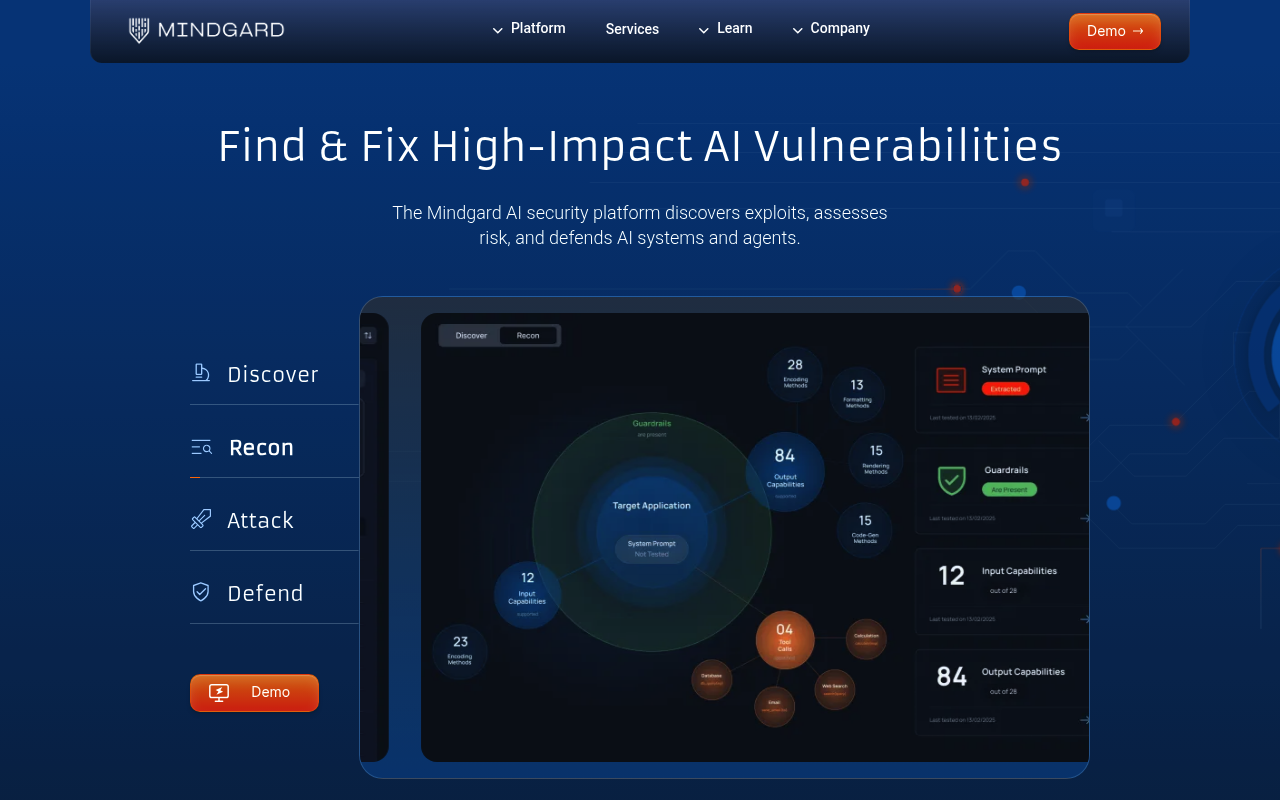
Mindgard is a UK-based offensive AI security company (London/Lancaster, spun out of Lancaster University) that provides an automated AI red-teaming and security testing platform for large language models, AI agents, and generative AI systems. Mindgard's platform combines AI Discovery and Recon (mapping the AI attack surface and shadow AI usage), continuous AI Red Teaming against evolving attacker techniques, AI Assessment, AI Runtime Protection, and Model Scanning, backed by a research-led attack library covering jailbreaks (ActorAttack, Crescendo, EvilConfidant, PersonGPT, DevModeV2, AsciiArtAttack, AntiGPT), prompt-injection techniques (Ascii85, AnsiEscaped, AnsiRaw and others), and policy/violation testing (MaliciousGeneration, PromptAlignment). Developers and security teams integrate Mindgard via a public REST API (projects, tests, multi-turn tests, datasets, findings, reconnaissance), a Python CLI (`pip install mindgard`), a Python SDK, a Burp Suite extension, and a GitHub Action for adding red-team checks to MLOps pipelines. The company also maintains and contributes to open-source security tooling including PyRIT integrations, an OpenAI-compatible LLM-Guard proxy, a chatbot API wrapper for testing web chatbots, and proof-of-concept vulnerability demonstrations (document RCE in LangChain agents, hidden audio jailbreaks, prompt-jailbreak demos). Mindgard's commercial model is enterprise SaaS with platform and services tiers; pricing is gated behind a sales conversation, and the platform is positioned for security, AppSec, and AI governance teams testing customer-facing or internally deployed AI systems.
Mindgard is profiled on the APIs.io network. Tagged areas include AI Security, AI Red Teaming, LLM Security, Generative AI Security, and Prompt Injection.
Mindgard’s developer surface includes documentation, API reference, GitHub presence, engineering blog, and 22 more developer resources.
Kin Score
 Kin Score
How this is scored →
Kin Score
How this is scored →scored 2026-10-17 · rubric v0.24.0
Security Posture 1
Authentication, domain security, vulnerability disclosure, and trust-center signals.
Resources
Documentation 3
Reference material describing how the API behaves
Design & Contract 1
Pagination, idempotency, versioning, errors, and events
Build 6
SDKs, sample code, and the tooling you integrate with
Access & Security 2
Authentication, authorization, and security posture
Learn 1
Tutorials, courses, talks, and written guidance
Operate 1
Status, limits, changes, and where to get help
Company 6
The organization behind the API
Other 6
Properties that don't map to a standard resource type
Source (apis.yml)
Work with this as data
Every provider here is available over the APIs.io API and to AI agents over MCP.