MarketAux
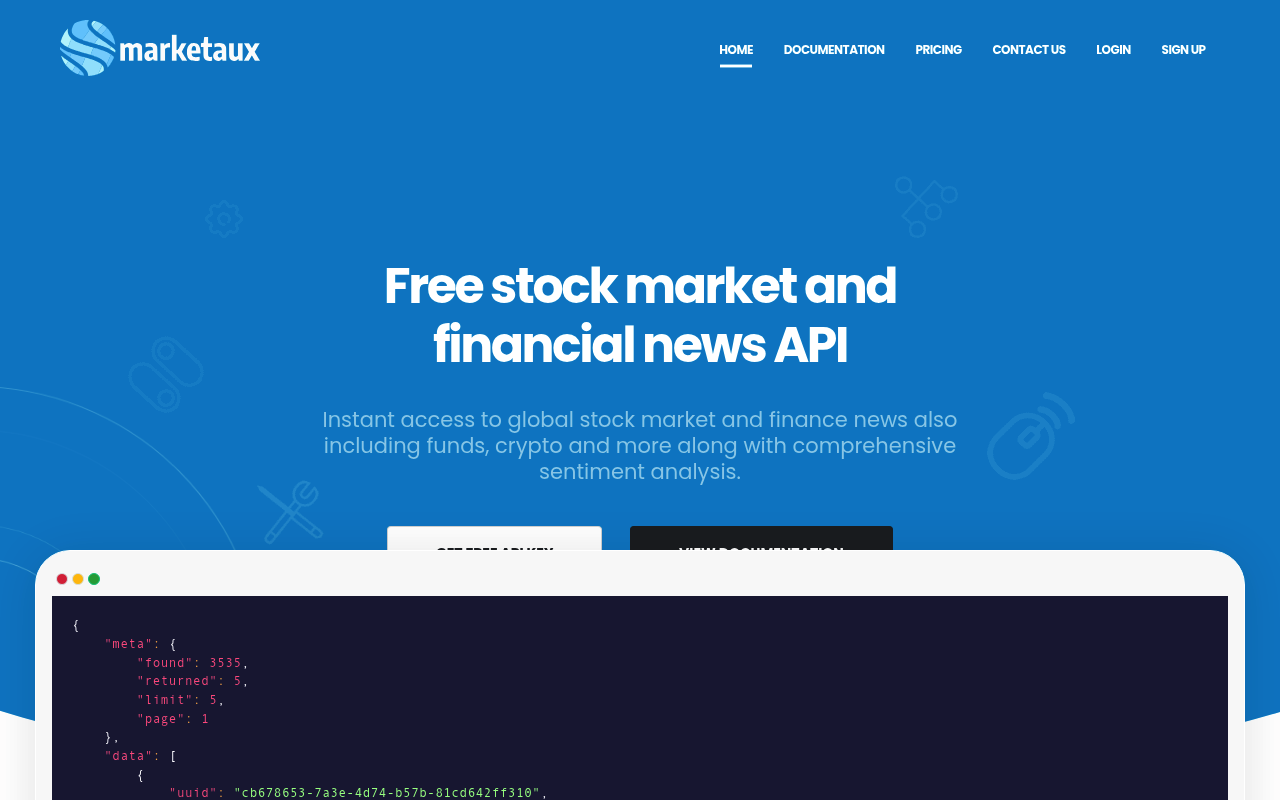
Marketaux is a global financial and stock market news API that pairs every article with entity recognition and sentiment analysis. It aggregates 5,000+ news sources in 30+ languages, tracking 200,000+ entities — equities, indices, ETFs, mutual funds, currencies, and cryptocurrencies — across 80+ markets. Beyond filtered news feeds, it provides entity statistics time series, aggregations, and trending-entity endpoints for identifying the best and worst performing entities in the news, with a free self-serve tier.
MarketAux publishes 3 API contracts indexed on the APIs.io network: Entities API, News API, and Sources API. Tagged areas include News, Financial News, Stock Market, Sentiment Analysis, and Market Data.
MarketAux’s developer surface includes documentation, API reference, getting-started guide, pricing, signup flow, support, FAQ, and 21 more developer resources.
Kin Score
 Kin Score
How this is scored →
Kin Score
How this is scored →scored 2026-10-23 · rubric v0.25.0
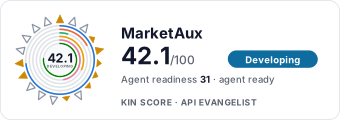 It updates itself when the score changes. Paste this where you link to your API docs:
<a href="https://apis.io/providers/marketaux/"><img src="https://apis.io/badge/marketaux/card.svg" alt="MarketAux on APIs.io — Kin Score by API Evangelist"></a>Other styles, a README pill and a shields.io endpoint are on the badge page.
APIs 3
Individual APIs this provider publishes, each with its own machine-readable definition.
MarketAux Entities API
Entity statistics, trending entities, entity search, and entity metadata.
MarketAux News API
Financial and market news feeds, similar-article lookup, and article retrieval by UUID.
MarketAux Sources API
News source metadata usable in news feed filters.
Open Collections 1
Open, tool-agnostic API collections (OpenAPI-derived and Bruno).
Marketaux API
OPEN COLLECTIONPricing Plans 1
Published pricing tiers and plan structures.
Marketaux Plans
PLANSRate Limits 1
Documented rate limits and quota policies.
Marketaux Rate Limits
RATE LIMITSOpenAPI Overlays 1
Overlays applied on top of this provider's contracts. Each card says who wrote it: a document the provider publishes, or one API Evangelist derived or generated.
Marketaux Openapi Overlay
DERIVEDSecurity Posture 2
Authentication, domain security, vulnerability disclosure, and trust-center signals.
Resources
Get Started 3
Portal, sign-up, and the first successful call
Documentation 2
Reference material describing how the API behaves
Agent Surfaces 4
MCP servers, agent skills, and machine-readable catalogs
Design & Contract 5
Pagination, idempotency, versioning, errors, and events
Build 2
SDKs, sample code, and the tooling you integrate with
Access & Security 2
Authentication, authorization, and security posture
Operate 3
Status, limits, changes, and where to get help
Commercial 4
Pricing, plans, and the legal terms of use
Company 1
The organization behind the API
Other 2
Properties that don't map to a standard resource type
Source (apis.yml)
Work with this as data
Every provider here is available over the APIs.io API and to AI agents over MCP.