Hum
Hum provides an embeddable internet marketplace platform that lets resident‑focused apps search, compare, and order broadband services without leaving the app. By abstracting provider‑specific plans, pricing, and activation flows, Hum enables white‑label, provider‑neutral integrations that generate revenue for app owners through commissions on activations.
Hum is listed with 2 APIs on the APIs.io network. Tagged areas include Internet, Marketplace, White Label, Real Estate, and Software-as-a-Service.
The Hum catalog on APIs.io includes 1 event-driven AsyncAPI specification, 1 JSON-LD context, and 1 Spectral governance ruleset.
Hum’s developer surface includes changelog, authentication, documentation, API reference, getting-started guide, and 20 more developer resources.
Kin Score
 Kin Score
How this is scored →
scored 2026-11-21 · rubric v0.28.1
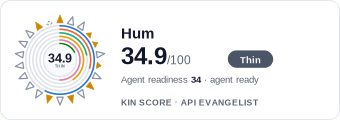 It updates itself when the score changes. Paste this where you link to your API docs:
<a href="https://apis.io/providers/letshum-com/"><img src="https://apis.io/badge/letshum-com/card.svg" alt="Hum on APIs.io — Kin Score by API Evangelist"></a>Other styles, a README pill and a shields.io endpoint are on the badge page.
- MCP Server +12 pts — deployment.mode + probe verdict on the mcp/ manifest, not the pointer; an unprobed slug falls back to authorship Ask about this →
- Agentic Access Contract +10 pts — agentic_access artifact present (x-agentic-access), graded by author Ask about this →
- Stable Error Semantics +8 pts — OpenAPI $refs a shared error schema across 4xx/5xx responses (verified), else common[].type includes ErrorCatalog / ErrorCodes / DeclineCodes Ask about this →
- Rate-Limit Signaling +7 pts — OpenAPI responses document X-RateLimit-* / RateLimit headers (verified), else a rate_limits artifact or RateLimits link (documented) Ask about this →
- Registration Without a Human +6 pts — a `registration_endpoint` in the served RFC 8414 / OIDC discovery document Ask about this →
- Delegated User Identity +6 pts — a served discovery document listing authorization_code in grant_types_supported (served), else an oauth2 authorizationCode flow or openIdConnect declared in an OpenAPI (documented) Ask about this →
- Contract Quality scores 29.3 — up to +17.7 composite points Ask about this →
- Access Clarity scores 17.0 — up to +16.6 composite points Ask about this →
- Developer Ergonomics scores 50.0 — up to +10.0 composite points Ask about this →
APIs 2
Individual APIs this provider publishes, each with its own machine-readable definition.
Hum API
Hum API for creating sessions and managing internet service orders.
Hum API
Hum API as documented publicly: 5 operations. Contract generated from the documentation by API Evangelist (2026-11-15); not the provider's own document.
Event Specifications 1
AsyncAPI definitions for this provider's event-driven and streaming APIs.
Letshum Com Webhooks
ASYNCAPISemantic Vocabularies 1
JSON-LD contexts and semantic vocabularies used across these APIs.
Letshum Com Context
JSON-LDSpectral Rules 1
Spectral governance rulesets for linting and validating these APIs.
Hum API Rules
SPECTRALJSON Schema 4
Standalone JSON Schema definitions for this provider's data models.
DeleteSessionsTokenResponse
JSON SCHEMAGetAnalyticsSessionsIdResponse
JSON SCHEMAGetPingResponse
JSON SCHEMAGetSessionsTokenServicesInternetResponse
JSON SCHEMASecurity Posture 2
Authentication, domain security, vulnerability disclosure, and trust-center signals.
Resources
Get Started 2
Portal, sign-up, and the first successful call
Documentation 2
Reference material describing how the API behaves
Agent Surfaces 2
MCP servers, agent skills, and machine-readable catalogs
Design & Contract 8
Pagination, idempotency, versioning, errors, and events
Scroll for all 8
Build 1
SDKs, sample code, and the tooling you integrate with
Access & Security 2
Authentication, authorization, and security posture
Operate 2
Status, limits, changes, and where to get help
Commercial 2
Pricing, plans, and the legal terms of use
Company 1
The organization behind the API
Other 3
Properties that don't map to a standard resource type
Source (apis.yml)
Hum API — frequently asked questions
Does Hum have an API?
Yes. APIs.io lists 2 APIs from Hum, including Hum API and Hum API.
Is there an OpenAPI specification for the Hum API?
Yes. APIs.io indexes 1 OpenAPI specification for Hum, each linked for download from this page.
How do I authenticate with the Hum API?
Hum uses bearer-token authentication (2 schemes). The details are profiled on APIs.io as Hum Authentication.
Is the Hum API ready for AI agents?
Hum has a Kin Score of 34.9 out of 100 (thin) and an Agent Readiness score of 33.7 (agent-ready), scored by API Evangelist on 2026-11-21.
Work with this as data
Every provider here is available over the APIs.io API and to AI agents over MCP.