
Kuru
Kuru is a fully on-chain central limit order book (CLOB) decentralized exchange and smart routing aggregator built on Monad, operated by Kuru Labs. It combines an on-chain order book with AMM vault liquidity to deliver low-slippage, self-custody trading, and exposes the Kuru Flow API — a liquidity-aggregating routing engine that lets wallets, dApps and aggregators quote and build any-token-to-any-token swaps across every market on Monad, optionally appending their own referrer fee. Developers integrate through a TypeScript SDK, a Python CLOB SDK for market making, published and audited Solidity contracts, and a first-party agent skill for automated trading.
Kuru publishes 2 API contracts indexed on the APIs.io network: Generate Token API and Quote API. Tagged areas include Company, DeFi, Decentralized Exchange, Order Book, and Trading.
Kuru’s developer surface includes documentation, API reference, getting-started guide, engineering blog, pricing, signup flow, CLI, and 21 more developer resources.
Kin Score
 Kin Score
How this is scored →
Kin Score
How this is scored →scored 2026-10-23 · rubric v0.25.0
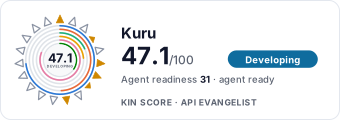 It updates itself when the score changes. Paste this where you link to your API docs:
<a href="https://apis.io/providers/kuru/"><img src="https://apis.io/badge/kuru/card.svg" alt="Kuru on APIs.io — Kin Score by API Evangelist"></a>Other styles, a README pill and a shields.io endpoint are on the badge page.
Markets this provider is in provisional
The Kin Score Market layer reads a provider inside its market: its position, and how deep its integrations go. Depth is only comparable within a position. Provisional and unweighted: not part of the Kin Score or agent readiness.
| Market | Position | Depth | Registered MCP server | Declares compatibility |
|---|---|---|---|---|
| Agent Skills (SKILL.md packages) | undeclared | - | - | 1 |
Registered MCP server and declares compatibility are report only — not weighted. Undeclared means we found nothing we can read, so there is no number: we never infer integrations.
APIs 2
Individual APIs this provider publishes, each with its own machine-readable definition.
Kuru Generate Token API
The Generate Token API from Kuru — 1 operation(s) for generate token.
Kuru Quote API
The Quote API from Kuru — 1 operation(s) for quote.
Open Collections 2
Open, tool-agnostic API collections (OpenAPI-derived and Bruno).
Kuru WebSocket Generate Token API
OPEN COLLECTIONKuru WebSocket Generate Token Quote API
OPEN COLLECTIONRate Limits 1
Documented rate limits and quota policies.
Kuru Rate Limits
RATE LIMITSOpenAPI Overlays 1
Overlays applied on top of this provider's contracts. Each card says who wrote it: a document the provider publishes, or one API Evangelist derived or generated.
Kuru Flow Overlay
DERIVEDSecurity Posture 2
Authentication, domain security, vulnerability disclosure, and trust-center signals.
Resources
Get Started 4
Portal, sign-up, and the first successful call
Documentation 2
Reference material describing how the API behaves
Agent Surfaces 4
MCP servers, agent skills, and machine-readable catalogs
Design & Contract 5
Pagination, idempotency, versioning, errors, and events
Build 4
SDKs, sample code, and the tooling you integrate with
Access & Security 2
Authentication, authorization, and security posture
Operate 2
Status, limits, changes, and where to get help
Commercial 2
Pricing, plans, and the legal terms of use
Company 2
The organization behind the API
Other 1
Properties that don't map to a standard resource type
Source (apis.yml)
Work with this as data
Every provider here is available over the APIs.io API and to AI agents over MCP.