
Kintsugi
Kintsugi is an AI-driven sales tax compliance and automation platform that calculates US sales tax, VAT, and GST in real time, monitors economic and physical nexus, manages exemptions and registrations, and auto-prepares and files returns. Its REST API exposes tax estimation, transactions, products, address validation, nexus, exemptions, registrations, and filings, authenticated with an API key plus organization ID header.
Kintsugi publishes 9 API contracts indexed on the APIs.io network, including Address Validation API, Customers API, Exemptions API, and 6 more. Tagged areas include Sales Tax, Tax Compliance, Tax Automation, VAT, and GST.
Kintsugi’s developer surface includes pricing, engineering blog, authentication, documentation, and 9 more developer resources.
What this lets a business do 1
Business capabilities this provider's published APIs can perform, derived from its own contracts. Browse all capabilities →
Kin Score
 Kin Score
How this is scored →
Kin Score
How this is scored →scored 2026-10-23 · rubric v0.25.0
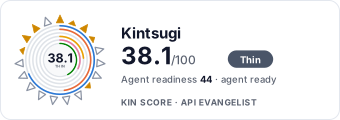 It updates itself when the score changes. Paste this where you link to your API docs:
<a href="https://apis.io/providers/kintsugi/"><img src="https://apis.io/badge/kintsugi/card.svg" alt="Kintsugi on APIs.io — Kin Score by API Evangelist"></a>Other styles, a README pill and a shields.io endpoint are on the badge page.
Markets this provider is in provisional
The Kin Score Market layer reads a provider inside its market: its position, and how deep its integrations go. Depth is only comparable within a position. Provisional and unweighted: not part of the Kin Score or agent readiness.
| Market | Position | Depth | Registered MCP server | Declares compatibility |
|---|---|---|---|---|
| E-invoicing and Tax Compliance (certified operators) | undeclared | - | - | - |
| Stripe App Marketplace and Partner Ecosystem (builders on Stripe) | undeclared | - | - | - |
| Amazon Seller Ecosystem (Selling Partner Appstore, Amazon Ads partners) | undeclared | - | - | - |
Registered MCP server and declares compatibility are report only — not weighted. Undeclared means we found nothing we can read, so there is no number: we never infer integrations.
APIs 9
Individual APIs this provider publishes, each with its own machine-readable definition.
Kintsugi Address Validation API
Address search and suggestions for jurisdiction assignment.
Kintsugi Customers API
Customer records and their transactions.
Kintsugi Exemptions API
Customer tax exemptions and certificates.
Kintsugi Filings API
Prepared and submitted sales tax returns.
Kintsugi Nexus API
Physical and economic nexus tracking.
Kintsugi Products API
Product records and taxability classification.
Kintsugi Registrations API
State tax registrations.
Kintsugi Tax Estimation API
Real-time sales tax, VAT, and GST estimation.
Kintsugi Transactions API
Committed sales transactions and credit notes.
Scroll for all 9
Open Collections 10
Open, tool-agnostic API collections (OpenAPI-derived and Bruno).
Kintsugi Tax Address Validation API
OPEN COLLECTIONKintsugi Tax Address Validation Customers API
OPEN COLLECTIONKintsugi Tax Address Validation Exemptions API
OPEN COLLECTIONKintsugi Tax Address Validation Filings API
OPEN COLLECTIONKintsugi Tax Address Validation Nexus API
OPEN COLLECTIONKintsugi Tax Address Validation Products API
OPEN COLLECTIONKintsugi Tax Address Validation Registrations API
OPEN COLLECTIONKintsugi Tax Address Validation Tax Estimation API
OPEN COLLECTIONKintsugi Tax Address Validation Transactions API
OPEN COLLECTIONKintsugi Tax API
OPEN COLLECTIONScroll for all 10
MCP Servers 1
Model Context Protocol servers that expose these APIs to AI agents.
Pricing Plans 1
Published pricing tiers and plan structures.
Rate Limits 1
Documented rate limits and quota policies.
Kintsugi Rate Limits
RATE LIMITSFinOps 1
Cost, billing, and metering signals for API financial operations.
Kintsugi Finops
FINOPSSecurity Posture 2
Authentication, domain security, vulnerability disclosure, and trust-center signals.
Agentic Access 1
Recommended x-agentic-access execution contracts for AI agents.
Resources
Documentation 1
Reference material describing how the API behaves
Agent Surfaces 1
MCP servers, agent skills, and machine-readable catalogs
Build 1
SDKs, sample code, and the tooling you integrate with
Access & Security 2
Authentication, authorization, and security posture
Operate 1
Status, limits, changes, and where to get help
Commercial 3
Pricing, plans, and the legal terms of use
Company 3
The organization behind the API
Other 1
Properties that don't map to a standard resource type
Source (apis.yml)
Work with this as data
Every provider here is available over the APIs.io API and to AI agents over MCP.