Jupiter
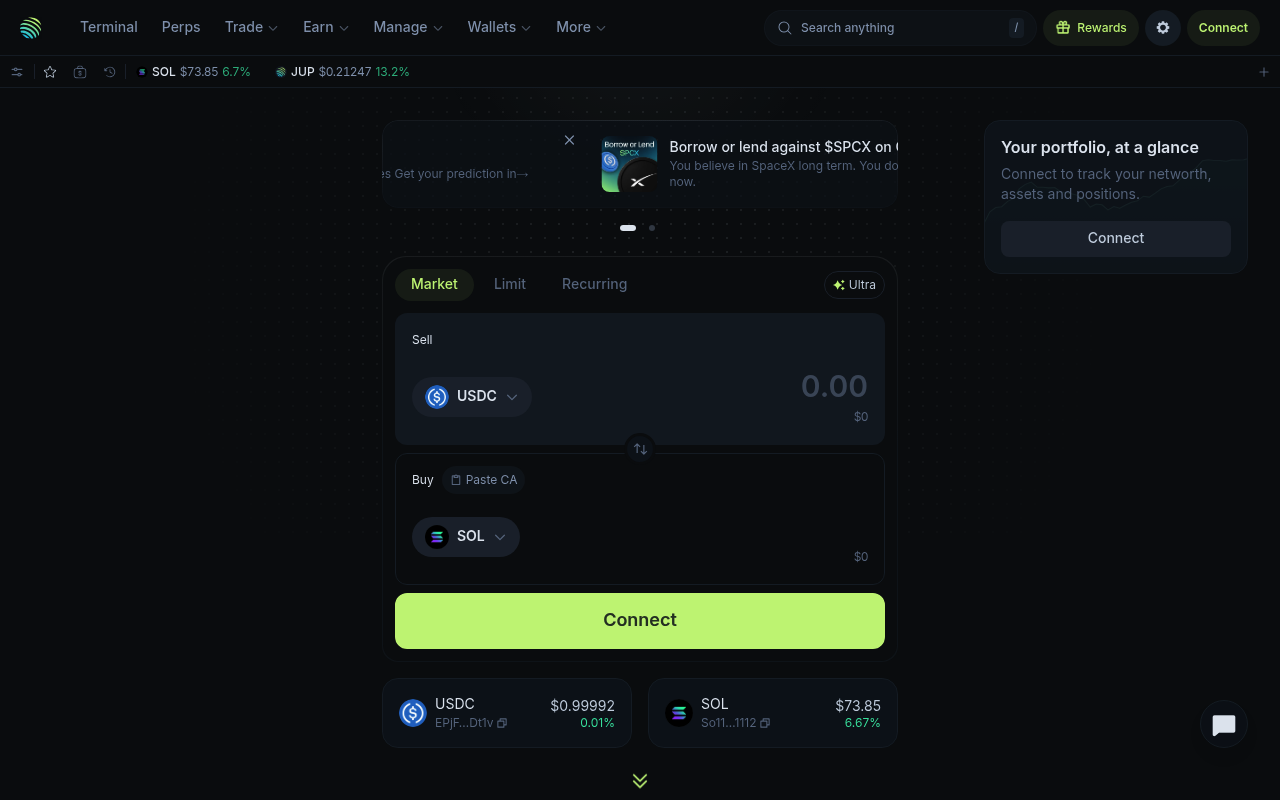
Jupiter is the liquidity infrastructure powering the majority of DeFi on Solana. It aggregates spot DEXes, runs leveraged perpetuals, supports limit orders, dollar cost averaging, lending and flash loans, prediction markets, and a token launchpad. Developers integrate via production-grade REST APIs at api.jup.ag (and the rate- limited lite-api.jup.ag) covering Swap, Tokens, Price, Lend, Trigger (limit orders), Recurring (DCA), Perps, and Prediction, all behind a single API key. Open-source SDKs and the Jupiter Terminal embed widget extend the platform to wallets, exchanges, and apps.
Jupiter publishes 22 API contracts indexed on the APIs.io network, including Events API, Forecast API, History API, and 19 more. Tagged areas include Solana, DeFi, DEX Aggregator, Swap, and Perpetuals.
The Jupiter catalog on APIs.io includes 1 Spectral governance ruleset.
Jupiter’s developer surface includes authentication, documentation, GitHub presence, engineering blog, and 10 more developer resources.
Kin Score
 Kin Score
How this is scored →
scored 2026-11-02 · rubric v0.26.0
 It updates itself when the score changes. Paste this where you link to your API docs:
<a href="https://apis.io/providers/jupiter-ag/"><img src="https://apis.io/badge/jupiter-ag/card.svg" alt="Jupiter on APIs.io — Kin Score by API Evangelist"></a>Other styles, a README pill and a shields.io endpoint are on the badge page.
- MCP Server +12 pts — deployment.mode + probe verdict on the mcp/ manifest, not the pointer; an unprobed slug falls back to authorship
- Idempotency +9 pts — OpenAPI mutating operations declare an idempotency key — a header, a request-body property, or a named de-duplication token whose own description says so (verified); else common[].type matches /idempoten/i (documented)
- A2A Agent Card +8 pts — a2a/
-a2a.yml manifest, graded on conformance.grade against A2A 1.0.0 - Request/Response Examples +7 pts — share of operations carrying request/response examples; else an Examples / Code Samples link
- Registration Without a Human +6 pts — a `registration_endpoint` in the served RFC 8414 / OIDC discovery document
- Delegated User Identity +6 pts — a served discovery document listing authorization_code in grant_types_supported (served), else an oauth2 authorizationCode flow or openIdConnect declared in an OpenAPI (documented)
- Access Clarity scores 5.3 — up to +18.9 composite points
- Developer Ergonomics scores 26.2 — up to +14.8 composite points
- Contract Quality scores 47.0 — up to +13.3 composite points
Markets this provider is in provisional
The Kin Score Market layer reads a provider inside its market: its position, and how deep its integrations go. Depth is only comparable within a position. Provisional and unweighted: not part of the Kin Score or agent readiness.
| Market | Position | Depth | Registered MCP server | Declares compatibility |
|---|---|---|---|---|
| Raycast Store Extensions (first-party publishers + community-wrapped products) | covered | 9.6 (thin) | - | - |
Registered MCP server and declares compatibility are report only — not weighted. Undeclared means we found nothing we can read, so there is no number: we never infer integrations.
Standards implemented 1
Standards this provider implements or carries. De facto ones are profiled and measured by the API Commons; formal ones come from the standards directory and are linked by the provider's own tags. The evidence column says how each claim was established — not that it was made.
APIs 22
Individual APIs this provider publishes, each with its own machine-readable definition.
Jupiter Swap API
Returns the best swap route across Solana DEX liquidity and produces a versioned transaction ready to sign and send. Supports quote-then-swap, swap-instructions for custom trans...
Jupiter Tokens API
Search Solana tokens by mint, symbol, or name; fetch metadata, verification status, tags, and trading metrics. Backs Jupiter's verified token list.
Jupiter Price API
USD pricing for up to 50 Solana tokens per request, sourced from on-chain aggregated liquidity. Used for portfolio valuation, charting, and quote previews.
Jupiter Trigger API (Limit Orders)
Create, query, and cancel on-chain trigger orders — single limit orders as well as one-cancels-the-other (OCO) and one-triggers-the-other (OTOCO) order structures.
Jupiter Recurring API (DCA)
Schedule recurring (dollar-cost-averaging) swaps that execute on a time interval. Manage active DCA positions and fetch execution history.
Jupiter Perps API
REST interface to Jupiter Perpetuals — fetch markets, positions, funding, pricing, and build open / close / modify position transactions.
Jupiter Lend API
Lending product API for supplying, borrowing, repaying, withdrawing, and executing flash loans against Jupiter Lend markets.
Jupiter Prediction API
Binary prediction-market API for browsing markets, fetching prices and positions, and constructing trade transactions.
Jupiter Lite API
Public, no-key, rate-limited mirror of the Jupiter API surface intended for experimentation, demos, and low-volume integrations.
Jupiter Terminal
Open-source embeddable swap widget that drops a fully-featured Jupiter swap experience into any web app with a few lines of code.
Jupiter Events API
The Events API from Jupiter — 6 operation(s) for events.
Jupiter Forecast API
The Forecast API from Jupiter — 1 operation(s) for forecast.
Jupiter History API
The History API from Jupiter — 1 operation(s) for history.
Jupiter Leaderboards API
The Leaderboards API from Jupiter — 1 operation(s) for leaderboards.
Jupiter Markets API
The Markets API from Jupiter — 3 operation(s) for markets.
Jupiter Orderbook API
The Orderbook API from Jupiter — 1 operation(s) for orderbook.
Jupiter Orders API
The Orders API from Jupiter — 4 operation(s) for orders.
Jupiter Positions API
The Positions API from Jupiter — 3 operation(s) for positions.
Jupiter Profile API
The Profile API from Jupiter — 2 operation(s) for profile.
Jupiter Trades API
The Trades API from Jupiter — 1 operation(s) for trades.
Jupiter Trading API
The Trading API from Jupiter — 1 operation(s) for trading.
Jupiter Vault API
The Vault API from Jupiter — 1 operation(s) for vault.
Scroll for all 22
Open Collections 2
Open, tool-agnostic API collections (OpenAPI-derived and Bruno).
Jupiter Swap API
OPEN COLLECTIONJupiter Swap API
OPEN COLLECTIONPricing Plans 1
Published pricing tiers and plan structures.
Rate Limits 1
Documented rate limits and quota policies.
Jupiter Ag Rate Limits
RATE LIMITSFinOps 1
Cost, billing, and metering signals for API financial operations.
Jupiter Ag Finops
FINOPSSpectral Rules 1
Spectral governance rulesets for linting and validating these APIs.
Jupiter API Rules
SPECTRALSecurity Posture 2
Authentication, domain security, vulnerability disclosure, and trust-center signals.
Agentic Access 1
Recommended x-agentic-access execution contracts for AI agents.
Resources
Documentation 1
Reference material describing how the API behaves
Agent Surfaces 1
MCP servers, agent skills, and machine-readable catalogs
Build 1
SDKs, sample code, and the tooling you integrate with
Access & Security 2
Authentication, authorization, and security posture
Operate 3
Status, limits, changes, and where to get help
Commercial 2
Pricing, plans, and the legal terms of use
Company 3
The organization behind the API
Other 1
Properties that don't map to a standard resource type
Source (apis.yml)
Jupiter API — frequently asked questions
Does Jupiter have an API?
Yes. APIs.io lists 22 APIs from Jupiter, including Jupiter Swap API, Jupiter Tokens API and Jupiter Price API, and 19 more.
Is there an OpenAPI specification for the Jupiter API?
Yes. APIs.io indexes 12 OpenAPI specifications for Jupiter, each linked for download from this page.
How do I authenticate with the Jupiter API?
Jupiter uses bearer-token authentication (apiKey · 1 scheme). The details are profiled on APIs.io as Jupiter Ag Authentication.
How much does the Jupiter API cost?
APIs.io lists 1 pricing plan for Jupiter, with each plan's price, limits and inclusions under Pricing Plans on this page.
Is the Jupiter API ready for AI agents?
Jupiter has a Kin Score of 26.5 out of 100 (thin) and an Agent Readiness score of 24.4 (agent-aware), scored by API Evangelist on 2026-11-02.
Work with this as data
Every provider here is available over the APIs.io API and to AI agents over MCP.