
Juno
Juno (juno.co), operated by Juno Technology, Inc., is a San Francisco-based owner's representation, development-consulting and construction-management firm for prefabricated, modular and mass-timber multifamily development, working with developers from site feasibility and entitlement through delivery across North America. Juno owns the rights to the Juno Mass Timber System, a field-tested kit-of-parts building system of roughly 33 components configurable into 25+ unit types, proven on the 24-unit Juno East Austin project at 400 Comal St, Austin TX. The current company is the 2024 relaunch ("Juno 2.0") of the venture-funded Juno / Juno Residential founded in 2019 by Jonathan Scherr, BJ Siegel and Chester Chipperfield, which raised roughly $32M from Comcast Ventures, Khosla Ventures and RET Ventures before running out of money; the relaunched firm is led by co-founders Emily Mills Marineau and Jen Canchola. Juno sells professional services and a physical building system, not software: as of this enrichment pass it publishes a marketing site, a mass-timber system page, a contact form, a newsletter signup, terms of service and a privacy policy, and no public API, developer portal, OpenAPI specification, SDK, or machine-readable contract of any kind.
Juno is profiled on the APIs.io network. Tagged areas include Company, Construction, Construction Management, Real Estate, and Multifamily.
Juno’s developer surface includes support and 12 more developer resources.
Kin Score
 Kin Score
How this is scored →
scored 2026-11-13 · rubric v0.28.0
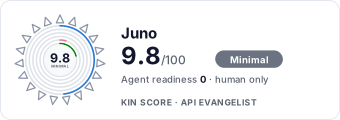 It updates itself when the score changes. Paste this where you link to your API docs:
<a href="https://apis.io/providers/juno/"><img src="https://apis.io/badge/juno/card.svg" alt="Juno on APIs.io — Kin Score by API Evangelist"></a>Other styles, a README pill and a shields.io endpoint are on the badge page.
- Machine-Readable Contract +18 pts — api_specs includes an OpenAPI document Ask about this →
- MCP Server +12 pts — deployment.mode + probe verdict on the mcp/ manifest, not the pointer; an unprobed slug falls back to authorship Ask about this →
- Agentic Access Contract +10 pts — agentic_access artifact present (x-agentic-access), graded by author Ask about this →
- Machine-Readable Auth +10 pts — a served openid-configuration/oauth-authorization-server carrying `issuer` (served), else the securitySchemes class in the provider OpenAPIs — bound (mutualTLS, DPoP, Signature) > negotiable (oauth2 authorizationCode/clientCredentials, openIdConnect) > bearer (http bearer, apiKey) Ask about this →
- Idempotency +9 pts — OpenAPI mutating operations declare an idempotency key — a header, a request-body property, or a named de-duplication token whose own description says so (verified); else common[].type matches /idempoten/i (documented) Ask about this →
- Stable Error Semantics +8 pts — OpenAPI $refs a shared error schema across 4xx/5xx responses (verified), else common[].type includes ErrorCatalog / ErrorCodes / DeclineCodes Ask about this →
- Contract Quality scores 0.0 — up to +25.0 composite points Ask about this →
- Developer Ergonomics scores 4.8 — up to +19.0 composite points Ask about this →
- Access Clarity scores 31.9 — up to +13.6 composite points Ask about this →
Juno API pricing
Pricing Plans 1
Published pricing tiers and plan structures.
Juno Plans Pricing
PLANSTerms of Service 1
What its API terms permit and prohibit, quoted from its own page.
Privacy & Data 1
Its role, the data it processes, retention and transfers, quoted from its own privacy page.
Eligibility 1
Who may sign up and where, quoted from its own terms.
AI Preferences 1
Its stance on AI training, inference and agents, quoted from its own pages.
Data License 1
How its data and outputs may be reused, quoted from its own terms.
Security Posture 1
Authentication, domain security, vulnerability disclosure, and trust-center signals.
Resources
Documentation 1
Reference material describing how the API behaves
Agent Surfaces 1
MCP servers, agent skills, and machine-readable catalogs
Access & Security 1
Authentication, authorization, and security posture
Operate 1
Status, limits, changes, and where to get help
Commercial 5
Pricing, plans, and the legal terms of use
Company 2
The organization behind the API
Other 2
Properties that don't map to a standard resource type
Source (apis.yml)
Work with this as data
Every provider here is available over the APIs.io API and to AI agents over MCP.