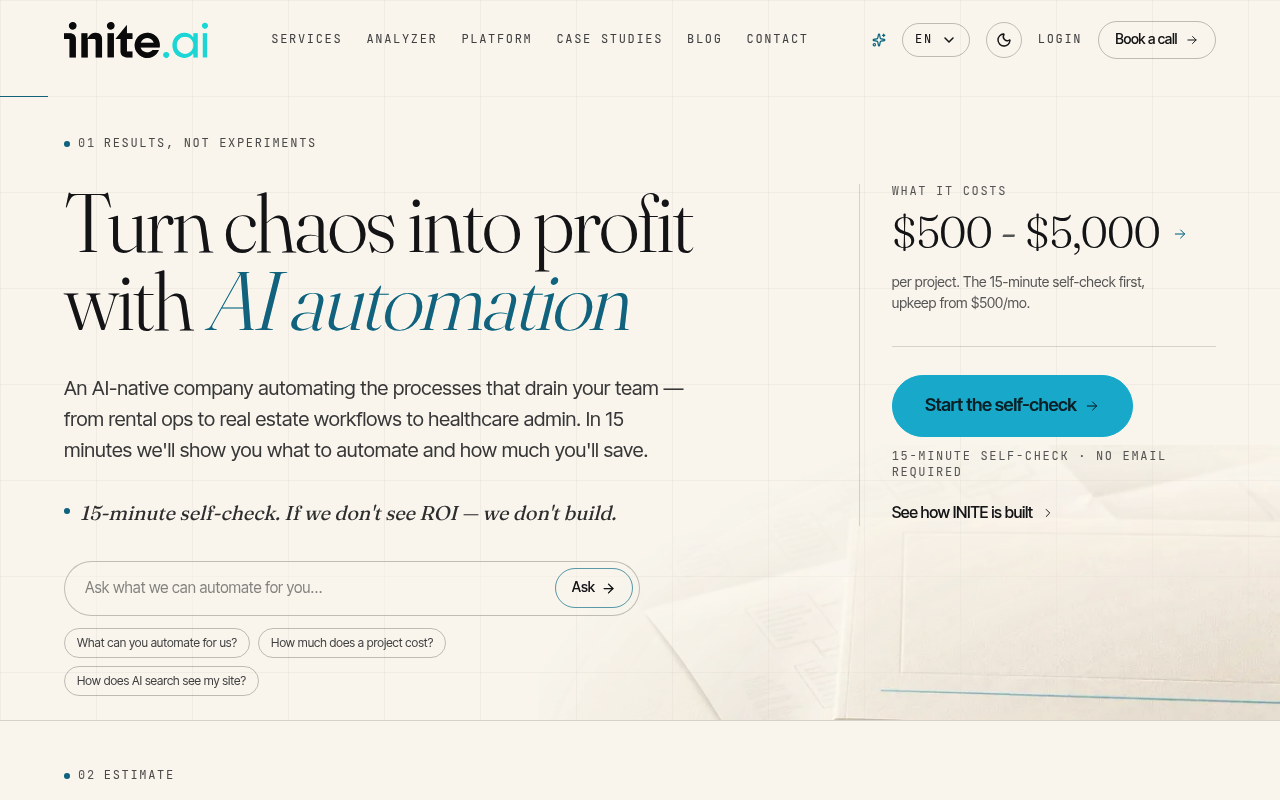
INITE provides AI automation platform for mid‑size companies (10‑200 employees) to design, implement, and monitor AI‑driven workflows. It deploys 1‑3 AI workflows in 2‑4 weeks, then hands them to your team, offering a 15‑minute self‑check to model ROI before building. The service helps businesses turn chaos into profit with rapid AI integration and measurable outcomes.
inite-ai publishes 24 API contracts indexed on the APIs.io network, including Agent API, Atlas API, Beliefs API, and 21 more. Tagged areas include Company, Artificial Intelligence, Automation, Software-as-a-Service, and Workflows.
The inite-ai catalog on APIs.io includes 1 event-driven AsyncAPI specification, 1 JSON-LD context, and 1 Spectral governance ruleset.
inite-ai’s developer surface includes authentication, engineering blog, documentation, API reference, pricing, support, and 35 more developer resources.
Regulatory Posture applies to this provider. Its tags matched the
Horizontal (data, software, accessibility, platform) regime, so
Regulatory Posture carries 15 points of the composite.
If this regime is wrong for your business, say so on your
provider repo — the
applicability map is public and we will correct it.
Create-or-Update Ergonomics applies to this provider. This API accepts writes, so it
carries 10 points of the composite. It is scored from the published contracts
themselves: whether a caller can create-or-update in one call, whether the write accepts a key the caller already
holds, and whether the response says which branch ran. Without that, every write needs a search-and-branch in
front of it, and the first time that check is skipped a duplicate record is created.
Scored against the observed mean rather than raw — a provider at the catalog average is unchanged by this facet,
not penalised by it.
The six quality facets above are damped to 75 points between them,
because the conditional facet above carries the other
25. That is why each facet's contribution is shown against a damped
maximum: raising a quality facet moves the composite by 75% of its nominal
weight, not 100%. The full arithmetic is at apis.io/rating/.
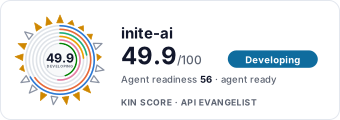
Show this score on your site.
It updates itself when the score changes. Paste this where you link to your API docs:
<a href="https://apis.io/providers/inite-ai/"><img src="https://apis.io/badge/inite-ai/card.svg" alt="inite-ai on APIs.io — Kin Score by API Evangelist"></a>
Other styles, a README pill and a shields.io endpoint are on the badge page.
Raise your score.
Agent readiness — checks not met, largest first (exact, from this profile):
Idempotency+9 pts — OpenAPI mutating operations declare an idempotency key — a header, a request-body property, or a named de-duplication token whose own description says so (verified); else common[].type matches /idempoten/i (documented) Ask about this →
Rate-Limit Signaling+7 pts — OpenAPI responses document X-RateLimit-* / RateLimit headers (verified), else a rate_limits artifact or RateLimits link (documented) Ask about this →
Agentic Commerce Well-Known Document+5 pts — a parsing /.well-known/ucp.json or acp.json declaring a version and at least one service, OR (0.27) a live x402 payment challenge from _data/x402-adoption.json — `self` when its endpoints are on the provider's own domain, `platform` when they are on a vendor's Ask about this →
Each check links to what satisfies it. Publish the artifact, or tell us where it already lives, and the score moves on the next scoring run.
Not sure how this applies to your stack? Ask about any one item. Kin Lane reads every question, looks at your profile and your situation, and replies with what a fix would take — scoped to that one area, priced up front, yours whether you ship it or not. Ask a question →
Standards this provider implements or carries. De facto ones are profiled and measured by the API Commons; formal ones come from the standards directory and are linked by the provider's own tags. The evidence column says how each claim was established — not that it was made.
Belief-level reads over the semantic_belief substrate: what the brain currently holds about a free-text (subject, field) key, with its supersede chain and inline scene provenanc...
The entity read surface (scope `brain:read`): typeahead, profile, bitemporal timeline and typed connections. The GDPR cascade on the same controller is an operator action and li...
The raw-substrate driver: verbatim pre-extraction dialogue turns (L0) as a contract — keyset reads, NDJSON export, and signed new-episode webhooks — so any consumer can build it...
Fact-level reads: one fact by id and its grounding episodes — provenance-first memory ("show me why I remember this"). Flag: FACTS_API_ENABLED (off → 404); fact retraction stays...
Read-only operator view (scope `brain:admin`) over the tenant’s installed indexers and their run health. Dark behind INDEXER_OPERATOR_VIEW_ENABLED (default off).
Writing memory: the declared-fact path (scope `brain:write`). Every write goes through bitemporal conflict resolution, so the response reports a decision, not an acknowledgement.
Self-serve credentials: issue, list and revoke API keys brain verifies itself. Bounded by the calling credential — a key is never wider than its issuer — and available identical...
Featured curation (scope `registry:curate`), pack pricing + publisher profiles (scope `registry:publish`) and the paid-pack checkout (scope `brain:admin`). State is instance-loc...
File-shaped memory — the storage behind Anthropic’s memory tool (`memory_20250818`). A model’s own notes, kept in the tenant’s database behind the same fences as every other mem...
Derived surfaces as first-class records: lifecycle status, watermark, builder identity, and rebuild as the public verb. Flag: PROJECTIONS_API_ENABLED (off → 404).
Scene-level reads over the memory_episode substrate: coherent multi-turn groupings of raw turns — what happened, together, when — with their member episodes, backlinks, state de...
Reading memory (scope `brain:read`): hybrid search, chained multi-hop search, and cited synthesis over the same retrieval stack. All three share the per-credential `expensive` t...
Where brain READS raw evidence from (scope `brain:admin`): connections that instantiate a pack’s declared `sources` entry, the per-connection catalogue of external items, and th...
Calls without X-API-Key need no key. Calls with it need a paid plan — get a key.
Get an API key
Free tier, no form to fill in. Signing in shares your email address with us — we
store it to create your key and to recognise you if you sign in with another
provider. See our Privacy Policy and
Terms.
 Kin Score
How this is scored →
 It updates itself when the score changes. Paste this where you link to your API docs: