InfoLang provides a semantic search datalake platform that ingests raw corpora—documents, PDFs, transcripts, code—and encodes them into meaning‑based records. Users can query by intent, recall relevant passages, and integrate with AI agents via a console or API. The service offers a playground, enterprise deployment, and upcoming 20‑million‑token context model Arkhe, enabling large‑scale retrieval and reasoning over terabytes of data.
InfoLang Inc. publishes 22 API contracts indexed on the APIs.io network, including Activity API, Billing API, Canon API, and 19 more. Tagged areas include Semantic Search, Data Lake, AI Agents, and Enterprise Data.
The InfoLang Inc. catalog on APIs.io includes 1 Spectral governance ruleset.
InfoLang Inc.’s developer surface includes pricing, engineering blog, API reference, getting-started guide, documentation, authentication, and 14 more developer resources.
Regulatory Posture applies to this provider. Its tags matched the
Horizontal (data, software, accessibility, platform) regime, so
Regulatory Posture carries 15 points of the composite.
If this regime is wrong for your business, say so on your
provider repo — the
applicability map is public and we will correct it.
Create-or-Update Ergonomics could not be measured. We hold no machine-readable contract for
this provider to read, so there is nothing to measure a write surface against. Excluded rather than scored zero:
never-measured and measured-empty are different facts. Publishing an OpenAPI is what makes this facet — and
several others — scorable at all.
The six quality facets above are damped to 85 points between them,
because the conditional facet above carries the other
15. That is why each facet's contribution is shown against a damped
maximum: raising a quality facet moves the composite by 85% of its nominal
weight, not 100%. The full arithmetic is at apis.io/rating/.
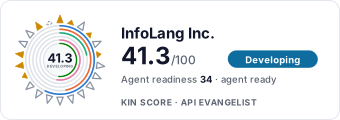
Show this score on your site.
It updates itself when the score changes. Paste this where you link to your API docs:
<a href="https://apis.io/providers/infolang-ai/"><img src="https://apis.io/badge/infolang-ai/card.svg" alt="InfoLang Inc. on APIs.io — Kin Score by API Evangelist"></a>
Other styles, a README pill and a shields.io endpoint are on the badge page.
Raise your score.
Agent readiness — checks not met, largest first (exact, from this profile):
MCP Server+12 pts — deployment.mode + probe verdict on the mcp/ manifest, not the pointer; an unprobed slug falls back to authorship Ask about this →
Idempotency+9 pts — OpenAPI mutating operations declare an idempotency key — a header, a request-body property, or a named de-duplication token whose own description says so (verified); else common[].type matches /idempoten/i (documented) Ask about this →
Rate-Limit Signaling+7 pts — OpenAPI responses document X-RateLimit-* / RateLimit headers (verified), else a rate_limits artifact or RateLimits link (documented) Ask about this →
Typed Event Surface+6 pts — AsyncAPI document, OR webhooks/callbacks objects in the as-published OpenAPI, OR common[].type includes Webhooks Ask about this →
7 more unmet checks in the Agent Readiness table above.
Kin Score — facets with the most composite points still available (weight × headroom):
Each check links to what satisfies it. Publish the artifact, or tell us where it already lives, and the score moves on the next scoring run.
Not sure how this applies to your stack? Ask about any one item. Kin Lane reads every question, looks at your profile and your situation, and replies with what a fix would take — scoped to that one area, priced up front, yours whether you ship it or not. Ask a question →
Standards this provider implements or carries. De facto ones are profiled and measured by the API Commons; formal ones come from the standards directory and are linked by the provider's own tags. The evidence column says how each claim was established — not that it was made.
The published plan catalog, Stripe checkout and customer-portal links, plus the webhook sink. `GET /v2/plans` is the one PUBLIC route here — a catalog is the same for everybody,...
The coordination layer for agent fleets, served beside the memory API under /coord/v1: an append-only assertion store with enforced authority ordering (operator > observation > ...
Ingest connectors: the gateway acting as an OAuth CLIENT toward Google Drive and Notion, so a workspace can pull documents from a source instead of uploading them. Provider toke...
WHETHER TWO KEYS NAME ONE FACT — `il-correspondence` pointed at Phase 1's subject keys. Subject-key drift (two agents writing `fact:convoy-departure` and `fact:convoy-departs`) ...
The ledger of what was TOLD TO WHOM — `il-disclosure` pointed at memory. Records that speech occurred to an exact audience; it does NOT record, and nothing here implies, that th...
WHAT IS STILL BEING ASKED — `il-inquiry` pointed at the corpus. Every knowledge system files the answer and throws the question away, and is then structurally unable to say what...
The raw Kairos surface, proxied verbatim under /v1 and /mcp and authenticated with an API key. Request and response shapes are owned by Kairos, not by this gateway.
The OAuth 2.1 authorization server — how a HUMAN connects an MCP client (Claude, an IDE) without pasting a machine key. Discovery documents, RFC 7591 dynamic client registration...
Console-only affordance: run one primitive from a positional `args` envelope and get the result plus billing headers and observed latency. Session-only.
World-phases, and which memories are governed by them — `il-regime`'s applicability algebra pointed at memory. A regime is an exact NAMED context (mission phase, jurisdiction, c...
The /v1 runtime primitives re-exposed under /v2 with lane-portable auth and the v2 error envelope. All three lanes. Bodies are validated against the pinned kairos-runtime schema...
WHY a memory stands, and what falls with it — `il-warrant`'s support/defeat algebra pointed at memory. An edge is an exact, stated REASON; withdrawing one is an append, never a ...
Outbound event subscriptions: management, Stripe-compatible HMAC signing, the delivery log and replay. All three lanes, gated on `webhooks:read` / `webhooks:write`. Memory text ...
Workspace CRUD. Session-only. Kairos is the source of truth and is written first; Supabase holds the name and ownership metadata. A new workspace inherits its OWNER's account plan.
Scroll for all 22
InfoLang Inc. API pricing
Prices published by InfoLang Inc., read 2026-11-12 from infolang.ai/pricing.
aid: infolang-ai
name: InfoLang Inc.
accessModel:
  pricing: freemium
  onboarding: self-serve
  trial: false
  try_now: true
  public: false
  gated: none
  gated_source:
  - onboarding
  label: Freemium · Self-serve signup
  confidence: medium
  source:
  - plans
  - authentication
  - security
  generated: '2026-11-13'
  method: derived
image: https://infolang.ai/og-image.jpg
description: InfoLang provides a semantic search datalake platform that ingests raw corpora—documents, PDFs, transcripts,
  code—and encodes them into meaning‑based records. Users can query by intent, recall relevant passages, and integrate with
  AI agents via a console or API. The service offers a playground, enterprise deployment, and upcoming 20‑million‑token context
  model Arkhe, enabling large‑scale retrieval and reasoning over terabytes of data.
url: https://artifacts.apis.io/infolang-ai/apis.yml
x-type: company
x-source: harvest:mcp-registry
x-tier: profiled
x-tier-reason: enrichment pass 2026-11-12 (modular-v1; was harvest)
specificationVersion: '0.20'
created: '2026-11-12'
modified: '2026-11-12'
tags:
- Semantic Search
- Data Lake
- AI Agents
- Enterprise Data
tags_raw:
- Semantic Search
- Datalake
- AI Agents
- Enterprise Data
maintainers:
- FN: Kin Lane
  email: kin@apievangelist.com
- FN: APIs.json
  email: info@apis.io
common:
- type: AgenticAccess
  url: agentic-access/infolang-ai-agentic-access.yml
- type: Plans
  url: plans/infolang-ai-plans-pricing.yml
- type: Spectral
  url: rules/infolang-ai-rules.yml
- type: Vocabulary
  url: vocabulary/infolang-ai-vocabulary.yml
- type: ErrorCatalog
  url: errors/infolang-ai-problem-types.yml
- type: Conformance
  url: conformance/infolang-ai-conformance.yml
- type: WellKnown
  url: well-known/infolang-ai-well-known.yml
- type: Hosts
  url: hosts/infolang-ai-hosts.yml
- type: Vendors
  url: vendors/infolang-ai-vendors.yml
- type: TermsOfService
  url: https://infolang.ai/legal/terms
- type: PrivacyPolicy
  url: https://infolang.ai/legal/privacy
- type: Pricing
  url: https://infolang.ai/pricing
- type: DeveloperPortal
  url: https://infolang.ai/developers
- type: Blog
  url: https://infolang.ai/blog
- type: APIReference
  url: https://docs.infolang.ai/api-reference
- type: GettingStarted
  url: https://docs.infolang.ai/python/quickstart
- type: Documentation
  url: https://docs.infolang.ai/
- type: Authentication
  url: authentication/infolang-ai-authentication.yml
- type: DomainSecurity
  url: security/infolang-ai-domain-security.yml
- type: Website
  url: https://infolang.ai/
apis:
- aid: infolang-ai:infolang-ai-activity-api
  name: InfoLang Inc. Activity API
  description: Cursor-paginated audit feed of workspace events. Read-only — all three lanes.
  humanURL: https://docs.infolang.ai/api-reference
  baseURL: https://api.infolang.ai
  tags:
  - Activity
  properties:
  - type: OpenAPI
    url: openapi/infolang-ai-activity-api-openapi.yml
- aid: infolang-ai:infolang-ai-billing-api
  name: InfoLang Inc. Billing API
  description: The published plan catalog, Stripe checkout and customer-portal links, plus the webhook sink. `GET /v2/plans`
    is the one PUBLIC route here — a catalog is the same for everybody, and a client that cannot read prices without a credential
    goes back to hard-coding them. Everything else is session-only; mutations require Admin.
  humanURL: https://docs.infolang.ai/api-reference
  baseURL: https://api.infolang.ai
  tags:
  - Billing
  properties:
  - type: OpenAPI
    url: openapi/infolang-ai-billing-api-openapi.yml
- aid: infolang-ai:infolang-ai-canon-api
  name: InfoLang Inc. Canon API
  description: 'The coordination layer for agent fleets, served beside the memory API under /coord/v1: an append-only assertion
    store with enforced authority ordering (operator > observation > inference — authority outranks recency), bitemporal queries
    (valid time vs transaction time), contested-state surfacing, and advisory claims with fencing tokens. Proxied verbatim
    and authorized by Kairos, on the same terms as /v1. OPTIONAL per deployment: where Canon is not enabled every /coord/v1
    path answers 404 and the memory API is unaffected. Probe GET /coord/v1/healthz, or read `capabilities.canon` from GET
    /v2/me.'
  humanURL: https://docs.infolang.ai/api-reference
  baseURL: https://api.infolang.ai
  tags:
  - Canon
  properties:
  - type: OpenAPI
    url: openapi/infolang-ai-canon-api-openapi.yml
- aid: infolang-ai:infolang-ai-connectors-api
  name: InfoLang Inc. Connectors API
  description: 'Ingest connectors: the gateway acting as an OAuth CLIENT toward Google Drive and Notion, so a workspace can
    pull documents from a source instead of uploading them. Provider tokens are stored encrypted (AES-256-GCM) in a table
    no read route touches and are NEVER returned by any endpoint here — the browse route exists precisely so a client never
    needs one. Gated on `connectors:read` / `connectors:write`.


    This is the opposite direction from the /oauth surface, which makes THIS API an authorization server for MCP clients.
    The two share no state.'
  humanURL: https://docs.infolang.ai/api-reference
  baseURL: https://api.infolang.ai
  tags:
  - Connectors
  properties:
  - type: OpenAPI
    url: openapi/infolang-ai-connectors-api-openapi.yml
- aid: infolang-ai:infolang-ai-correspondences-api
  name: InfoLang Inc. Correspondences API
  description: 'WHETHER TWO KEYS NAME ONE FACT — `il-correspondence` pointed at Phase 1''s subject keys. Subject-key drift
    (two agents writing `fact:convoy-departure` and `fact:convoy-departs`) silently splits one fact into two folds with nothing
    looking wrong; this surface makes the split visible and repairable WITHOUT rewriting a log. The gateway can PROPOSE that
    two keys correspond; only an operator credential can `identify` them as one thing, and even that is forward-only. Recall
    can annotate every subjected hit (`correspondence: true`) with a `split_risk` flag — and never unions the two subjects''
    beliefs. All three lanes, gated on `coord:read` / `coord:write`; `501` where the upstream kernel verbs are not compiled
    in.'
  humanURL: https://docs.infolang.ai/api-reference
  baseURL: https://api.infolang.ai
  tags:
  - Correspondences
  properties:
  - type: OpenAPI
    url: openapi/infolang-ai-correspondences-api-openapi.yml
- aid: infolang-ai:infolang-ai-disclosures-api
  name: InfoLang Inc. Disclosures API
  description: 'The ledger of what was TOLD TO WHOM — `il-disclosure` pointed at memory. Records that speech occurred to an
    exact audience; it does NOT record, and nothing here implies, that the audience received, read or understood it. Receipt
    is unknowable from here. A recall can account for itself automatically (`disclose_to`), gated per regime so the ledger
    stays readable, and `GET …/memories/{id}/disclosures` answers the blast-radius question: this memory was compromised,
    who was told, when, and how. There is no delete — a retraction is a NOTICE that coexists with the telling, because you
    cannot unsay a disclosure. All three lanes, gated on `coord:read` / `coord:write`; `501` where the upstream kernel verbs
    are not compiled in.'
  humanURL: https://docs.infolang.ai/api-reference
  baseURL: https://api.infolang.ai
  tags:
  - Disclosures
  properties:
  - type: OpenAPI
    url: openapi/infolang-ai-disclosures-api-openapi.yml
- aid: infolang-ai:infolang-ai-health-api
  name: InfoLang Inc. Health API
  description: Unauthenticated liveness and readiness probes.
  humanURL: https://docs.infolang.ai/api-reference
  baseURL: https://api.infolang.ai
  tags:
  - Health
  properties:
  - type: OpenAPI
    url: openapi/infolang-ai-health-api-openapi.yml
- aid: infolang-ai:infolang-ai-identity-api
  name: InfoLang Inc. Identity API
  description: Who am I, and what can this credential reach. `whoami` answers on all three lanes; `me` and `bootstrap` are
    session-only.
  humanURL: https://docs.infolang.ai/api-reference
  baseURL: https://api.infolang.ai
  tags:
  - Identity
  properties:
  - type: OpenAPI
    url: openapi/infolang-ai-identity-api-openapi.yml
- aid: infolang-ai:infolang-ai-ingest-api
  name: InfoLang Inc. Ingest API
  description: Bulk intake of a zip archive or individual files, chunked into Kairos memories. Session-only; requires Member.
  humanURL: https://docs.infolang.ai/api-reference
  baseURL: https://api.infolang.ai
  tags:
  - Ingest
  properties:
  - type: OpenAPI
    url: openapi/infolang-ai-ingest-api-openapi.yml
- aid: infolang-ai:infolang-ai-inquiries-api
  name: InfoLang Inc. Inquiries API
  description: 'WHAT IS STILL BEING ASKED — `il-inquiry` pointed at the corpus. Every knowledge system files the answer and
    throws the question away, and is then structurally unable to say what is OUTSTANDING, who narrowed it into what, or that
    the question being answered today is not the one originally asked. For an intelligence operation that is the PIR/RFI loop
    verbatim.


    Refining a question does not answer it (IR2), splitting one supersedes it rather than answering it (IR3), an answer must
    NAME its evidence (IR4), and an agenda row is an equivalence CLASS rather than a question (IR6). Recall can annotate every
    subjected hit (`inquiries: true`) with the outstanding questions on its key, and filter to them (`only_outstanding`) —
    and a memory NEVER answers a question by arriving on its subject. All three lanes, gated on `coord:read` / `coord:write`;
    `501` where the upstream kernel verbs are not compiled in.'
  humanURL: https://docs.infolang.ai/api-reference
  baseURL: https://api.infolang.ai
  tags:
  - Inquiries
  properties:
  - type: OpenAPI
    url: openapi/infolang-ai-inquiries-api-openapi.yml
- aid: infolang-ai:infolang-ai-kairos-passthrough-api
  name: InfoLang Inc. Kairos passthrough API
  description: The raw Kairos surface, proxied verbatim under /v1 and /mcp and authenticated with an API key. Request and
    response shapes are owned by Kairos, not by this gateway.
  humanURL: https://docs.infolang.ai/api-reference
  baseURL: https://api.infolang.ai
  tags:
  - Kairos passthrough
  properties:
  - type: OpenAPI
    url: openapi/infolang-ai-kairos-passthrough-api-openapi.yml
- aid: infolang-ai:infolang-ai-keys-api
  name: InfoLang Inc. Keys API
  description: API key lifecycle. Session-only. Secrets are returned exactly once, at mint time, and never again.
  humanURL: https://docs.infolang.ai/api-reference
  baseURL: https://api.infolang.ai
  tags:
  - Keys
  properties:
  - type: OpenAPI
    url: openapi/infolang-ai-keys-api-openapi.yml
- aid: infolang-ai:infolang-ai-members-api
  name: InfoLang Inc. Members API
  description: Grants on a workspace. Session-only; mutations require Admin, and only an Owner may grant or remove the Owner
    role.
  humanURL: https://docs.infolang.ai/api-reference
  baseURL: https://api.infolang.ai
  tags:
  - Members
  properties:
  - type: OpenAPI
    url: openapi/infolang-ai-members-api-openapi.yml
- aid: infolang-ai:infolang-ai-memories-api
  name: InfoLang Inc. Memories API
  description: List, search and enumerate stored memories. Class A — all three lanes, proxied to Kairos.
  humanURL: https://docs.infolang.ai/api-reference
  baseURL: https://api.infolang.ai
  tags:
  - Memories
  properties:
  - type: OpenAPI
    url: openapi/infolang-ai-memories-api-openapi.yml
- aid: infolang-ai:infolang-ai-oauth-api
  name: InfoLang Inc. OAuth API
  description: The OAuth 2.1 authorization server — how a HUMAN connects an MCP client (Claude, an IDE) without pasting a
    machine key. Discovery documents, RFC 7591 dynamic client registration, a PKCE-mandatory authorize endpoint, the console's
    consent completion, and the token endpoint. Everything here is public except `POST /oauth/consent`, which carries the
    consenting human's session JWT.
  humanURL: https://docs.infolang.ai/api-reference
  baseURL: https://api.infolang.ai
  tags:
  - OAuth
  properties:
  - type: OpenAPI
    url: openapi/infolang-ai-oauth-api-openapi.yml
- aid: infolang-ai:infolang-ai-playground-api
  name: InfoLang Inc. Playground API
  description: 'Console-only affordance: run one primitive from a positional `args` envelope and get the result plus billing
    headers and observed latency. Session-only.'
  humanURL: https://docs.infolang.ai/api-reference
  baseURL: https://api.infolang.ai
  tags:
  - Playground
  properties:
  - type: OpenAPI
    url: openapi/infolang-ai-playground-api-openapi.yml
- aid: infolang-ai:infolang-ai-regimes-api
  name: InfoLang Inc. Regimes API
  description: 'World-phases, and which memories are governed by them — `il-regime`''s applicability algebra pointed at memory.
    A regime is an exact NAMED context (mission phase, jurisdiction, classification level, retention window); membership is
    a scope link somebody wrote down, never a timestamp. Ending a regime is not voiding it: an ended phase''s memories still
    applied while it ran, which is retention with a law instead of a TTL field. All three lanes, gated on `coord:read` / `coord:write`;
    `501` where the upstream kernel verbs are not compiled in.'
  humanURL: https://docs.infolang.ai/api-reference
  baseURL: https://api.infolang.ai
  tags:
  - Regimes
  properties:
  - type: OpenAPI
    url: openapi/infolang-ai-regimes-api-openapi.yml
- aid: infolang-ai:infolang-ai-runtime-api
  name: InfoLang Inc. Runtime API
  description: The /v1 runtime primitives re-exposed under /v2 with lane-portable auth and the v2 error envelope. All three
    lanes. Bodies are validated against the pinned kairos-runtime schemas; response bodies are Kairos's, passed through unchanged.
  humanURL: https://docs.infolang.ai/api-reference
  baseURL: https://api.infolang.ai
  tags:
  - Runtime
  properties:
  - type: OpenAPI
    url: openapi/infolang-ai-runtime-api-openapi.yml
- aid: infolang-ai:infolang-ai-usage-api
  name: InfoLang Inc. Usage API
  description: Metered usage and plan inclusions. Read-only — all three lanes.
  humanURL: https://docs.infolang.ai/api-reference
  baseURL: https://api.infolang.ai
  tags:
  - Usage
  properties:
  - type: OpenAPI
    url: openapi/infolang-ai-usage-api-openapi.yml
- aid: infolang-ai:infolang-ai-warrants-api
  name: InfoLang Inc. Warrants API
  description: 'WHY a memory stands, and what falls with it — `il-warrant`''s support/defeat algebra pointed at memory. An
    edge is an exact, stated REASON; withdrawing one is an append, never a delete, so the reason and its retraction both stay
    in the log forever. `GET …/memories/{id}/warrant` answers the traceability question in one call: what stands behind this
    memory, and which claims would change if this premise were discounted (ONE HOP — never the transitive closure). Recall
    can annotate every hit (`warrants: true`), and a memory nobody has argued about reads as `examined: false` rather than
    as `unsupported`. All three lanes, gated on `coord:read` / `coord:write`; `501` where the upstream kernel verbs are not
    compiled in.'
  humanURL: https://docs.infolang.ai/api-reference
  baseURL: https://api.infolang.ai
  tags:
  - Warrants
  properties:
  - type: OpenAPI
    url: openapi/infolang-ai-warrants-api-openapi.yml
- aid: infolang-ai:infolang-ai-webhooks-api
  name: InfoLang Inc. Webhooks API
  description: 'Outbound event subscriptions: management, Stripe-compatible HMAC signing, the delivery log and replay. All
    three lanes, gated on `webhooks:read` / `webhooks:write`. Memory text is excluded from payloads unless an endpoint opts
    in.'
  humanURL: https://docs.infolang.ai/api-reference
  baseURL: https://api.infolang.ai
  tags:
  - Webhook
  tags_raw:
  - Webhooks
  properties:
  - type: OpenAPI
    url: openapi/infolang-ai-webhooks-api-openapi.yml
- aid: infolang-ai:infolang-ai-workspaces-api
  name: InfoLang Inc. Workspaces API
  description: Workspace CRUD. Session-only. Kairos is the source of truth and is written first; Supabase holds the name and
    ownership metadata. A new workspace inherits its OWNER's account plan.
  humanURL: https://docs.infolang.ai/api-reference
  baseURL: https://api.infolang.ai
  tags:
  - Workspace
  tags_raw:
  - Workspaces
  properties:
  - type: OpenAPI
    url: openapi/infolang-ai-workspaces-api-openapi.yml
x-enrichment:
  date: '2026-11-12'
  status: enriched
  artifacts_added: 18
  pass: modular-v1
  engine: identity=local,contract=local,surfaces=local,docs=local,regulatory=local
InfoLang Inc. API — frequently asked questions
Does InfoLang Inc. have an API?
Yes. APIs.io lists 22 APIs from InfoLang Inc., including InfoLang Inc. Activity API, InfoLang Inc. Billing API and InfoLang Inc. Canon API, and 19 more.
Is there an OpenAPI specification for the InfoLang Inc. API?
Yes. APIs.io indexes 22 OpenAPI specifications for InfoLang Inc., each linked for download from this page.
How do I authenticate with the InfoLang Inc. API?
InfoLang Inc. documents its authentication (http · 1 scheme). The details are profiled on APIs.io as InfoLang Inc. Authentication.
How much does the InfoLang Inc. API cost?
InfoLang Inc. publishes its prices; its Free plan is $0 forever as of 2026-11-12. APIs.io lists 4 pricing plans for InfoLang Inc., with each plan's price, limits and inclusions under Pricing on this page.
Is the InfoLang Inc. API ready for AI agents?
InfoLang Inc. has a Kin Score of 41.3 out of 100 (developing) and an Agent Readiness score of 34.4 (agent-ready), scored by API Evangelist on 2026-11-13.
Calls without X-API-Key need no key. Calls with it need a paid plan — get a key.
Get an API key
Free tier, no form to fill in. Signing in shares your email address with us — we
store it to create your key and to recognise you if you sign in with another
provider. See our Privacy Policy and
Terms.
 Kin Score
How this is scored →
 It updates itself when the score changes. Paste this where you link to your API docs: